Tensions boil over as IHC judges ‘refuse’ CJ-ordered changes


• Justices Tariq Jahangiri, Babar Sattar and Sardar Ejaz Khan take issue with president’s notification reconstituting IHC Tribunal
• Former tribunal members issue reserved order on judge’s appeal, say law doesn’t allow filling capital court by borrowing from other high courts
• Ruling may affect number of judges transferred to Islamabad judiciary; order gives affected parties 30 days to approach SC
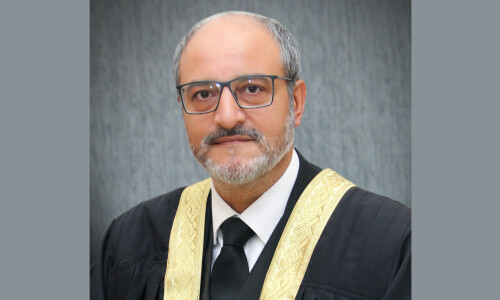
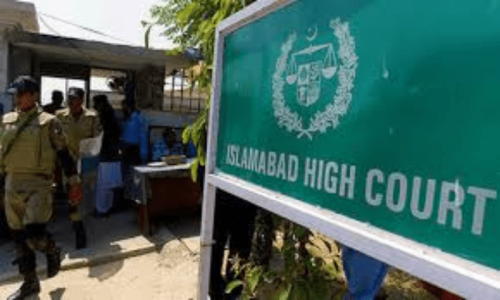
ISLAMABAD: The tensions simmering among judges of the Islamabad High Court (IHC) seemingly boiled over on Friday, when three members of the IHC Tribunal — who were replaced earlier this month when the tribunal was reconstituted — declared that neither the acting chief justice nor the president had the authority to dissolve or reconstitute the tribunal without legal justification.
This emerged in a ruling, issued on Wednesday in the Judicial Service Appeal of Additional District and Sessions Judge Mohammad Shabbir.
AD&SJ Shabbir had challenged the initial appointment and promotion of Judge Shahrukh Arjumand as a senior civil judge in Islamabad, and his subsequent elevation to the position of district and sessions judge.
The tribunal consisting of Justices Tariq Mehmood Jahangiri, Babar Sattar and Sardar Ejaz Ishaq Khan was hearing AD&SJ Shabbir’s appeal when a March 18 notification, issued by President Asif Ali Zardari, replaced them with Justices Khadim Hussain Soomro, Mohammad Azam Khan and Raja Inaam Ameen Minhas.
The order issued on Friday noted that it was being released “in peculiar circumstances that require some explanation”.
In the order, the three judges set aside the initial appointment of Justice Azam Khan to the Islamabad judiciary. Justice Khan was elevated to the Islamabad High Court by the Judicial Commission of Pakistan earlier this year.
In addition, the judges also set aside the appointments of Judge Arjumand, D&SJ Wajid Ali, D&SJ Humayun Dilawar, AD&SJ Qudratullah; and SCJs Abbas Shah, Ihtasham Allam Khan and Inamullah.
“Neither the letter nor the spirit of Islamabad High Court Act, 2010, allows filling permanent posts in the subordinate judiciary established for Islamabad Capital Territory on deputation basis, by borrowing judges from Provincial High Courts,” the order said.
It called on the IHC registrar to “make arrangements to return all members presently serving in the subordinate judiciary for Islamabad Capital Territory on deputation within six months from the date of this order”.
It stated that members of the tribunal had taken a decision on the appeal on Mar 13, but were later informed of a Mar 17 verbal directive, instructing them not to announce judgements as steps were being taken to dissolve the tribunal.
Subsequently, the March 18 notification purportedly reconstituted the tribunal on the advice of the acting chief justice.
However, the three judges held that this notification was unlawful, asserting that once the tribunal had been constituted in accordance with the Islamabad Subordinate Judiciary Service Tribunal Act, 2016, it could not be dissolved or reconstituted without legal justification.
“As the high court is a collegium, the administrative authority vested in the office of the chief justice must be exercised in a consensual manner… any decision by the chief justice or a committee appointed by the chief justice, that is not in accordance with the requirements of the law is not sustainable in the eyes of law, including decisions with regard to an appointment on deputations, induction, or promotion, and is liable to be set aside by this tribunal,” the order said.
The three judges also made several critical observations. They ruled that the appointment of judges on deputation to the Islamabad judiciary was unconstitutional and ordered the repatriation of all judges currently serving on deputation within six months.
The three judges declared the appointment of Justice Khadim Hussain Soomro, Justice Mohammad Azam Khan and Justice Raja Inaam Ameen Minhas as members of the IHC Tribunal ‘unconstitutional’.
The judges also held that the acting chief justice had no administrative authority to interfere with the tribunal’s functions, stating that such actions were outside the scope of the Constitution and law.
Recognising the impact of their decision, the judges ordered the suspension of the enforcement of their order for 30 days, to allow the affected parties to appeal before the Supreme Court.
Notably, these three judges are among those who have challenged the recent transfer of acting IHC Chief Justice Sarfraz Dogar, Justice Soomro and Justice Mohammad Asif to the IHC.
Published in Dawn, March 22nd, 2025