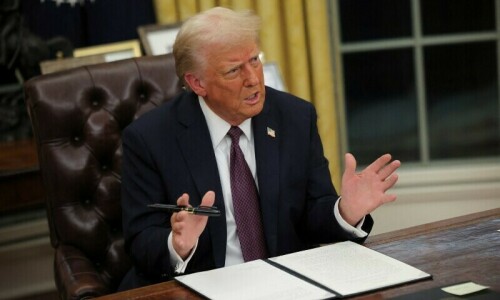
Columbia University agrees to Trump’s demands in attempt to restore funding


Columbia University has agreed to changes demanded by the Trump administration as a precondition for restoring $400 million in federal funding that was pulled this month over allegations the school tolerated anti-Semitism on campus.
The New York-based university, acquiescing to several demands in a memo released on Friday, laid out plans to ban some face masks on campus, empower security officers to remove or arrest individuals, and appoint a new official with broad powers to review departments that offer courses on the Middle East.
What Columbia would do with its Middle Eastern, South Asian, and African Studies department was among the biggest questions facing the university as it confronted the loss of hundreds of millions of dollars in government grants and contracts.
The Trump administration had told the school to place the department under academic receivership for at least five years, taking control away from its faculty.
Academic receivership is a rare step taken by a university’s administrators to fix a dysfunctional department by appointing a professor or administrator outside the department to take over. It is unheard of for the US government to make such a demand.
While Columbia, in its memo, stopped short of referring to a receivership, its move appeared to meet that demand. The school said it would appoint a new senior administrator to review curriculum and faculty to make sure they are balanced, and review leadership at several departments.
Professor Jonathan Zimmerman, an education historian at the University of Pennsylvania and a “proud” graduate of Columbia, called it a sad day for the university.
“Historically, there is no precedent for this,” Zimmerman said. “The government is using the money as a cudgel to micromanage a university.”
Todd Wolfson, a Rutgers University professor and president of the American Association of University Professors, called US President Donald Trump’s demands “arguably the greatest incursion into academic freedom, freedom of speech and institutional autonomy that we’ve seen since the McCarthy era”.
“It sets a terrible precedent,” Wolfson said. “I know every academic faculty member in this country is angry about Columbia University’s inability to stand up to a bully.”
In a statement released alongside the memo, interim President Katrina Armstrong said the changes were part of a broader effort “to advance our mission, ensure uninterrupted academic activities, and make every student, faculty, and staff member safe and welcome on our campus”.
The White House had yet to respond to Columbia’s memo as of Friday evening, and the status of the funding remained unclear. Trump’s demands were a precondition before Columbia could enter negotiations with the government over funding.
The Ivy League university’s response is being watched by other universities that the administration has targeted as it advances its policy objectives in areas ranging from campus protests to transgender sports and diversity initiatives.
Private companies, law firms and other organizations have also faced the prospect of cuts in government funding and business unless they agree to adhere more closely to Trump’s priorities.
Powerful Wall Street law firm Paul Weiss came under heavy criticism on Friday over a deal it struck with the White House to escape an executive order imperilling its business.
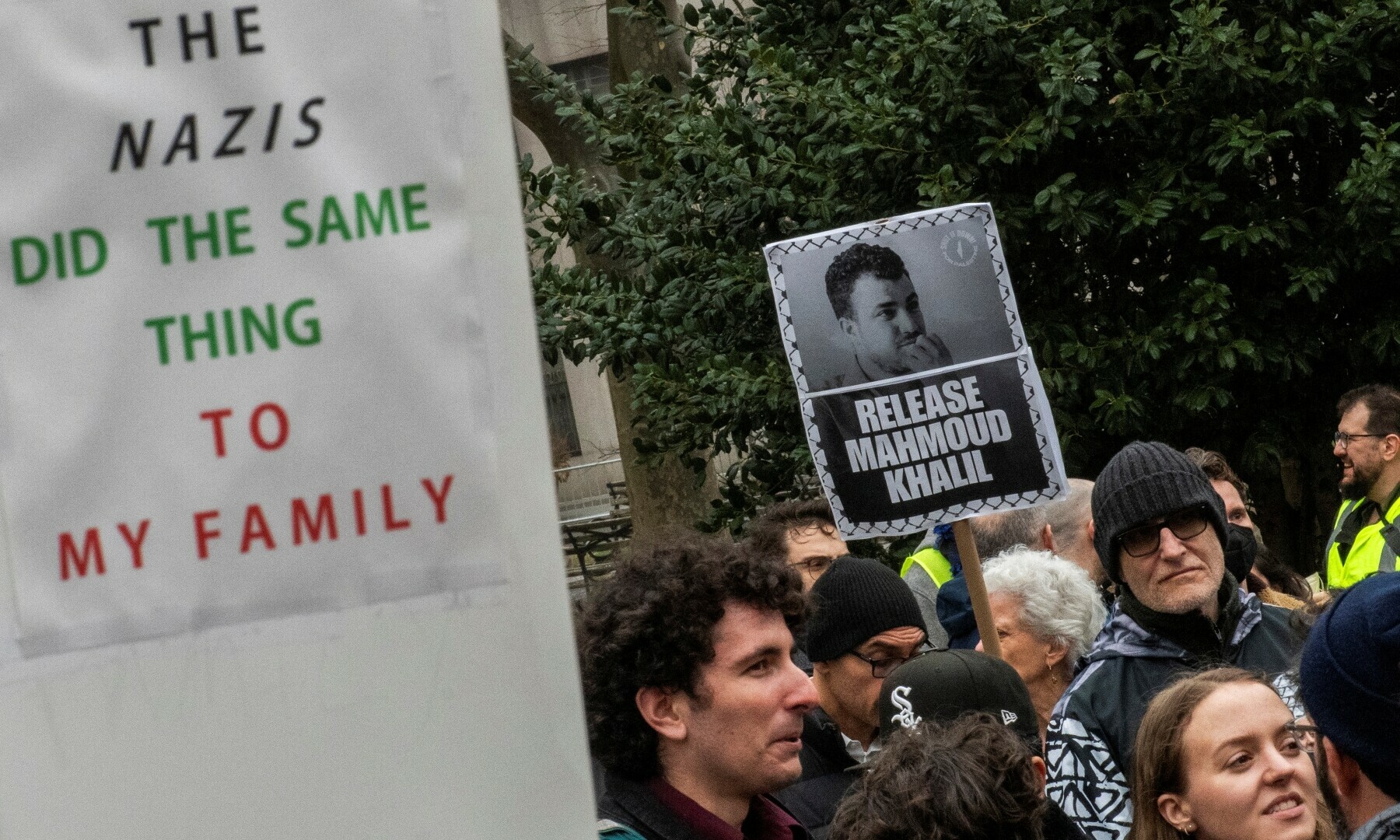
The administration has warned at least 60 other universities of similar action. Columbia has come under particular scrutiny, following the pro-Palestinian student protest movement that roiled its campus last year, when its lawns filled with tent encampments and noisy rallies against the US government’s support of Israel.
Arrest powers
Among the outlined changes, Columbia has hired three dozen special officers who have the power to arrest people on campus and has revised its anti-discrimination policies, including its authority to sanction campus organisations, the memo said.
Face masks to conceal identities are no longer allowed, and any protesters must now identify themselves when asked, the memo said. The ban does not apply to face masks worn for medical or religious purposes.
The school also said it is searching for new faculty members to “ensure intellectual diversity”.
The sudden shutdown of millions of dollars in federal funding to Columbia this month was already disrupting medical and scientific research at the school, researchers said.
Cancelled projects included the development of an AI-based tool that helps nurses detect the deterioration of a patient’s health in hospital two days earlier than other early warning systems.
The Trump administration also cancelled funding for a study designed to improve the safety of blood transfusion therapies for adults, children and newborns, and research on uterine fibroids, non-cancerous tumours that can cause pain and affect women’s fertility