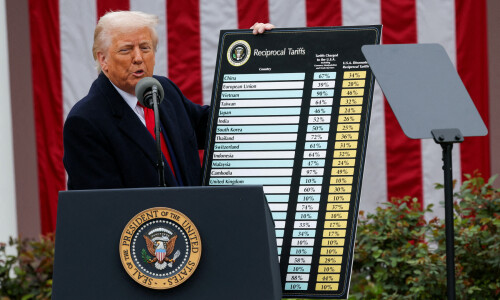
KARACHI: In response to the unexpected 29 per cent reciprocal tariff imposed by the United States on Pakistan, exporters feel that the impact would be detrimental, though not significantly severe, as competitors are also subject to similarly high taxes on their exports to the US.
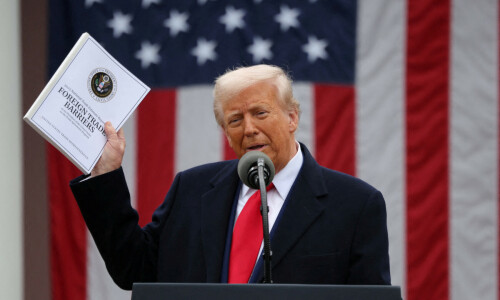
US President Donald Trump announced a raft of tariffs on Wednesday, saying they were designed to stop the US economy from being “cheated”.
Pakistani exporters said the tariff would not cause any significant hit since competitors like India, China, Vietnam and Bangladesh will also face high tariffs in the US market.
United Business Group (UBG) President and ex-chief of the Federation of Pakistan Chamber of Commerce and Industry Zubair Tufail said the negative impact of the US tariff on exports from Pakistan is imminent but not to any great extent.
Industry players suggest zero-rated imports to offset negative fallout
“The US tariff will have little negative impact since most of the competitors will face the same, higher or lower tariff on exports,” he said. He was sure exporters would not face a tough time in the US markets.
However, others were hopeful that the government could find a remedy since the imports from the US are too little.
Pakistan imported goods worth $1.87 billion from the US, while its exports amounted to $5.4bn in FY24. This compares to imports of $2.2bn and exports of $5.9bn in FY23, showing a trade surplus with the US.
“We suggest the government make the US imports zero-rated. It will automatically give an advantage to exports from Pakistan since the tariffs have been imposed on a reciprocal basis,” said Javed Bilwani, an exporter and business leader.
He said since the size is too small compared to total imports of $53.7bn in FY24, it would not cost much to Pakistan if imports from the US are made zero-rated duty.
However, the US is Pakistan’s biggest exporting destination. China is the largest trade partner, but exports to Beijing were limited to $2.7bn in FY24 against an import of $13.5bn, showing a vast trade gap of $10.8bn for Pakistan.
“I believe the 29pc duty will vary from item to item while Pakistan could get an advantage from the higher tariffs to China and Vietnam,” said Samiuallah Tariq, head of research and development for Pak-Kuwait Investment Company.
Researchers said if Pakistan removes the duty on imports from the US, the country will benefit its people since Pakistan mainly imports cotton, soybean, pulses and other food items.
Hurdles and opportunities
On Wednesday, Mr Trump imposed 29pc reciprocal tariffs on Islamabad, which charged the United States 58pc. Analysts saw immediate hurdles and long-term opportunities for Pakistan.
Ali Hasanain, associate professor of economics at LUMS, said, “America is one of Pakistan’s most important trade partners, and the one with which we run the largest trade surpluses”, adding that nearly a fifth of the country’s exports were destined for the US.
He highlighted that exports to the US were less than 1.5pc of Pakistan’s GDP. “Even if these are entirely wiped out — which is highly unlikely — the impact will be smaller than multiple times we have shrunk our economy through mismanagement,” he said.
Sajid Amin, economist and deputy executive director of research at Sustainable Development Policy Institute (SDPI), speaking to Dawn.com, noted that the immediate impact will be negative, considering the US is the country’s largest trading partner.
“To offset that, Pakistan might have to subsidise local production to become more competitive,” he said. “Somewhere, you would have to cut down on local production costs” of the major exports to the US.
“The challenge will be whether the IMF will allow the country to subsidise,” he highlighted.
He added that the long-term impact, however, remained uncertain.
“Firstly, you would have to offset the immediate negative impact successfully,” he said.
“Secondly, Pakistan’s tariffs are less than Bangladesh and Vietnam, which can be an opportunity but for that we’d need to be innovative,” he stated, adding that the medium and long-term impact would depend on how the country can offset the immediate negative impact of the tariffs, and how Pakistan can innovate in industries where it has an advantage over other countries hit by tariffs.
Challenges for textile
Adil Nakhoda, economist and professor at the Institute of Business Administration Karachi (IBA), told Dawn.com that the country’s exports to the US have been limited to textiles, which could face the most significant challenges in the short run.
He noted that the US was the “most important single country destination market for Pakistani exports” and did not see the reciprocal tariffs impacting foreign relations as the US imposed tariffs on all trading partners, albeit at different levels.
Regarding measures the country could take, he noted that “Pakis-tan can consider increasing its exports of textile-made-up products to the EU.
Khurram Husain, business and economic journalist, noted that the tariffs imposed would make the ties between the two countries “even more transactional”.
He also highlighted that alternative markets for the country’s exports would “take a long time to cultivate”.
“At the moment, there is no replacement for the US for Pakistani exporters,” he said, adding that the US and the EU have remained the most significant markets.
Published in Dawn, April 4th, 2025