The questionable math behind Trump’s reciprocal tariffs


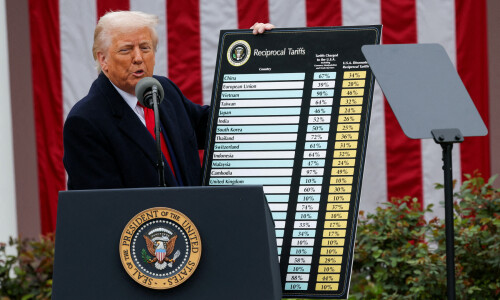
KARACHI: In the immediate aftermath of US President Donald Trump’s announcements of sweeping tariffs on imports, economists rushed to deduce how these rates were calculated.
It didn’t take long for them to conclude how the Trump administration had finalised these tariffs.
The math, they thought, would be a bit more nuanced, but it was rather perversely simplistic.
Take the example of Pakistan, where Trump announced a 29pc tariff on imports. How was this number reached?
According to the US Trade Representative (USTR), the country exported goods worth $2.1bn to Pakistan in 2024. Meanwhile, it imported goods worth $5.1bn. This brings the US’ trade deficit with Pakistan to $3bn.
The Trump administration divided the trade deficit ($3bn) with imports from Pakistan ($5.1bn), which gives 0.588. The value, when rounded off, becomes 0.59 or 59pc. Dividing this number in half gives 29.5pc, rounded off to 29pc.
According to the Wall Street Journal, this formula was used to calculate tariffs for at least 71 of the 184 nations, plus the European Union.
The formula doesn’t necessarily account for tariffs charged by countries on US imports, as per WSJ.
For example, Chinese tariffs on US imports were about 23pc as of last month, according to the Peterson Institute for International Economics.
But dividing the US 2024 goods-trade deficit with China, of some $295 billion, by the amount the US imported from China results in the 67pc tariff value presented by the White House.
For the European Union, the formula has produced a punitive tariff of 20pc, four times the 5pc which the World Trade Organisation calculates as the EU’s average tariff rate.
Several journalists and economists posted on social media about the possible reciprocal tariff formula.
In a post on X, Journalist James Surowiecki pointed out that South Korea — slapped with a 25pc tariff — is not charging 50pc tariff on US imports.
White House Deputy Press Secretary Kush Desai replied to Mr Surowiecki’s post, stating, “[W]e literally calculated tariff and non-tariff barriers”. He included a screenshot of a White House paper explaining the formula.
The formula — Δτ₁ = (x-m) / (ε x φ x m) — derived by the US Council of Economic Advisers also takes into account the import price elasticity (ε) and passthrough from tariffs to import prices (φ).
Economists have pointed out that the US Treasury has set ‘ε’ at 4 and ‘φ’ at 0.25. In essence, multiplying both values gives 1, thus cancelling out each other and reducing the formula to total exports minus imports (trade balance) divided by imports from the country.
Published in Dawn, April 4th, 2025