Iran is seeking a “real and fair” agreement with the United States on its nuclear programme, a senior aide to supreme leader Ayatollah Ali Khamenei said on Friday, setting the stage for a diplomatic showdown this weekend in Oman.
Longtime adversaries Iran and the US are set to hold talks on Saturday in Muscat, aimed at reaching a deal on Tehran’s nuclear programme.
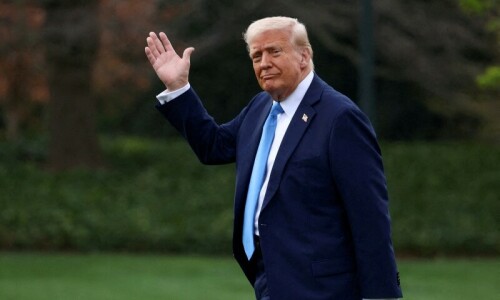
US President Donald Trump last month sent a letter to Khamenei urging negotiations and warning of possible military action if Iran refuses.
“Far from putting up a show and merely talking in front of the cameras, Tehran is seeking a real and fair agreement, important and implementable proposals are ready,” Khamenei adviser Ali Shamkhani said in a post on X.
He confirmed that Iranian Foreign Minister Abbas Araghchi was heading to Oman “with full authority for indirect negotiations with America”, adding that if Washington showed goodwill, the path forward would be “clear and smooth”.
In the lead-up to the talks, the two sides have engaged in a war of words, with Trump reiterating his warning that military action was “absolutely” possible if talks failed.
Iran responded by saying it could expel UN nuclear inspectors, prompting another US warning that such action would be an “escalation”.
Iran has consistently denied seeking to acquire nuclear weapons.
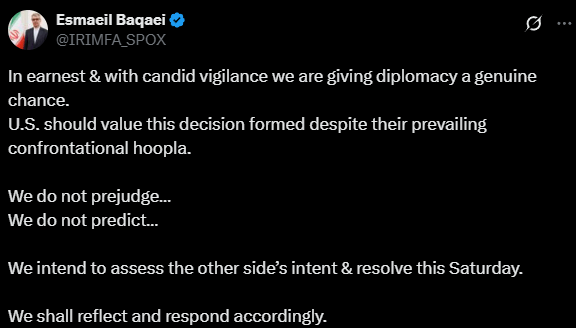
On Friday, Iran foreign ministry spokesman Esmaeil Baqaei said Iran was “giving diplomacy a genuine chance in good faith and full vigilance”. “America should appreciate this decision, which was made despite their hostile rhetoric,” he said on X.
Stupid actions
The talks were first announced by Trump during Israeli Prime Minister Benjamin Netanyahu’s visit to Washington.
While he said the talks would be high-level and “direct”, Iran has insisted they would be “indirect”.
It later emerged that Araghchi and US special envoy Steve Witkoff were due to lead the talks in Oman, which has in the past played a mediating role on the Iran nuclear file.
Witkoff visited Russia today for talks on Ukraine with Russian President Vladimir Putin, an ally of Iran.
Expert-level consultations between Russia, China and Iran on nuclear issues took place in Moscow on Tuesday, according to the Russian foreign ministry.
Ahead of the Oman talks, the US imposed additional sanctions on the Islamic republic targeting its oil network and nuclear programme.
Iran’s nuclear agency chief Mohammad Eslami downplayed the effect of the US-imposed sanctions, saying: “They applied maximum pressure with various sanctions, but they were unable to prevent the country from progressing.”
“They still think that they can stop this nation and country with threats and intimidation, psychological operations, or stupid actions,” he added.
Iran has come into the spotlight since Trump returned to office in January, and its regional allies have in recent months suffered major setbacks.
Among them are Hamas and Hezbollah in Lebanon, hit by staggering losses in conflicts with Israel sparked by the October 7, 2023 attack.
Since the start of Israel’s offence on Gaza, Iran and Israel have engaged in direct attacks for the first time in history.
And in Syria, longtime Iran ally ex-president Bashar al-Assad was ousted in December.
Enemy of Iran
Warning of military action against Iran should the talks fail, Trump said US ally Israel would “obviously be very much involved in that, be the leader of that”.
Khamenei’s adviser Shamkhani later warned such threats could prompt measures, including the expulsion of UN nuclear watchdog inspectors.
“Transfer of enriched materials to secure locations may also be considered,” he added, referring to the country’s uranium enrichment.
Ahead of the talks, hardline media in Iran voiced scepticism they would yield results.
The Kayhan newspaper ran editorials warning the new sanctions showed the US was “an enemy of Iran and its people” and dismissed negotiations to lift sanctions as a “failed strategy”. Reformist media outlets struck a more optimistic tone, emphasising the potential economic and investment opportunities talks could create.
During his first term, Trump unilaterally withdrew from a landmark 2015 nuclear deal between Iran and world powers and reimposed sweeping economic sanctions.
Tehran adhered to the deal, formally known as the Joint Comprehensive Plan of Action, for a year after Washington withdrew but later began rolling back its own commitments.
In its latest quarterly report in February, the International Atomic Energy Agency said Iran had an estimated 274.8 kilogrammes of uranium enriched to up to 60 per cent. Weapons grade is around 90pc.
Iran has also increased the number of centrifuges.