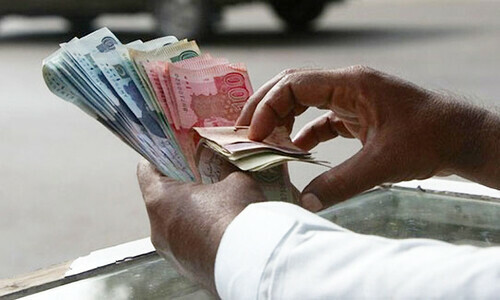
Overseas Pakistanis continue to be a lifeline for the country, consistently sending increasing amounts of foreign exchange. In a promising sign, the current hybrid regime has pledged to explore meaningful ways to reward them. In March 2025 alone, remittances reached an all-time high of $4.1 billion, reflecting a 37 per cent year-on-year increase.
State Bank Governor Jameel Ahmed has projected that total remittances for the current fiscal year ending in June could reach $38bn, surpassing the initial target of $36bn. Between July 2024 and March 2025, Pakistan has already received $28bn from its 10 million-strong diaspora, a 33pc increase over the same period last year.
This is a positive and stabilising development. The government is reportedly considering a reserved quota for overseas Pakistanis in parliament and is eager to attract their investment in viable sectors such as mining, agriculture, and information technology. Swiftly executing these initiatives could strengthen trust and help sustain the current remittance momentum.
These larger-than-expected inflows will be crucial in managing Pakistan’s current account amidst a widening trade deficit and could help stabilise the rupee — provided the trade deficit does not spiral or remittance growth falters.
Though positive efforts are underway, sustained progress hinges on more fundamental actions such as restoring political stability and improving governance
However, Pakistan’s export prospects are under renewed pressure amid the evolving global trade dynamics, particularly in the wake of sweeping US tariffs. With the country’s low rankings in innovation and ongoing structural issues in the services sector, prospects for narrowing the services trade deficit appear bleak.
According to the Pakistan Institute of Development Economics (PIDE), Pakistan could face a loss of $1bn to $1.4bn in goods exports if the Trump tariffs come into full effect — especially if ongoing negotiations yield no favourable outcomes.
Even if remittances maintain their current pace, managing the current account in the next fiscal year could become increasingly difficult. Assuming another 33pc annual increase in remittances may be overly optimistic, given the broader context: slowing global economic growth, retaliatory trade measures by China, the prolonged conflicts in Ukraine and the Middle East, and heightened geopolitical uncertainty surrounding Iran’s nuclear programme.
As per the latest balance of payments data, Pakistan posted a current account surplus of $1.86bn during 9MFY25, reversing a $1.6bn deficit in the same period last year. This improvement has been driven largely by remittance growth. Yet, the overall trade deficit (goods and services combined) has expanded to $21bn, up from $18.3bn a year earlier. This figure is expected to grow further in the final quarter due to sluggish exports and increasing imports, eroding the current account surplus and weakening its ability to support the rupee.
As per the latest balance of payments data, Pakistan posted a current account surplus of $1.86bn during 9MFY25, reversing a $1.6bn deficit in the same period last year
The PIDE report also warns that the textile sector could be the hardest hit by the Trump tariffs, potentially forcing firms to lay off up to half a million workers. With unemployment already high, such a blow could deepen socio-economic distress, trigger further political instability, and complicate efforts to combat terrorism and militancy.
Compounding these challenges is Pakistan’s underwhelming performance in attracting foreign direct investment (FDI). Despite efforts by the civil-military-led Special Investment Facilitation Council, FDI totalled just $1.64bn in 9MFY25 — only marginally higher than $1.44bn in the same period last year.
In response, the federal government has turned its focus to the mining and minerals sector, inviting the US and other foreign firms to explore opportunities. However, provincial governments are still reviewing the recently amended relevant laws, and any delay or unilateral federal moves could create friction. Even if these regulatory hurdles are cleared, meaningful FDI inflows are unlikely before the second half of FY26. Until then, Pakistan must explore innovative strategies to meet its external debt obligations and manage its balance of payments.
A recent credit rating upgrade to a ‘B-’ by Fitch may offer some support, but sustained progress hinges on more fundamental shifts: restoring political stability, decisively tackling militancy through both dialogue and force, and improving governance. Achieving this will not be easy, especially given Pakistan’s narrowing geopolitical and strategic options.
The current regime’s economic efforts must be tempered by a renewed commitment to constitutionalism, institutional clarity, and justice for all.
On the economic front, there is a clear need to expedite the privatisation programme to lessen the burden of the loss-making state-owned institutions on the fiscal book.
The current hybrid regime had set a modest target of Rs30bn to get through privatisation proceeds but that too remains elusive even after nine months of this fiscal year. The government may consider offering stakes in state-owned enterprises to overseas Pakistani investors as part of an incentive package. But this requires maximum transparency in policymaking and execution lest it opens a political pandora box of favouritism and nepotism.
Published in Dawn, The Business and Finance Weekly, April 21st, 2025