Trump officials push Russia-Ukraine peace deal after Vatican meeting


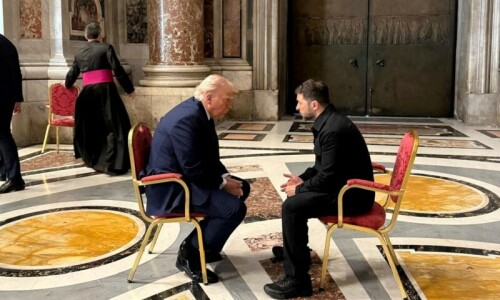
Top officials in United States President Donald Trump’s administration on Sunday pressed Russia and Ukraine to make headway on a peace deal following a one-on-one meeting between Trump and Ukrainian President Volodymyr Zelensky at the Vatican a day earlier.
“It needs to happen soon,” US Secretary of State Marco Rubio told NBC’s ‘Meet the Press’. “We cannot continue to dedicate time and resources to this effort if it’s not going to come to fruition.”
Rubio said the US would consider in the coming week whether to continue mediating talks “or if it’s time to sort of focus on some other issues”.
Trump and Zelensky, in Rome for the funeral of Pope Francis, met in a Vatican basilica on Saturday to try to revive faltering efforts to end Russia’s war with Ukraine.
The meeting was the first between the two leaders since an angry encounter in the Oval Office in Washington in February and comes at a critical time in negotiations aimed at bringing an end to the conflict.
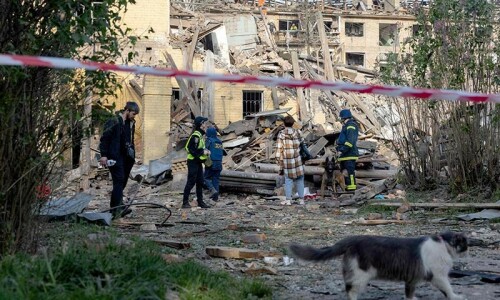
In a Truth Social post later on Saturday, Trump rebuked Russian President Vladimir Putin over recent attacks on Ukraine, saying “there was no reason for Putin to be shooting missiles into civilian areas, cities and towns, over the last few days.”
In a pre-taped interview that aired on CBS News programme ‘Face the Nation’ on Sunday, Russian Foreign Minister Sergei Lavrov said Russia would continue to target sites used by Ukraine’s military.
When asked about a Russian strike on Kyiv last week that killed civilians, Lavrov said “the target attacked was not something absolutely civilian” and that Russia only targets “sites which are used by the military”.
Zelensky wrote on the messaging app Telegram that his top military commander had reported that Russia had already conducted nearly 70 attacks on Sunday.
“The situation at the front and the real activity of the Russian army prove that there is currently insufficient pressure on Russia from the world to end this war, he said.
Differing proposals
Ukrainian and European officials pushed back last week against some US proposals on how to end Russia’s war in Ukraine, making counterproposals on issues from territory to sanctions, Reuters reported on Friday.
The primary areas of difference in the two proposals were over the sequencing for resolving questions over territory, the lifting of sanctions on Russia, security guarantees and the size of Ukraine’s military.
American proposals called for US recognition of Russia’s control over Crimea, the Ukrainian peninsula Moscow seized and annexed in 2014, as well as de facto recognition of Russia’s hold on other parts of Ukraine.
In contrast, the European and Ukrainian proposal defers detailed discussion about territory until after a ceasefire is concluded.
German Defence Minister Boris Pistorius said on Sunday that Ukraine should not agree to the US proposal, saying it went too far in ceding swathes of territory in return for a ceasefire.
Despite the divergent views, Trump’s national security adviser on Sunday said the meeting with Zelensky showed his determination to reach a deal.
“That meeting is going to go down in the history books for President Trump, to be a president of peace,” National Security Adviser Mike Waltz told Fox News’ ‘Sunday Morning Futures’.
Waltz said Trump has “expressed his frustration” at the leaders of both nations but remained determined to help negotiate an agreement. He also said the US and Ukraine would eventually reach an agreement over rare earth minerals and that talks continued over the weekend.
Democrats in the US Congress have criticised Trump’s approach to the conflict and Senate Minority Leader Chuck Schumer said on Sunday that he was concerned Trump would “cave in to Putin”.
“To just abandon Ukraine, after all the sacrifice that they made, after so much loss of life, and with the rallying of the whole West against Putin, it would just be a moral tragedy,” Schumer said on CNN’s ‘State of the Union’.
Schumer said siding with Russia in the conflict would tear apart alliances with Europe and embolden dictators around the world.