
Back in 1998, Steven Spielberg’s Saving Private Ryan was widely acclaimed for the bloody realism of its opening scenes. In Warfare, co-directors Ray Mendoza and Alex Garland have achieved something very similar for the Iraq war (2003-2011).
This time, however, the assault on the senses lasts for almost the entire duration of the film — around 95 mins. The result is an unrelenting depiction of 21st century battle, which both invokes and disrupts the generic conventions of the combat film.
Warfare begins by staking a claim to authenticity. The opening credits tell us that it is based entirely on the memories of those who were there: the members of a US Navy Seal platoon involved in an operation in the immediate aftermath of the 2006 Battle of Ramadi.
In pre-release interviews, Mendoza — a Seal veteran and former member of the platoon — explained that Warfare was made as a purposeful attempt to provide a visual account of what happened, for a comrade (Elliott Miller, played in the film by Cosmo Jarvis) who lost his memory after a horrific battlefield injury.
It is by no means the only war film to find inspiration in the memories of veterans. From The Best Years of Our Lives (1946) to Lone Survivor (2013), traumatic first-hand experiences have long informed Hollywood’s depictions of war and its aftermath.
But in Warfare, this framing has a very deliberate consequence. It telescopes the action, so that questions of broader political context are necessarily sidelined in favour of the visceral experiences of those on the ground. The Seals are there because they are there — no other rationale for their mission is offered.
Warfare is a Band of Brothers for the ‘War on Terror’ generation and reflects the chasm in American culture that separates the ‘good war’ of the 1940s from the far less popular conflicts of the early 21st century
Towards the start, Warfare also follows some well-trodden ground when it pointedly lingers on the boredom before battle. This is reminiscent of another work of filmic war memoir, 2005’s Jarhead.
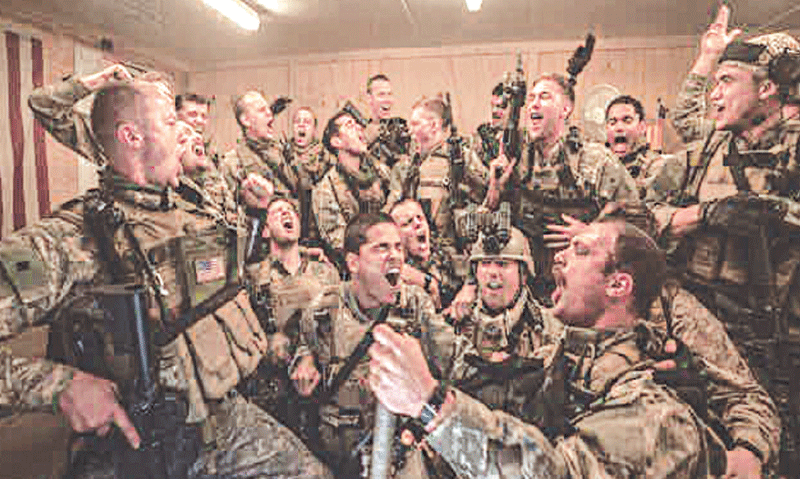
The Seals sweat and swear until, suddenly, chaos is catalysed. What follows is among the most intense depictions of combat ever seen on the big screen. Besieged by an ever-present, yet largely out-of-sight enemy, the embattled soldiers fight to protect one another, rescue their wounded, and escape. As they do so, the fog of war descends.
This is where the film most clearly reveals its debt to the war film genre. Indeed, for all the originality of its screenplay, Warfare actually invokes several familiar generic motifs of the combat film. The most obvious is the focus on a platoon, but two others also stand out.
One concerns the film’s narrative centre: a band of isolated and outnumbered American warriors battling heroically against the odds. A popular motif in American culture since at least the 1836 Battle of the Alamo (during the Texas Revolution), it has been used and reused over the years in countless Westerns and war films, perhaps most explicitly in 2016’s 13 Hours: The Secret Soldiers of Benghazi. In its underlying structure, the story told by Warfare is informed by this very same trope.
A second familiar motif is the film’s Shakespearean meditation on the brotherhood of battle. Like 2001’s HBO mini-series Band of Brothers (about a company of second World War paratroopers), this is a story of men at war. Blood is shed and unbreakable bonds are forged.
It is here though that Garland and Mendoza also disrupt. For where Henry V offers his “happy few” a validating cause, no such higher purpose reveals itself in Warfare.
In fact, these undoubtedly brave warriors are clearly unwelcome invaders. The fraught interactions with the frightened (and unnamed) Iraqi civilians, whose home they have occupied, makes this obvious, as do the persistent attempts by Iraqi insurgents to kill them.
Whatever happens, therefore, one thing is certain: these Seals, unlike their second World War predecessors, will not be greeted as liberators by flag-waving locals casting garlands of flowers.
This is where Warfare reveals that, for all its telescoped focus, it is not apolitical after all. Quite the contrary; the film is inescapably a product of its moment.
The fighting “out there”, says Warfare, offered no redeeming purpose and so, for veterans, all that is left are memories of the love and the loyalty between those who went into battle together.
Seen like this, Warfare’s place in the genre also now becomes clear. This is a Band of Brothers for those who fought the ‘War on Terror.’ It’s a point made especially apparent in the closing credits, which feature photos of the real Seal veterans next to those of the actors who played them (not unlike how each episode of Band of Brothers included veterans’ testimony).
Warfare’s structure, focus and elisions speak volumes about the chasm in American culture — particularly in the eyes of veterans — that separates the “good war” of the 1940s from the far less popular conflicts of the early 21st century.
The writer is Reader in Modern Political History at Loughborough University in the UK
Republished from The Conversation
Published in Dawn, ICON, May 4th, 2025