Kashmiris face harassment across India


SHABIR Ahmad Dar and another salesman were assaulted by members of a Hindu right-wing group in Uttarakhand’s Mussoorie hill-station last week, BBC News reported.
The assailants, who accused the men of being responsible for terrorism, vandalised their stall and ordered them to leave town.
For over two decades, Dar made a living selling embroidered Pashmina shawls in this town. But his Kashmiri identity has now made him a target.
“They told us we didn’t belong here,” Dar said from his home in India-held Kashmir, where he returned out of fear. “We left everything behind — even goods worth thousands of dollars. We’re too scared to go back.”
Footage of the assault quickly spread online, prompting police to arrest three men. But they were released hours later with a fine and an apology. By then, Dar and dozens of other Kashmiri traders had already fled.
The backlash reflects a growing pattern of harassment targeting Kashmiris across India following the attack in Pahalgam.
In Indian Punjab, Ummat Shabir, a nursing student, said her neighbour called her a “terrorist who should be thrown out”.
“My classmate was thrown out of a taxi after the driver found out she was Kashmiri,” she said. The two returned to India-held Kashmir after a three-day journey, fearing for their safety.
Even in Mussoorie, where Dar and his colleague Shafi Subhan had worked peacefully for decades, the atmosphere has changed.
“After the Pulwama attack in 2019, there was tension, but no one touched us,” said Subhan, who has sold shawls in the town for 20 years. “This time, no one stepped in to help us. People just watched. It hurt us physically — but emotionally, a lot more”
The violence in Pahalgam — one of the deadliest attacks on civilians in recent years — sparked widespread anger in India. Politicians across the spectrum called for strong retaliation and many reports have emerged of Kashmiri vendors and students facing threats and abuse in cities like Delhi, Jaipur, and Chandigarh.
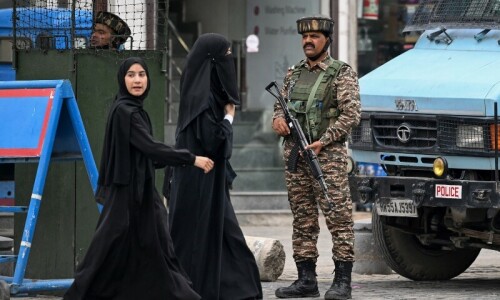
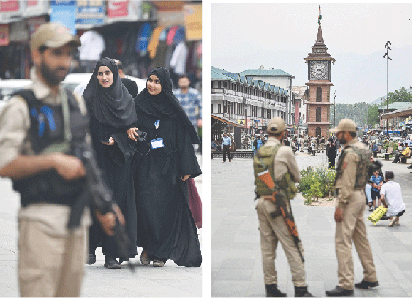
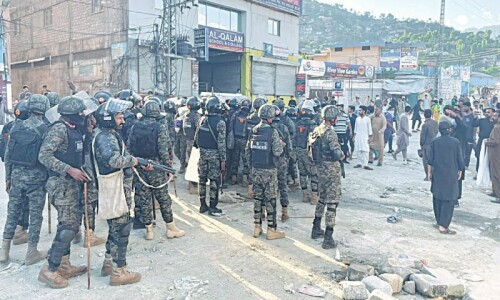
In response to the attack, Indian security forces launched a sweeping crackdown in held Kashmir, detaining thousands, sealing off tourist sites, increasing troop presence, and demolishing homes allegedly linked to Kashmiri fighters.
Rights groups and some local leaders have criticised the government’s response, calling the demolitions a form of collective punishment.
“Don’t let innocent people become collateral damage,” occupied Kashmir Chief Minister Omar Abdullah said. His predecessor, Mehbooba Mufti, warned authorities to distinguish “between terrorists and civilians”.
Published in Dawn, May 3rd, 2025