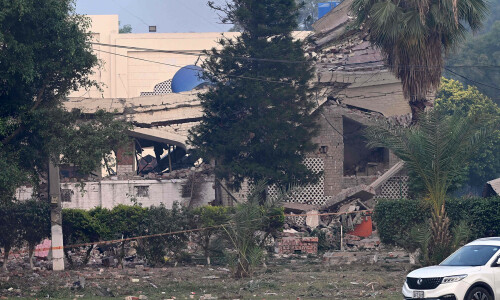
IT is a time of great peril in the subcontinent. India’s provocative attack targeting several locations in Azad Kashmir and Punjab early on Wednesday comes after two weeks of sabre-rattling by warmongering officials and media personnel in that country following the tragic Pahalgam episode.
It appears that the danger has not passed, as Prime Minister Shehbaz Sharif told the nation last evening that India would “suffer the consequences” of its ill-advised moves. Earlier, there was a welcome show of political unity in the National Assembly, while the day began with a meeting of the National Security Committee, which dubbed New Delhi’s perilous actions as “acts of war”.
The deadly aggression against Pakistan has put both neighbours on the path to more conflict, unless a negotiated end to this dispute — and to the core issue of Kashmir — is found. Pakistan has responded to the blatant violation of its sovereignty resolutely, with the state saying that five Indian warplanes were downed during the hostilities. It is hoped that the message been understood in New Delhi, and that the latter’s shenanigans will not be repeated.
Aside from sites in Azad Kashmir, locations in Punjab were also hit. At least 31 people in Pakistan were killed in India’s so-called Operation Sindoor, according to the DG ISPR. This reckless act on India’s part could have resulted in more casualties had the intruders not been confronted in time. The Indian military’s claim that the attacks were “non-escalatory in nature” defies belief. Violating a country’s frontiers, hitting its cities and towns and murdering its people is not just escalatory; these are very much acts of war. Moreover, if the Indian state says only the ‘terror infrastructure’ was targeted, then how would New Delhi explain the fact that civilian neighbourhoods, as well as the Neelum-Jhelum hydropower project, were attacked? The fact is that the Indian state took this ill-conceived action to cover up for its massive security lapse in Pahalgam. What happened in the held Kashmir tourist spot was indeed deplorable, and the guilty should be brought to justice. Yet the BJP government has used the tragedy to create war hysteria against Pakistan, without any proof of this country’s involvement in that attack.
If India has solid evidence against Pakistan, why has it failed to make it public? Using Pahalgam as a casus belli against Pakistan seems to be a manoeuvre by the Modi regime to boost its standing domestically, and throw its weight around in the neighbourhood. This foolish gambit has failed and has brought the nuclear-armed neighbours to the brink of war.
Following the Indian attack, there has been a crescendo of global voices calling for restraint and de-escalation, with several states offering their good offices to mediate. Pakistan has shown itself ready to accept such offers, but will India respond positively to prevent the slide towards all-out war? The events of the past few weeks have once again demonstrated that the Kashmir dispute remains a global flashpoint. While India may believe its own fiction that the Kashmir dispute has been ‘resolved’, Pakistan, the Kashmiris as well as the world community continue to acknowledge the fact that the region remains disputed. Pakistan and India have fought several wars over Kashmir, and are on the precipice of a fresh conflict due to it.
Therefore, in order to establish long-term peace in South Asia, both states need to talk to each other, frankly and meaningfully. This may be a bitter pill to swallow for the Hindu revivalist BJP regime, which has never stopped dreaming of ‘Akhand Bharat’. But it would be to its own detriment if it does not shed its ideological fantasies and come to the table with Pakistan and the Kashmiris to achieve a solution acceptable to all. The alternative is perpetual hostility. In the immediate future, the global community must step up efforts to de-escalate, and media and civil society on both sides should stop fanning the flames of war.
Published in Dawn, May 8th, 2025