Deterrence re-established, say armed forces


• ISPR DG says 26 Indian sites struck, response textbook demonstration of integrated tri-services
• Indian military dodges question about loss of fighter jets
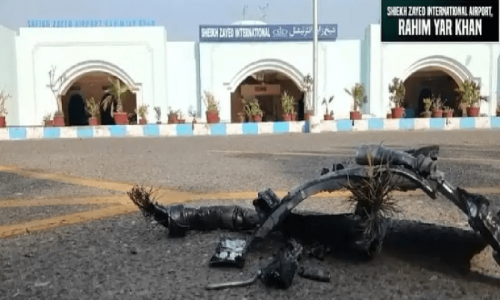
ISLAMABAD: Pakistan’s armed forces on Sunday said they struck 26 Indian targets in ‘Operation Bunyanum Marsoos’ to re-establish deterrence after India violated Pakistan’s airspace earlier this week and separately targeted air bases in early-morning strikes.
In a press conference alongside Pakistan Air Force (PAF) Director General Public Relations Air Vice Marshal Aurangzeb Ahmed and Naval Staff (Operations) Deputy Chief Vice Admiral Raja Rab Nawaz, Pakistan Army’s chief spokesperson Lt Gen Ahmed Sharif Chaudhry shared details about the operation.
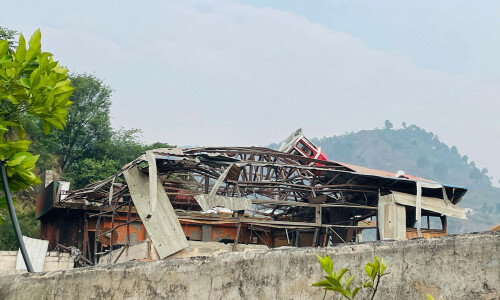
He said the dastardly attacks began on the night of May 6 and 7, resulting in the loss of innocent civilian lives, including women, children and the elderly. He said one Pakistani aircraft was slightly damaged during the Indian missile attack.
“Twenty-six military targets, along with facilities in India used to target Pakistani citizens and entities involved in fomenting terrorism in Pakistan, were engaged in both Occupied Jammu and Kashmir and mainland India,” he said in the presser.
Gen Chaudhry said Pakistan’s response was a “textbook demonstration” of integrated tri-services, enabled by real-time situational awareness, network-centric warfare capabilities and seamless multidomain operations.
“The targets included air force and aviation bases at Suratgarh, Sirsa, Adampur, Bhooj, Nalia, Bathinda, Barnala, Halwara, Avantipura, Srinagar, Jammu, Mamoon, Ambala, Udampur and Pathankot — all of which sustained major damages,” he added.
The DG said Brahmos facilities, which had fired missiles in Pakistan and killed innocent civilians, were also destroyed.
India launched a series of strikes under ‘Operation Sindoor’ soon after the Pahalgam tragedy in the early hours of May 7 across Pakistan, in which 31 people were martyred. Pakistan’s military responded swiftly, downing five Indian jets, destroying Indian brigade headquarters, and check posts in the occupied Kashmir along the Line of Control.
The ISPR chief paid tribute to those who were martyred in the Indian aggression and their families, while praying for the speedy recovery of the wounded.
“We extend our heartfelt gratitude to every officer, soldier, airman and sailor of the Armed Forces of Pakistan who made this success on the battlefield possible through their courage, professionalism and sacrifice.”
The military spokesperson particularly thanked the youth of Pakistan — “who became the frontline soldiers as information and cyber warriors of the country” — and the media that stood as a “steel wall” against the Indian media. He also appreciated politicians for their support to the army during these times and lauded the premier for taking “destiny-changing decisions” during this testing time
War not an option

Responding to a question about who first requested for the ceasefire, the DG ISPR said: “Put it on record that Pakistan never requested for a ceasefire.”
He warned that there was no space for a war between two nuclear-armed nations. “if anyone wants to carve out this space for war, he is actually carving out the space for mutual annihilation,” he added.
He said: “This is why you saw how in this conflict Pakistan acted in a very mature manner and through conventional forces, we maintained escalation control, through conventional forces we gave them a two notch up response while also ensuring that the Pakistan forces employed on the counterterrorism operations … no pull is also exerted on them.”
IAF airfields hit
Air Vice Marshal Ahmed, while describing Pakistan’s response to the Indian Air Force, said the PAF’s response was based “on the time and place of own choosing”, displaying “bold, aggressive and unwavering resolve of the brave military leadership”.
“I must appreciate the leadership … they were resolute and clear in giving instructions to all of us and that is perhaps the reason why we were so sure about what we had to do,” he said.
“With unprecedented reach, precision and lethality, while avoiding collateral, the PAF hit maximum number of IAF airfields in a single operational package since 1971 because they crossed the international border,” the officer said.
“While reestablishing deterrence, Pakistan negated the setting of a new normal under the hegemonistic design of a supremacist regime through swift and effective response.”
Sea frontiers
Vice Admiral Rab Nawaz said the Pakistan Navy was able to defend the country’s sea frontiers from a “numerically superior enemy”.
He gave details of the navy’s readiness to thwart any attack from the sea. He said there was a hype that INS Vikrant (Indian fleet) was approaching Karachi. “We were keeping a very close eye on the activities at sea […] we were monitoring it from day one,” he added.
“On the night of May 6 and 7, it was close to Bombay and on May 9, it was essentially 400 nautical miles from the Pakistani coast and it retreated close to Bombay,” he said.
“If a carrier gets within 400 nautical miles, it simplifies our problem. The navy maritime air arm was proper ready to generate a response at all times. If there was any aggression from the sea we were ready to respond effectively,” he said.
Indian military dodges question
Indian military officers, meanwhile, said that the objectives of ‘Operation Sindoor’ were achieved, with ‘high-value terrorists’ being eliminated, but dodged a question whether they had lost a bunch of warplanes in the operation.
The officers, speaking at a press conference, provided key details on Operation Sindoor, its impact and results, saying that the “objective has been achieved”.
Air Marshal AK Bharti, DGMO Lt Gen Rajiv Ghai, Maj Gen SS Sharma and Vice Admiral AN Pramod addressed the press. Responding to reports that Rafale fighter jets were downed, Air Marshal AK Bharti did not confirm or deny the claims, stating instead that “losses are a part of any combat scenario”.
The Indian military said, “We are in a combat scenario and losses are a part of it. Question is that ‘have we achieved our objective’? Answer is a thumping yes. As for details, at this time I would not like to comment on that, as we are still in combat, and give advantage to (our) adversary. All our pilots are back home.”
Our correspondent in New Delhi also contributed to this report
Published in Dawn, May 12th, 2025