• Tariff may drop by only 30-67 paise despite revised deals
• Industry disappointed as promised relief falls short
ISLAMABAD: As the dust settled over official claims about Rs4 trillion savings through revision in power sector contracts, the government-owned entities on Thursday testified at a public hearing that those savings would be almost half — about Rs2-2.5tr over their remaining life — and it would translate into base tariff reduction of 30-67 paise per unit next year.
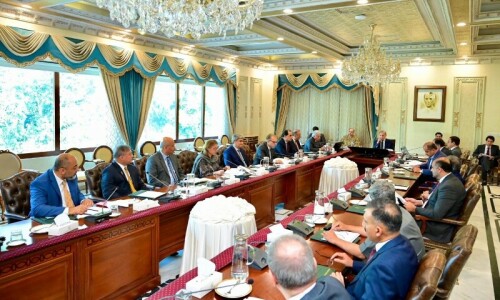
The public hearing presided over by National Electric Power Regulatory Authority (Nepra) Chairman Waseem Mukhtar was held at the request of Central Power Purchasing Agency (CPPA) — a corporate subsidiary under the Power Division for approval of next fiscal year’s Power Purchase Price (PPP), commonly described as base tariff.
Various commentators questioned the official hype over savings secured by revising contracts with independent power producers (IPPs) and government-owned power plants (GPPs).
Amir Sheikh, a Lahore-based industrialist, wondered how the tariff renegotiations would benefit the industry when tariffs proposed by the CPPA were generally close to unprecedented levels while the industry had expected much bigger relief.
He said the proposed reductions in base tariff were so small that subsequent adjustments through fuel and quarterly revisions would jack up consumer-end rates.
He said the industry was also considering shifting back to in-house captive power generation as supply was not stable and power rates were not declining. Those already announced by the government were time-bound, ending in two months, he added.
An official from the Punjab Power Board expressed similar concerns, questioning whether the impact of renegotiated capacity payments had been considered in the proposals and if the projections for capacity payments remained unchanged.
CPPA’s Naveed Qaiser conceded that the government had initially projected a Rs4tr savings in capacity payments, which had now been revised to Rs2–2.4tr due to additional liabilities from Jamshoro Power Plan and Shahtaj Sugar Mills.
The Nepra Khyber Pakhtunkhwa member criticised the distribution companies for showing lower system losses through economic load shedding, meaning closure of electricity based on system losses. “Reduction in losses by shutting down feeders is no improvement”, he said adding the complete closure of power supply would then eliminate Discos losses.
A CPPA official said the Discos’ losses would increase by Rs600bn if commercial-based loadshedding was discontinued and it was not desirable.
The Nepra chairman wondered how the government expected growth in electricity demand when it had declined in the last two years. CPPA responded that higher economic growth and lower electricity rates would deliver the results as energy consumption had improved in recent months compared to significant reductions a year earlier.
The CPPA sought revision in base electricity tariff for the next fiscal year, proposing only 30 paise to a maximum of Rs2.25 per unit reduction in consumer rates under seven scenarios.
Chairman Mukhtar asked which was the most likely case in the eyes of the CPPA. CPPA’s Qaiser said that the base tariff for next year would likely be lower by 30 to 67 paise per unit over the current year.
Only in one unlikely case of normal circumstances and a stable exchange rate at Rs280 the average base tariff would reduce by Rs2.25 per unit in 2025-26 to Rs24.75 from the current about Rs27 per unit. In case of local currency depreciation to Rs300 against the US dollar, the base tariff reduction would be around 30 paise per unit.
The average PPP would be on top of about Rs8.16 to Rs9.52 per unit fuel cost, taking the total electricity price to range between Rs34 and Rs35 per unit excluding taxes, fees, duties and surcharges.
The CPPA request outlined seven scenarios developed through sensitivity analysis of key assumption parameters, specifically demand, hydrology, fuel prices, and exchange rates. Across the analyzed scenarios, indigenous fuels constitute 55pc to 58pc of the overall energy mix, while clean fuels contribute between 52pc and 56pc.
Published in Dawn, May 16th, 2025