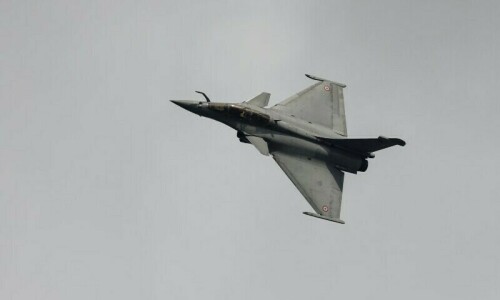
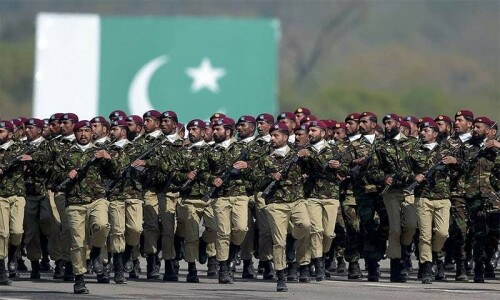
The current tense regional environment likely underpins the government’s proposal, endorsed by its largest coalition partner, the Pakistan Peoples’ Party, to raise the defence budget by 18 per cent for the next fiscal year. The critical question for a resource-constrained country, however, remains: who will pay for it?
Driven by patriotism and deep respect for a military establishment that successfully repelled the strategic ambitions of a hostile neighbour five times its size, most Pakistanis would readily pledge to defend the nation’s sovereignty and support the security apparatus in any way they can. However, is it fair, or economically prudent, to place a greater burden on those already living below poverty line, or to further tax businesses that are essential to job creation and unlocking the country’s vast human potential?
Younus Dagha, former Sindh minister and federal secretary, and current Chairman of the Policy Research and Advisory Council at Karachi Chamber of Commerce and Industry, advocated for prioritising ‘smart defence’ in future investments. He urged the government to mobilise funds for strengthening national security by tapping under-taxed sectors such as agriculture, retail and wholesale.
“Pakistan’s recent victory over India has underscored two critical lessons. First, we cannot afford to neglect our defence needs. Second, outcomes in modern warfare are determined by investment in and training on high-tech platforms. A comprehensive reorganisation of our defence structure must be a priority for decision-makers. Continued investment in smart defence systems is essential, while resources should be reallocated from traditional formations that have become obsolete, as clearly demonstrated by the 40-month Russia-Ukraine stalemate,” he remarked.
An 18pc increase in the defense budget implies a larger share of the national revenues being redirected at the expense of other critical areas
“Imposing additional taxes on existing taxpayers will be counterproductive for the economy,” he cautioned. “Only an economically strong country can defend itself effectively.”
Citing heightened security threats, media reports indicate that the government is actively considering a significant 18pc increase in the defence budget, raising it to over Rs2.5 trillion for the fiscal year 2025-26. The proposed hike is being justified as essential to bolstering national security.
However, the report did not clarify how the government plans to finance the enhanced defence spending. In Pakistan, such increases are typically covered through a mix of government revenue, borrowing and other financial arrangements.
The increased allocation to the ministry of defence from the national budget implies a larger share of government revenues being directed toward military spending, potentially at the expense of other critical areas.
The government of Prime Minister Shehbaz Sharif has two options: either mobilise funds specifically for defence as a one-time emergency measure outside the regular budget, or it can increase the defence allocation at the expense of other key budgetary heads. These include resource transfers to provinces, the administrative structure comprising federal salaries and civil/military pensions, support for state-owned enterprises and development spending on physical and social infrastructure. All of this would be in addition to interest payments, which remains non-negotiable.
Some senior members of the government’s economic team, when contacted, were either unaware of the latest developments or declined to share details that could clarify how the government intends to balance its finances under the current circumstances.
Given the sensitivity of the subject, most business leaders approached chose to refrain from making public statements. Speaking privately, they unanimously agreed on the need to defend the country effectively and acknowledged that adequate resources must be allocated for this purpose. However, they emphasised the importance of more efficient utilisation of existing funds and urged the government to cut non-essential and unproductive public expenditures. Echoing the views of Younus Dagha, they stressed that if additional resource mobilisation is necessary, whether through tax or non-tax measures, it should target under-taxed sectors, rather than further burdening those already contributing more than their fair share.
Drawing on the practices of successive governments, including the current coalition, some analysts believe that once again, ordinary citizens will be asked to bear the burden in the name of national security. “Elite platforms representing industrial barons, brokers and bankers, are well-organised and highly effective,” observed one analyst.
“They have privileged access to the corridors of power and wield influence through both financial clout and political connections. If they succeed in shielding their own interests, it will be a voiceless majority that ends up paying a disproportionate price for national security,” he added.
A critic of the government’s handling of public welfare pointed to its recent decision not to fully pass on the benefits of declining international oil prices to people, even though they were made to bear the full impact when global prices surged.
Published in Dawn, The Business and Finance Weekly, May 19th, 2025