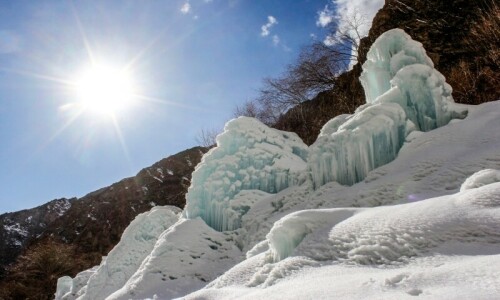
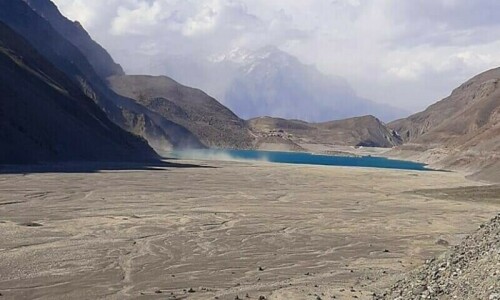
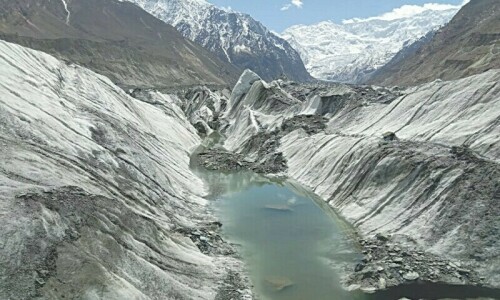
ISLAMABAD: Due to rising global temperatures, nearly 10,000 glaciers in Pakistan are retreating at an alarming rate and glacial melts have led to the formation of 3,044 lakes, with 33 of them classified as highly volatile.
This information was placed before the National Assembly by Federal Minister for Climate Change and Environmental Coordination Musadik Malik on Monday through a written reply to a question asked by Mussarat Rafique Mahesar of the Pakistan Peoples Party (PPP) about the measures being taken by the government to address the long term impact of climate change on water availability, including shrinking glaciers and reduced rainfall.
According to the minister, these unstable lakes pose a grave threat to at least 7.1 million people living downstream.
During this period of intensified glacial activity, Pakistan has already experienced 75 Glacial Lake Outburst Flood (GLOF) events, highlighting the country’s extreme vulnerability to climate disasters.
Minister says Pakistan received 40pc less rainfall compared to its 30-year average
The lawmakers were further informed that Pakistan is also experiencing decline in rainfall, posing serious threats to its water security, agriculture, and overall climate resilience as a recent data from the Pakistan Meteorological Department indicates that the country has received 40 per cent less rainfall compared to its 30-year historical average.
Providing statistical data, the minister said that the glacial regions of Pakistan, particularly in Gilgit-Baltistan and Khyber Pakhtunkhwa, were home to an astonishing 13,032 glaciers.
The Indus Basin alone contains approximately 26,000 square kilometers of glaciers, representing around 26 per cent of the total glacier area within the broader Third Pole region, which includes the Himalayas, Karakoram, and Hindu Kush Mountain ranges.
He said the Ministry of Climate Change had taken significant measures to address the long-term impacts of climate change on water availability, particularly the effects of shrinking glaciers and declining rainfall, which had led to recurring water shortages during critical crop seasons.
The GLOF-II project, he said, had been instrumental in establishing early warning systems across 24 vulnerable valleys and installing 50 weather stations and 408 river discharge sensors, while empowering over 65,000 women with training in climate-resilient agricultural practices.
“The Living Indus Initiative continues to drive 25 major ecosystem restoration projects across the Indus Basin, integrating nature-based solutions into national water security efforts.
“Complementing these initiatives, the Recharge Pakistan programme focuses on using wetlands and green infrastructure to mitigate flood risks and enhance groundwater recharge,” said the minister.
In 2025, he said, the climate change ministry launched the Glacier Conservation Strategy, a landmark initiative aimed at preserving Pakistan’s vital glacier reserves, securing future water supplies, and building resilience against climate-induced risks.
This strategy forms a key part of Pakistan’s broader response to the escalating threats posed by global warming to its water and agricultural systems.
Moreover, he said, Pakistan had amplified its international advocacy efforts.
During the Glaciers 2025 Summit, Prime Minister Shehbaz Sharif highlighted that Pakistan’s glaciers had retreated by 23pc since the 1960s, with projections indicating that glacial melt would initially increase flooding in the Indus River system over the next two to three decades, followed by a severe decline in river flows.
Mr. Malik said Pakistan’s efforts to cut emissions, adapt to climate change, and meet international climate commitments had been hampered by several concerns. These include institutional difficulties, a lack of financial and technological resources, and economic reliance on high-emission industries.
“Rapid urbanisation and growing population also put more strain on ecosystems, resulting in biodiversity loss, deterioration of the quality of the air and water, and increased vulnerability to the effects of climate change.
“Pakistan’s capacity to decarbonise is hindered by its heavy reliance on fossil fuels, especially coal. The Pakistan government, through the Ministry of Climate Change and Environmental Coordination, was actively collaborating with provincial governments to work on various climate-resilient water management initiatives aimed at addressing the growing risks of water shortages.
“The ministry is working closely with its line departments and provincial governments to integrate climate risk considerations into national and provincial water policies.
Published in Dawn, May 20th, 2025