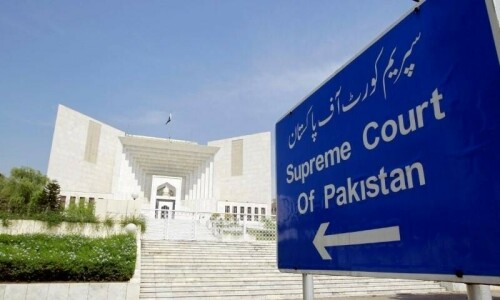
Nowhere in world, courts martial try terrorism cases: Justice Mandokhail


• Justice Mandokhail issues 36-page dissenting note against majority decision to uphold civilians’ military trial
• Regrets govt opted to burden military courts instead of improving judicial system
ISLAMABAD: Justice Jamal Khan Mandokhail of the Supreme Court’s constitutional bench on Friday issued a 36-page dissenting note challenging the majority verdict that upheld the trial of civilians in military courts and raising questions about the use of military courts for civilian cases.
“Nowhere in the world, courts martial try terrorism-related cases,” said Justice Mandokhail, a member of the seven-judge constitutional bench, in the dissenting note.
Justice Mandokhail and Justice Naeem Akhtar Afghan, in a minority judgement on May 7, set aside intra-court appeals against the Oct 23, 2023, five-judge judgement that had declared the military trials of civilians illegal.
While brushing aside the perception that civil courts had failed to tackle the menace of terrorism and courts martial were the only solution to the problem, Justice Mandokhail explained that courts martial did not have jurisdiction to deal with cases of terrorism or other criminal matters.
He regretted criticism of criminal courts was unfounded and was not supported by any reliable data. It was true that the conviction rate by the ordinary criminal courts was low, but it did not mean that the courts did not have the will to do proper justice, he added.
Justice Mandokhail also expressed regrets that the elected governments instead of addressing the politically motivated and frivolous cases, improving the system of investigation, establishing a mechanism of collecting truthful witnesses and protecting them, providing workable atmosphere, protection to the judges and improving the judicial system, expressed no confidence in criminal courts by opting to burden the courts martial with such a huge responsibility.
According to him, Pakistan Army Act relates to members of the armed forces to ensure proper discharge of their duties and maintenance of discipline, as provided by Article 8(3a) of the Constitution and, therefore, does not offer fundamental rights to persons under military discipline.
On the right to appeal against decisions of the court martial, Justice Mandokhail observed there was always a possibility of mistakes or errors in court rulings. He noted that an appeal to a higher, independent and impartial forum was a universally recognised tool to scrutinise the decision of fora below so as to eliminate the slightest instance of miscarriage of justice.
Appeal being a continuation of trial was, therefore, an important substantial ingredient of the fundamental principles of fair trial and due process, without which, the fundamental rights of individuals would be compromised.
Justice Mandokhail said the military officers presiding over the courts martial may be good at disposing military-related matters, but had no judicial expertise and experience to deal with criminal cases. Courts martial cannot be considered on a par with the judicial officers who are not only law graduates but also with the only function to deliver justice and having vast judicial experience at their credit, he emphasised.
The judicial officers were independent, impartial and without the influence, command and control of the executive, he noted.
He regretted that the federal and provincial governments, instead of attending to the causes of terrorism and taking preventive measures, were trying to achieve their goal through courts martial, which was “not a correct approach”.
Justice Mandokhail was of the opinion that expecting ordinary criminal courts to convict persons without evidence and material, connecting them with the offence, would amount to violating the principle of natural justice, fair trial and due process.
He noted that the Pakistan Army Act was a disciplinary statute related to members of the armed forces as provided by Article 8(3a) of the Constitution and therefore, did not offer fundamental rights to persons under military discipline.
However, on the effect of taking away fundamental rights in civilians’ trial, Justice Mandokhail observed that these rights were inalienable, unless expressly taken away by the Constitution. Taking away, abridging or denying the fundamental rights, had serious consequences, he observed, as it could undermine the fundamental principle of democracy, compromise the well-being of a citizen, and amount to giving a licence to the executive to abuse, torture, illegally detain and treat the citizens inhumanely.
Besides, the denial of fundamental rights would have a negative impact upon the economic treaties and domestic and foreign investments, Justice Mandokhail observed, adding that violating or denying the fundamental rights could weaken the rule of law.
Article 245 prescribed the functions of the armed forces, limited to defending the state from external aggression and internal threat, while Article 175(3) mandated that the judiciary shall be separated from the executive, he wrote.
As the function of the armed forces did not include the prosecution of general criminal offences committed by civilians, exercising powers beyond the defined scope was without jurisdiction, he noted.
According to him, indulging courts martial in adjudication of criminal cases of a general nature in respect of the general public would subject them to strong criticism in either case of conviction or acquittal, which will result in loss of trust and confidence in the army, whose function is only to defend and protect the country.
Published in Dawn, May 31st, 2025