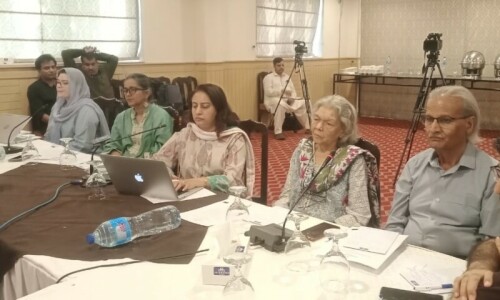
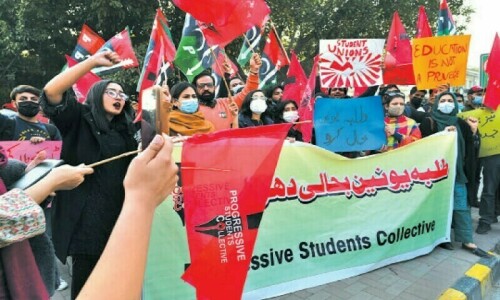
HRCP’s recent call for the repeal of the Peca (Amendment) Act of 2025 should serve as a stark warning for a government increasingly reliant on coercive legislation to stifle legitimate dissent.
As the HRCP report rightly underscores, Peca has morphed into a blunt instrument used to silence critics, muzzle the press and weaken fundamental freedoms guaranteed by the Constitution.
From political workers to TikTokers, and even a police officer critical of the presidency, the law’s application has grown alarmingly broad and punitive. What was initially framed as a measure against cybercrime now operates more as a tool of political retribution.
The criminalisation of vaguely defined terms such as ‘false information’ and the unchecked power vested in regulatory bodies dominated by the executive mark a steady and dangerous shift towards authoritarianism — a shift that is playing out before the world even as the government pretends otherwise.
The report paints a dire picture: offences that were once bailable and non-cognizable are now treated as serious crimes. The newly created National Cyber Crime Investigation Agency lacks transparency and safeguards; and the economic intimidation of journalists, such as freezing bank accounts, is the new normal.
Nowhere is this crackdown felt more acutely than in regions already under pressure, such as Balochistan, Gilgit-Baltistan and Azad Kashmir, where connectivity is hyper-regulated and journalistic work is fraught with risk.
The state’s argument for curbing disinformation cannot be used to justify the silencing of legitimate criticism. Democracies thrive on and are underpinned by accountability, and the strength of the latter depends on the freedom to speak truth to power. Peca, in its current form, does not protect the public; instead, it protects those in power from the scrutiny of the public.
What is particularly significant in the HRCP report is the call to establish a national coalition of civil society, journalists and political stakeholders. This is not merely a procedural suggestion but a democratic necessity.
The government should seize this opportunity to open dialogue and reform repressive laws before it slides further into autocracy. Ignoring this call would be a grave misstep. The repeal of Peca is not just a legal correction, but a moral and democratic obligation. Pakistan must choose whether it wants to be seen as a nation that safeguards speech or one that penalises it.
Published in Dawn, June 2nd, 2025