US begins uneasy FIFA World Cup countdown as Trump moves Marines to Los Angeles


US cities hosting next year’s FIFA World Cup faced questions on Wednesday about how to reassure international fans concerned by President Donald Trump’s immigration crackdown and travel ban as the year-to-go countdown began.
The United States, along with Canada and Mexico, is set to co-host the finals, which will feature 48 teams and a record 104 matches in a tournament that FIFA boss Gianni Infantino said would usher in a new generation of football fans.
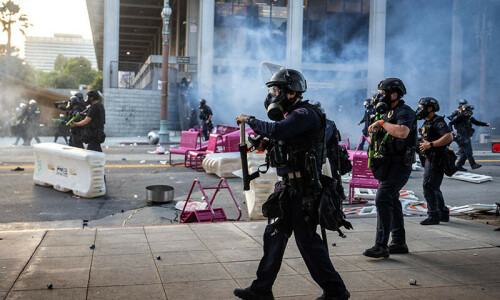
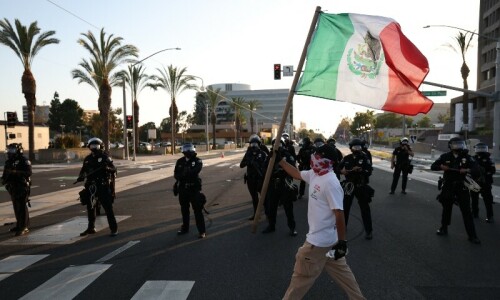
Celebrities and football stars were due to walk the red carpet at the Fox Studio Lot in Los Angeles — one of the host cities — for the year-to-go event there, a day after President Trump deployed Marines and the National Guard to quell protests.
California Governor Gavin Newsom described the deployment as an “unmistakable step toward authoritarianism”, while Trump officials defended it and branded the protests as lawless, blaming local and state Democrats for permitting upheaval.
Los Angeles is one of several host cities that will mark the year-to-go occasion, including New York-New Jersey, which will welcome fans at a waterside festival in Jersey City with the Statue of Liberty in view.
“If we look at [American] football as the US’s sport, soccer is the world’s sport and this is an opportunity for us to welcome people from all over the world,” Alex Lasry, the New York-New Jersey host Committee CEO, told Reuters.
Minky Worden, director of global initiatives at Human Rights Watch, said FIFA needed to work with the US government to ensure the rights of competitors, support staff, fans and media were protected regardless of their identities or views.
“FIFA should publicly acknowledge the threat US immigration and other anti-human rights policies pose to the tournament’s integrity … [and] should establish clear benchmarks and timelines for the US policy changes needed to ensure respect for immigrants’ rights during the 2026 World Cup and beyond,” she said.
US Democratic leaders raised concerns over a national crisis on Tuesday as Trump moved Marines into Los Angeles to tackle civilian protests over his immigration policies.
“There are certainly things that are happening at the national level, the international level, there are going to be geopolitical issues that we don’t even know right now that are going to affect the tournament,” Meg Kane, a host city executive for Philadelphia told reporters at a Paley Centre event on Monday. “So we recognise that we’re planning within uncertainty.”
FIFA did not immediately respond to a request for comment.
Infantino confident
FIFA President Infantino said last month after meeting Trump that he was confident the world would be welcomed in for the 2026 World Cup and this year’s Club World Cup, which runs from June 14 to July 13.
But the task of reassuring international fans was complicated by a travel ban that went into effect on Monday, cracking down on what Trump called “foreign terrorists”.
Of the 12 countries facing travel bans, Iran is the only one that has qualified for the 2026 tournament so far. Tehran said on Saturday that the ban showed “deep hostility” toward Iranians and Muslims.
European fans, supporter groups and former players contacted by Reuters said it was too early for anyone to be thinking about revising schedules or reevaluating plans for attending the World Cup.
Alina Hudak, the Miami host committee president and CEO, told Reuters she had been in touch with the local consular corps to address their concerns and to offer support.
“My responsibility is to make sure that we’re ready, that we’re safe, that we’re coordinating logistically with all of our law enforcement agencies, that we’ve done everything we can to ensure that our mass transit system is ready and can handle the volume,” said Hudak.
“And so for me, you know, what’s happening outside of that is something that we’re monitoring, but not something that, quite frankly, I have an impact [on].”