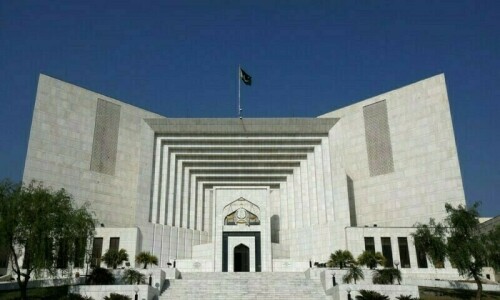
SC Constitutional Bench dismisses pleas against transfer of IHC judges


The Supreme Court’s Constitutional Bench on Thursday announced its verdict in a case pertaining to the seniority and transfer of Islamabad High Court (IHC) judges, declaring that their transfers were not unconstitutional.
The bench — headed by Justice Muhammad Ali Mazhar and comprising Justices Naeem Akhtar Afghan, Shahid Bilal Hassan, Salahuddin Panhwar and Shakeel Ahmed — took up petitions filed by five IHC judges, the Karachi Bar Association (KBA) and the IHC Bar Association, among others.
In February, Justice Sardar Mohammad Sarfraz Dogar from the Lahore High Court (LHC), Justice Khadim Hussain Soomro from the Sindh High Court (SHC) and Justice Muhammad Asif from the Balochistan High Court (BHC) were transferred to the IHC.
The controversy centres around the alteration of the judges’ seniority list after these transfers as Justice Dogar was made the senior puisne judge, which paved the way for his appointment as the acting IHC chief justice after Justice Aamer Farooq’s elevation to the SC.
Today’s judgement was announced in a 3-2 majority ruling, with Justices Afghan and Ahmed dissenting.
In the short order, a copy of which is available with Dawn.com, the SC noted that “the transfer of a judge by the president of Pakistan by means of Article 200 of the Constitution (permanently or temporarily) cannot be construed as a fresh appointment.”
The order explained that exercise of powers of transfer by the president under Article 200 of the Constitution was not unregulated or unfettered.
Rather, it was structured on a “four tier formula which expounds that no judge shall be transferred except with his consent and after consultation by the president with the chief justice of Pakistan and the chief justices of both high courts”.
The short order emphasised that before exercising the power of transfer, certain inbuilt procedures and mechanisms had to be followed and the decision was “within the sphere and realm of judiciary and not within the domain of executives”.
The short order added: “Thus, for all intents and purposes, the transfer of judges by the president of Pakistan (…) is within the framework of the Constitution and cannot be declared ultra vires.”
The judges further noted that the terms and conditions of transfer, including seniority, should have been taken up and mentioned by the president at the time of issuing the notification of transfer in terms of Article 200 of the Constitution.
The judges also said that they partially remanded the matter to the president, “without upsetting the notification of transfer to determine the seniority after examining/vetting the service record of the transferee judges as soon as possible, including the question of whether the transfer is on a permanent or temporary basis”.
The order concluded that the seniority and transfer of judges was determined by the president by means of a notification/order and that Justice Dogar would continue in his role as acting chief justice of the IHC till the seniority and nature of posting — permanent or temporary — of the transferred judges were determined by the president by means of notification/order.
Dissenting order
In the dissenting order, authored by Justice Naeem Akhter Afghan, he said that the judges accepted the constitutional petitions.
The order declared the impugned notification regarding the transfer of concerned judges as “null, void and of no legal effect”.
Justice Afghan said, “The permanent transfer of three Judges to IHC has been made by the president in wrong exercise of discretion under Clause (1) of Article 200 of the Constitution.”
He added: “It has offended Article 175A of the Constitution and has made the same redundant.”
The order also stated that the permanent transfer process of three Judges to the IHC was under the “concealment of relevant and material facts from the transferee Judges”, adding that it was also “lacking meaningful, purposive and consensus-oriented consultation” with the chief Justices of the apex and high courts.
It further said that “the process for permanent transfer of three Judges to IHC has been completed in an unnecessary haste.”
According to the judges, the proportionate representation of provinces in IHC could have been achieved by “making fresh appointments of judges from the provinces by the Judicial Commission of Pakistan under Article 175A of the Constitution”.
The dissenting note added: “It [notification] is violative of Article 2A, Article 4 and Article 25 of the Constitution and it has undermined the independence of judiciary, due process and principle of equality.”