Pakistan, Bangladesh, China pledge deeper cooperation
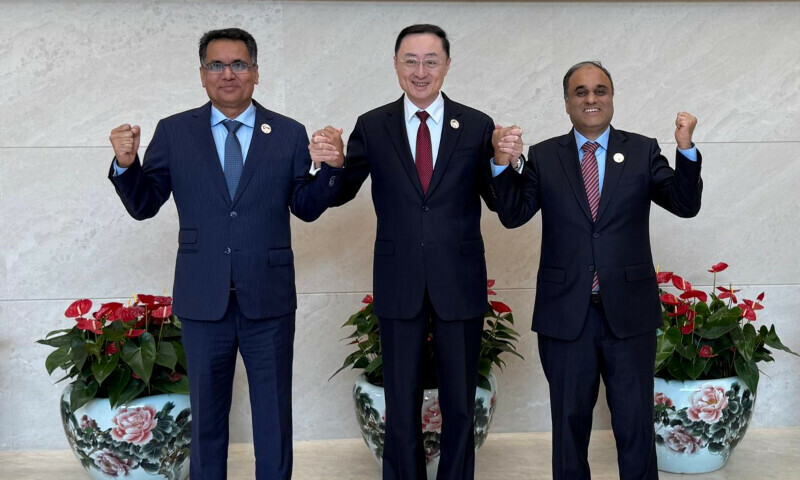

ISLAMABAD: Pakistan, China and Bangladesh have launched a trilateral cooperation mechanism, pledging to pursue “win-win cooperation” in what could mark a subtle yet significant shift in South Asia’s strategic landscape.
The announcement came after the inaugural meeting of the Bangladesh-China-Pakistan Vice Foreign Minister/Foreign Secretary mechanism on Friday.
A statement issued by the Foreign Office said the meeting was attended by Chinese Vice Foreign Minister Sun Weidong, Bangladesh’s acting Foreign Secretary Ruhul Alam Siddique and Pakistan’s Additional Foreign Secretary Imran Ahmed Siddiqui.
Foreign Secretary Amna Baloch joined the initial session via video link.
New trilateral forum looks to enhance engagement, work for more trade, investment
In her remarks, Ms Baloch expressed Pakistan’s desire for a deeper engagement between China and South Asian countries.
She highlighted the “upward trajectory of bilateral ties” with both China and Bangladesh and “conveyed Pakistan’s readiness to work with the two nations to enhance ties in trade and investment, agriculture, digital economy, environment protection, marine sciences, green infrastructure, culture, education and people-to-people exchanges.
The three nations agreed to establish a joint working group to oversee the implementation of the agreements reached during the talks.
The launch of this trilateral platform marks a notable development in the South Asian geopolitical landscape, particularly as it brought together Pakistan and Bangladesh, which had remained diplomatically distant for decades.
The relations between Islamabad and Dhaka have warmed considerably since the ouster of former Bangladeshi prime minister Sheikh Hasina last year.
Under the interim leadership of Chief Adviser Muhammad Yunus, Dhaka has actively pursued broader diplomatic horizons, including a new phase of engagement with both China and Pakistan.
China, for its part, has sought to deepen its influence in South Asia through economic diplomacy and regional connectivity initiatives.
Mr Yunus’s state visit to Beijing in March and Bangladesh’s invitation to China to invest in sensitive infrastructure projects such as the Teesta River and Mongla Port suggest a policy shift away from Ms Hasina’s India-leaning approach.
Meanwhile, Pakistan and Bangladesh have resumed direct trade, military exchanges, and high-level diplomatic dialogue after more than a decade of minimal contact.
For Beijing, the growing trilateral ties advance its long-term regional objectives that relate to building alternate economic corridors, expanding its presence in the Bay of Bengal, and diminishing India’s strategic space in the neighbourhood.
For India, the formation of a China-Pakistan-Bangladesh alignment could pose significant diplomatic and security concerns, particularly as some of the proposed Chinese-supported infrastructure projects lie close to India’s sensitive northeastern corridor.
While the trilateral mechanism remains in its formative stages, the institutionalisation of these ties signals a deliberate attempt by the three countries to explore long-term cooperation beyond bilateral engagements.
The grouping could evolve into a new regional bloc with implications for South Asian geopolitics, especially if the partnership expands to include broader connectivity, defence dialogues, and coordinated positions at international forums.
No specific timeline was announced for the next round of meetings, but the establishment of a joint working group is expected to accelerate follow-up discussions and cooperation across multiple sectors.
Published in Dawn, June 21st, 2025