FOR twelve relentless days, Israel and Iran clashed in a war that shattered long-standing assumptions about the balance of power in the Middle East.
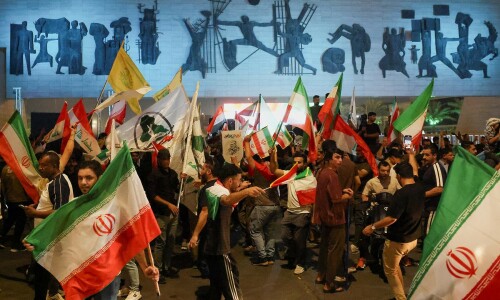
While neither side achieved a knockout blow, Iran has emerged with its leadership intact and its regional prestige enhanced.
Unsurprisingly, Tehran’s strategists are reportedly plotting the resumption of nuclear enrichment. How exactly they will evade fresh sanctions, or even avoid another episode of aggression, remains unclear. But the resolve is unmistakable.
Iranian Foreign Minister Abbas Araqchi hinted at a shift in Tehran’s approach, telling Qatar’s Al-Araby Al-Jadeed that Iran’s posture on its nuclear programme and the global non-proliferation framework “will witness changes.”
Despite loss of senior generals and top nuclear scientists on day one, Iran’s command structure has largely survived, and the regime that Israel and the West wanted out remains in place
In tandem, Iran’s parliament moved aggressively by passing a bill on Wednesday to suspend cooperation with the IAEA and sending it to the Guardian Council for final approval.
From Iran’s perspective, the outcome is a “lasting symbol of pride, strength and self-belief,” says Iranian envoy to Pakistan Amb Reza Amiri Moghadam.
Lt Gen (retd) Masood Aslam, a former corps commander in the Pakistan Army, agrees that this “was [the] best possible end Iran could have achieved”.
Israel, backed by US intelligence and followed by American bunker-buster raids on Natanz, Fordow and Isfahan, aimed to destroy the nuclear infrastructure and decapitate Iran’s scientific-military elite and topple the regime.
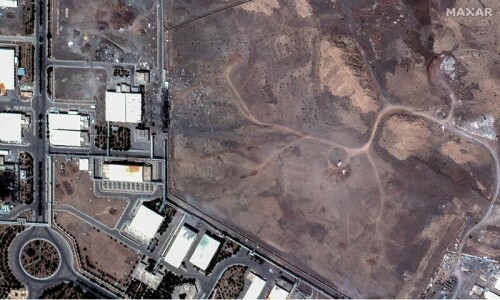
How successful was Tel Aviv? Satellite imagery indicates that the strikes would cause at the most only months-long delays to enrichment, not the permanent halt that Israeli PM Netanyahu and President Trump had promised, or were hoping for.
And despite the loss of senior generals and top nuclear scientists on day one, Iran’s command structure has largely survived, and the regime that Israel and the West wanted out remains in place.
Iran didn’t just absorb the shock; its ballistic and hypersonic missile brigades retaliated in over forty waves.
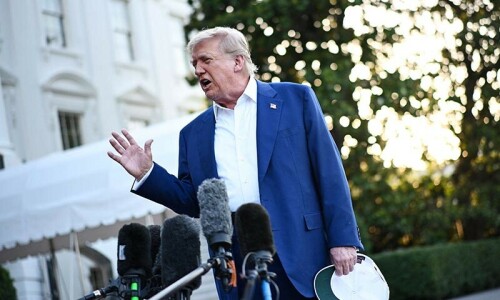
Trump, speaking at margins of the Nato summit in The Hague, admitted, “Israel was hit really hard… those ballistic missiles took out a lot of buildings.”
In a separate estimation by former Haaretz editor Avi Scharf, “the US launched a year’s worth of interceptors in twelve days,” and Israel’s own aerial defence inventories were “approaching their limit”.
While the aggravating situation in Israel and the strike on the Al-Udeid military base in Qatar formed the backdrop of Trump’s announcement of a unilateral cease-fire, he was also facing mounting domestic pressure over starting a fresh war without Congressional approval.
Israel, with no choice, followed suit. Meanwhile, Iran, having earlier said that it was retaliating solely in self-defence, simply stood down.
The road ahead
Though the ceasefire is holding, this peace is fragile. The Iranian parliament has already taken a step towards revival of Iran’s “peaceful” enrichment program, suspended IAEA inspections, and whispered about speeding up secrecy-shrouded enrichment. Talk of exiting the Non-Proliferation Treaty (NPT) is also getting louder.
Contradictions are also emerging in the global nuclear watchdog’s reading of the situation.
On one hand, IAEA found no off-site radiation spike, but its chief’s testimony said that “very significant damage” likely occurred and is insisting on inspections. This also casts doubt on any purely benign outlook. Tehran’s next step could spark a regional arms race as Saudi Arabia and Turkey too could scramble for their own deterrents, especially because they would no more be fully trusting US.
Israel, wary of prospects of a reintegrated but nuclear-shy Iran, may resume covert operations, or even resort to strikes to block enrichment.
Iranian strategists, buoyed by their perceived success, could also intensify missile tests and rehabilitate groups like Hezbollah and the Houthis, whose capabilities had been downgraded because of Israeli and US kinetic actions.
All the while, Washington’s roller-coaster of rhetoric, strikes and sudden withdrawals has undercut its credibility as mediator, making uncoordinated, unilateral moves by regional players all too likely.
Lessons for South Asia
Though the battlefield here was the Middle East, the war’s lessons have rippled to South Asia. In New Delhi and Islamabad, planners must be studying the campaign’s multi-domain playbook — air strikes, cyber operations, precision missiles and strategic ambiguity — building on their clash from earlier this year, which followed a similar template, albeit at a lower scale.
India, which sided with Israel politically, would be dissecting deep-strike tactics; whereas Pakistan, which was instinctively supportive of Iran, is admiring its resilience.
“What worked for Iran was the capacity to absorb shock and persevere,” Gen Aslam noted.
But mirroring Israel’s methods against a peer like Pakistan would be fraught with risks for India.
For its part, Pakistan must bolster its air defences, modernise its air force and navy for the next round of confrontation, which may not be too far away.
Christopher Clary, non-resident Fellow at the Stimson Center, believes “Pakistan’s air force and air defences are better than Iran (especially the air force) and India’s air forces and missile defences are weaker than Israel’s, but India may strive for the ability to reach deep into Pakistan and strike at air bases, missile storage sites, and missile staging areas.”
Gen Aslam also argues that India does not enjoy the same US backing as Israel gets.
Published in Dawn, June 26th, 2025