SCO moot in China unable to adopt joint statement; Pakistan reaffirms commitment to fight terrorism
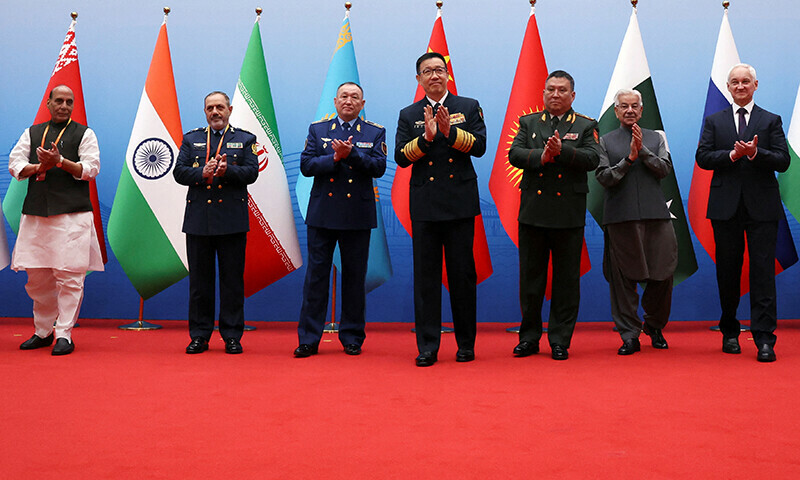

Defence ministers attending the Shanghai Cooperation Organisation (SCO) meeting on Thursday failed to reach a consensus on a joint statement due to India’s refusal, while Pakistan’s Defence Minister Khawaja Asif reaffirmed the country’s commitment to combating terrorism and promoting regional peace and security within the SCO framework.
The SCO is a 10-nation Eurasian security and political grouping whose members include China, Russia, Pakistan, India, and Iran. Their defence ministers’ meeting was held as a precursor to the annual summit of its leaders set for the autumn.
Addressing the session, Asif condemned Israel’s recent 12-day war against Iran and stressed the importance of collective efforts to address evolving global and regional security challenges, state broadcaster PTV News reported.
“Terrorism is a common threat. Pakistan calls on all states to desist from politicising the joint effort of the International Community to fight the means of terrorism to deflect attention from their internal failures,” the defence minister stated.
Noting that Pakistan denounced terrorism in all of its forms, Asif, according to PTV, said that the country condemned the April terrorist attack in occupied Kashmir’s Pahalgam, which left 26 people dead.
“We call upon all states to hold these states and their state actions to account who planned, financed and sponsored the terrorist attack as Jaffar Express in Balochistan,” Asif added, not naming the country that aided the attack.
“We have in our custody … a serving Naval Commander Kulbhushan Jadhav [who] confessed to financing, planning and perpetrating multiple terrorist attacks in Pakistan.”
The defence minister highlighted Pakistan’s continuing role in counter-terrorism, using ongoing operations against the Tehreek-i-Taliban Pakistan, the Balochistan Liberation Army and the Islamic State as an example.
The minister “welcomed SCO’s efforts against the ‘three evils’ — terrorism, separatism, and extremism — and emphasised the need to strengthen cooperation in cyber security, anti-narcotics, and counter-extremist ideologies”, PTV’s report read.
During his address, Asif also called for a ceasefire in Gaza and emphasised the need for a stable Afghanistan “for regional connectivity and long-term stability”.
However, a joint communique could not be signed by all members due to what the Indian foreign ministry deemed “a lack of consensus on referring to ‘terrorism’”.
“Certain members, member countries, could not reach [a] consensus on certain issues and hence the document could not be finalised on our side,” Indian foreign ministry spokesperson Randhir Jaiswal told reporters at a weekly media briefing, according to The Times of India.
“India wanted concerns on terrorism reflected in the document, which was not acceptable to one particular country, and therefore, the statement was not adopted,” he said, without naming the country.
According to The Times of India, New Delhi refused to sign the document after it omitted a reference to the Pahalgam attack.
A Pakistani official at the moot, who requested anonymity, told Dawn.com that, “India faced diplomatic isolation at the Shanghai Cooperation Organisation meeting, where Pakistan achieved significant success.
“India failed to link the Pahalgam incident to Pakistan in the joint communique, declined to sign the communique to cover its embarrassment, received no support from any member state on the Pahalgam issue and also stood alone in its differing stance on Israeli aggression against Iran,” he stated.
Meanwhile, Reuters reported that the foreign ministries of China and Pakistan did not immediately respond to a request for comment on India’s statement.
Earlier on Thursday, when asked about the joint statement, a Chinese defence ministry spokesperson said the meeting had “achieved successful results”, without elaborating.
The escalation between the nuclear-armed neighbours began following the April 22 attack in Pahalgam, which killed 26 people. India, without investigation or evidence, implied “cross-border linkages” of the attackers. Pakistan firmly rejected the claim and called for a neutral probe.
Following the allegations, India launched a series of missile strikes on Pakistan, resulting in civilian casualties. According to the Inter-Services Public Relations, 24 impacts were recorded across six locations, leaving 33 Pakistani civilians dead and 76 injured. In response, Pakistan’s military shot down five Indian jets and destroyed brigade headquarters and multiple checkposts along the Line of Control.
On the morning of May 10, India targeted several Pakistani airbases, prompting a swift military response from Pakistan under the retaliatory campaign codenamed Operation Bunyan-um-Marsoos. It took US intervention for the two countries to declare a ceasefire the same day.
Thursday’s summit was the first time that senior ministers from India and Pakistan had shared a stage since the clash.