Pakistan a ‘net region stabiliser’ following Indian aggression: army chief



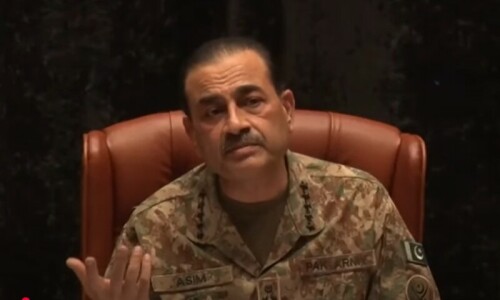
Chief of Army Staff (COAS) Field Marshal Asim Munir on Saturday stated that Pakistan proved itself as a “net region stabiliser” after having repelled Indian military aggression twice and demonstrating its commitment to regional security.
The remarks followed recent tensions between India and Pakistan over New Delhi’s allegations against Islamabad, without evidence, about a deadly attack in occupied Kashmir’s Pahalgam.
Pakistan had strongly denied the allegations and called for a neutral probe. As the situation turned into a military confrontation between the nuclear powers, it took American intervention for both sides to agree to a ceasefire.
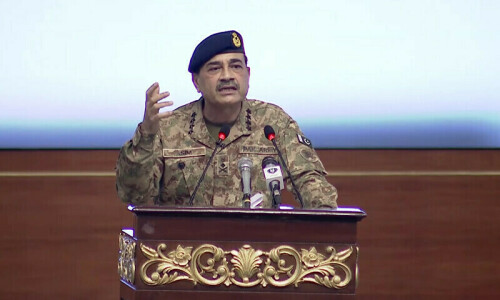
Speaking at the Pakistan Naval Academy in Karachi, COAS Munir said that Pakistan will protect its sovereignty and national interests decisively and without hesitation, state media PTV reported.
The report quoted the army chief as saying, “In recent years, India has twice undertaken acts of unprovoked aggression against Pakistan, which were met with our resolute response.”
“Despite grave provocations, Pakistan acted with restraint and maturity, and demonstrated its commitment to regional peace and stability, leading to its role as a net regional stabiliser,” he added.
He further said that India was “deliberately creating tension in the region” when Pakistan was close to eliminating terrorism, PTV said on X.
COAS Munir also highlighted the Kashmir issue, saying, “At such a time, we must remember the sacrifices of our Kashmiri brothers who are struggling against India’s illegal occupation.”
“Pakistan is a strong advocate for a just resolution of the Kashmir issue in accordance with United Nations resolutions and the aspirations of the Kashmiri people,” he added.
He called for a “just and peaceful resolution” to the Kashmir issue for lasting peace in the region.
Separately, Field Marshal Munir visited the Corps Headquarters in Peshawar, where he was briefed on the prevailing security situation and ongoing counter-terrorism operations, according to a statement by the Inter-Services Public Relations (ISPR).
The statement said, “During the visit, the field marshal also attended the funeral of martyrs of the incident at Bannu Garrison and visited the injured at Bannu Combined Military Hospital.”
“COAS (Munir) paid rich tribute to the unwavering courage and resilience of Pakistan’s security forces, who continue to confront and neutralise the Indian-sponsored Fitna-al-Khawarij with exemplary valour.”
The ISPR further said that the army chief vowed to bring “all facilitators, abettors, and perpetrators of terrorism” to justice, assuring “swift and decisive retribution” against those who undermine the country’s stability.
“The field marshal also emphasised the critical need for institutional capacity enhancement of civilian law enforcement agencies, particularly the Khyber Pakhtunkhwa Police,” the statement said.
“He urged relevant government stakeholders to prioritise these efforts, while reaffirming the Army’s continued support in building and augmenting the capabilities of law enforcement institutions.”
In July last year, the government designated the banned Tehreek-i-Taliban Pakistan (TTP) as Fitna-al-Khawarij, while mandating all institutions to use the term khariji (outcast) when referring to the perpetrators of terrorist attacks on Pakistan.
Earlier today, at least 13 security personnel were martyred in a suicide bombing in KP’s North Waziristan district, carried out by Indian proxy terrorists.
The military has said India was using its “assets” to intensify terrorist attacks in Pakistan, with ISPR Director General Lt Gen Ahmed Sharif Chaudhry detailing “irrefutable evidence” of an Indian military personnel’s involvement.