Fazl terms Fata’s merger with KP a ‘mistake’
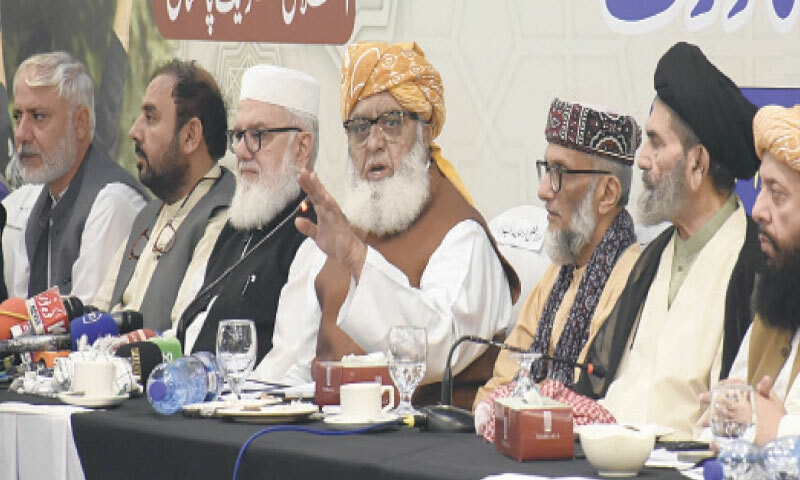

• JUI-F chief says reversal requires two-thirds majority in parliament; claims writ of state doesn’t exist in Balochistan, KP
• Questions ‘free movement’ of terrorists across Pakistan-Afghanistan border
• MYC moot opposes two-state solution to Palestine issue, Abraham Accords
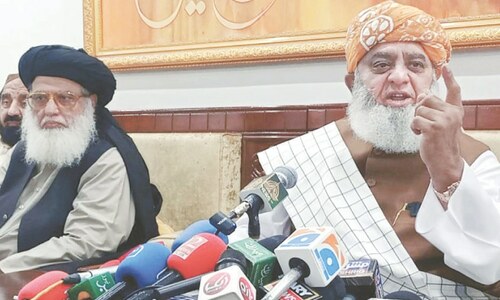
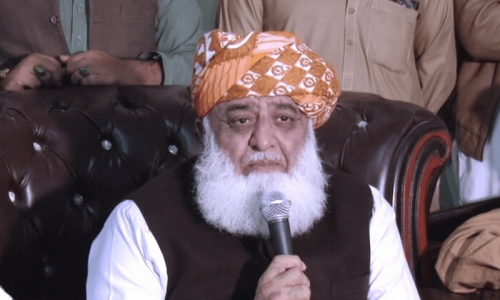
ISLAMABAD: Calling the merger of erstwhile Fata into Khyber Pakhtunkhwa a “mistake”, JUI-F chief Maulana Fazlur Rehman on Wednesday expressed his tacit support for its rollback, which is reportedly being discussed in power corridors.
Speaking at a meeting of the Milli Yakjehti Council, the JUI-F leader said he opposed the marger, alleging that the move was an attempt to bring about geographic changes in the region and implement an ‘American agenda’.
The event was chaired by Allama Sajid Ali Naqvi. While Maulana Fazl was invited as the chief guest; his party is not a member of the MYC.
“We had opposed the Fata merger at the time, and our stance was clear that it was a mistake,” the JUI-F chief said. “Now, even the provincial government admits that the decision to merge was not correct and they are talking about forming a commission in this regard,” he claimed.
He added that the situation is that the tribal people were dying in their homes due to militancy, and there were talks of reversing the merger. “But if you now want to reverse it or create a new province, you will need a two-thirds majority in both provincial and national assemblies as well as the Senate,” Maulana Fazl said.
While condemning the armed struggle against the state, the JUI-F chief said that ‘elimination of terrorism’ was far from reality, as the government’s writ did not exist in the restive provinces of Balochistan and Khyber Pakhtunkhwa.
“This lawlessness, is it due to the incompetence of state institutions, or is it being done deliberately,” the Maulana asked. He said operations against terrorism took place from Swat to Waziristan, but those who were displaced due to these anti-terror operations were still homeless.
He questioned how the terrorists were able to move freely between Afghanistan and Pakistan, saying that the state must not shift the burden of its failures onto others.
Stressing that the Federal Shariat Court had set Dec 31, 2027, as the final deadline for the abolition of the interest-based (Riba) economy, he urged religious parties to keep an eye on this deadline.
Palestine, Abraham Accords
The meeting rejected the two-state solution to the Palestine issue and the Abraham Accords, demanding that the government of Pakistan must clearly state its position on both matters. It is important to note that Pakistan does not recognise Israel but has always advocated for the two-state solution.
The resolution of the conference demanded immediate humanitarian assistance for Gaza. It officially opposed the normalisation deals made between some Muslim nations and Israel, calling them a betrayal of Palestinians. The meeting also warned the government against joining the Abraham Accords — being brokered by the West. The gathering strongly condemned the atrocities committed by Israel and India in Palestine and Kashmir and expressed full solidarity with the oppressed peoples.
The meeting also declared the so-called “honour killings” as un-Islamic, while referring to the recent killings in Balochistan.
The conference called for enhanced defence, scientific, economic, and diplomatic cooperation between Turkiye, Iran, Pakistan, Afghanistan and Bangladesh to collectively face the challenges confronting the Muslim world.
Maulana Fazl raised concerns over a recent Islamabad High Court verdict related to blasphemy laws, stressing that the Council of Islamic Ideology (CII) rulings must be protected constitutionally.
It was referring to the IHC’s decision related to the alleged blasphemy cases. The MYC formed an action committee, comprising representatives of all religious parties, to look into the matter.
Published in Dawn, July 24th, 2025