• Details remain sketchy despite Trump announcement; no word on tariff rate as Aurangzeb meets key officials
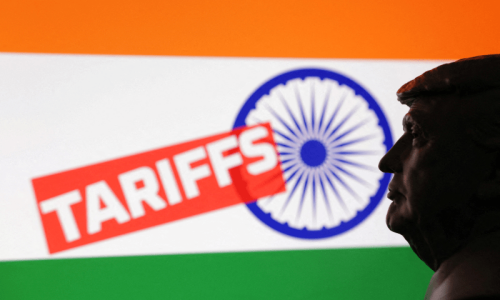
• India slapped with 25pc tariff, punished for buying Russian arms, oil through ‘secondary tariffs’
• Six Indian companies face State Dept sanctions for being part of Iran oil, petrochemical trade
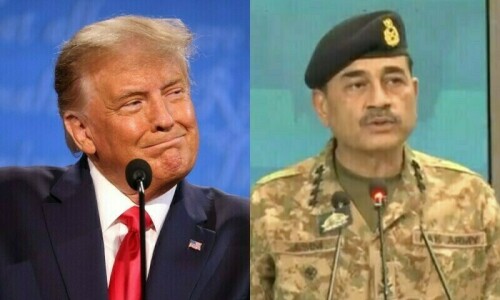
WASHINGTON: President Donald Trump announced on Wednesday that the US has concluded a deal with Pakistan that will allow the two allies to work together on developing Pakistan’s vast oil reserves.
The announcement, posted on his Truth Social account, did not specify whether the two countries have also reached an agreement on tariffs.
“We have just concluded a Deal with the Country of Pakistan, whereby Pakistan and the United States will work together on developing their massive Oil Reserves,” Trump wrote.
“We are in the process of choosing the Oil Company that will lead this Partnership. Who knows, maybe they’ll be selling Oil to India some day!”
Although Pakistan has long claimed to have large oil deposits along its coast, this marks the first high-level move towards tapping them.
The reference to India was also particularly poignant, as the US president earlier slapped the country with a 25 per cent tariff on imports, mainly as a punishment for acquiring oil and military equipment from Russia.
“Likewise, other Countries are making offers for a Tariff reduction. All of this will help reduce our Trade Deficit in a very major way,” he wrote, adding: “A full report will be released at the appropriate time.”
In a separate part of his post, Trump mentioned South Korea to illustrate the ongoing tariff discussions, in a way that could also be seen as inviting further offers from countries like Pakistan.
“South Korea is right now at a 25% Tariff, but they have an offer to buy down those Tariffs. I will be interested in hearing what that offer is.”
Pakistani officials have previously offered to reduce the country’s $3 billion trade deficit with the United States by increasing imports of US goods, including oil, rather than accepting higher tariffs.
Aurangzeb holds talks
Finance Minister Mohammad Aurangzeb, who is currently in Washington for what officials describe as final-stage negotiations on a tariff deal, also began meetings with senior US officials on Wednesday.
The Pakistani delegation is keeping the details of the talks under wraps, but one official said, “We hope to sign a deal before the (Aug 1) deadline expires.”
“We hope to conclude a mutually beneficial trade agreement… hopefully in days, not in weeks,” said Foreign Minister Ishaq Dar during a recent event at the Atlantic Council in Washington.
Mr Dar, who was recently in New York to address the United Nations, said a committee had been formed to finalise the terms of the proposed deal.
“As long as we are better than or equal to our peers, we should be fine,” Mr Dar said.
While the exact tariff rate being negotiated for Pakistan has not been publicly disclosed, Pakistani officials have said they’re seeking terms on a par with other recent US trade agreements — particularly those with Japan, Indonesia, the Philippines, and Vietnam, where tariffs are reportedly set between 15pc and 20pc.
Trump ‘punishes’ India
In addition to the 25pc tariffs, Trump also slapped an unspecified additional penalty on India for acquiring military equipment and oil from Russia, starting Aug 1.
However, he later said the US was currently negotiating a deal with India. “They have one of the highest tariffs in the world now, they’re willing to cut it very substantially. But we’ll see what happens,” Mr Trump told reporters.
In a strongly worded post on the social media platform Truth Social, Mr Trump accused India of imposing excessively high tariffs and maintaining some of the world’s most “strenuous and obnoxious non-monetary trade barriers”. He also criticised New Delhi’s continued reliance on Russian arms and energy purchases.
“India will therefore be paying a tariff of 25pc, plus a penalty for the above, starting on August 1,” Mr Trump wrote. “While India is our friend, we have done relatively little business with them because of their trade practices.”
The US president made it clear that no further extensions would be given to countries that failed to reach a deal by the end-of-week deadline.
The imposition of a penalty tariff on India for its purchases of Russian oil, if enacted, would be the first use of what Mr Trump has taken to calling “secondary tariffs”, a kind of penalty that would be imposed instead of the financial sanctions typically used against countries that do business with embargoed nations, according to The New York Times.
In response, the Indian government said in a statement that it was studying the implications of Mr Trump’s announcements and remained dedicated to securing a fair trade deal with the US.
“India and the US have been engaged in negotiations on concluding a fair, balanced and mutually beneficial bilateral trade agreement over the last few months. We remain committed to that objective,” it said, according to Reuters.
The news pushed the Indian rupee down 0.4pc to around 87.80 against the US dollar in the non-deliverable forwards market, from its close at 87.42 during market hours. Gift Nifty futures were trading at 24,692 points, down 0.6pc.
Sanctions on six Indian firms
Separately, the State Department announced sanctions against six Indian firms for “engaging in Iranian petroleum, petroleum products, or petrochemical trade”.
The sanctioned entities include:
Kanchan Polymers, which “imported and purchased over $1.3M worth of Iranian-origin petrochemical products”.
Alchemical Solutions, which imported and purchased Iranian-origin petrochemical products valued at over $84m.
Ramniklal, a petrochemical company that imported and purchased Iranian-origin products valued at over $22m.
Jupiter Dye Chem, which imported and purchased Iranian-origin petrochemical products valued at over $49m.
Global Industrial, which imported and purchased products, including methanol, valued at over $51m.
Persistent Petrochem Private Limited, which imported approximately $14m worth of shipments.
In addition, it also placed sanctions on a number of China and UAE-based companies and several oil tankers.
Published in Dawn, July 31st, 2025