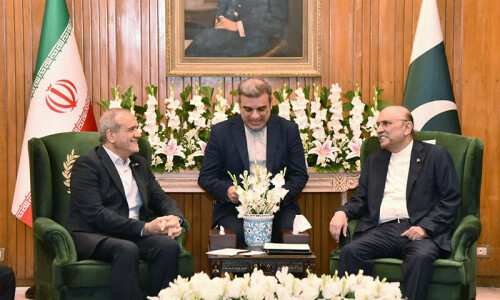
THE focus of Iranian President Masoud Pezeshkian’s visit to Pakistan, which wrapped up on Sunday, was trade and security, and the challenge before Tehran and Islamabad remains translating the many deals and MoUs signed during the talks into concrete agreements.
This is mainly so because of the poor relations between the US and Iran, particularly the former’s sanctions that threaten any state wishing to expand ties with Tehran. The visit is significant as it comes after the June Iran-Israel war, in which the US also participated, and at a time when geopolitical alliances are shifting rapidly.
Dr Pezeshkian and his delegation met the top civilian and military leaders of the country. Among the matters discussed was the bloodbath in Gaza; the Iranian leader also appreciated Pakistan’s support during the Israeli aggression.
Dr Pezeshkian expressed his desire to raise bilateral trade to $10bn, while the need to jointly combat terrorism, especially along the border in Balochistan, was also discussed. The Iranians further sought to join Pakistan and China in expanding regional trade as part of the Silk Road initiative. At least 12 MoUs and deals were signed covering various sectors. Of course, the elephant in the room is US sanctions; unless both sides address this irritant, it will be difficult to achieve the economic goals both Pakistan and Iran desire.
Perhaps the biggest casualty of foreign sanctions has been the Iran-Pakistan gas pipeline; Tehran has completed the project at its end, while Pakistan is wary of finalising the scheme lest it attract Washington’s wrath.
Prime Minister Shehbaz Sharif promised an “early resolution” to the pipeline issue when he was in Iran in May, but the issue did not come up during the Iranian leader’s visit, at least not publicly. It appears that Pakistan is willing to import petroleum from the US in order to satisfy the Trump administration, and is not willing to import Iranian gas for fear of annoying the US. Unless the pipeline imbroglio is settled amicably, without fear of foreign pressure, Pakistan may have to fight an ugly arbitration battle, which will harm ties with Iran.
Along with trade, militant groups reportedly active on both sides of the border must be neutralised so that they are unable to damage ties. In 2024, due to the malign activities of armed non-state actors, both capitals traded missile fire; thankfully, the issue was resolved before things could escalate.
But it serves as a reminder of how militant groups can create highly volatile situations. Pakistan indeed must walk a tightrope between Washington and Tehran. But while we must maintain good ties with the US, it is essential to have cordial relations with a neighbour with whom we share a long border, and a long history.
Published in Dawn, August 5th, 2025