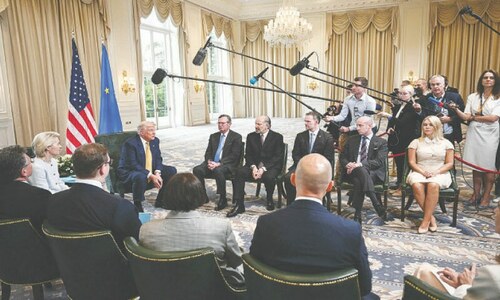
How long Europeans can benefit from US security?


THE phrase “the West can rule the world by the British mind with American muscle” reflects a historical perspective on the collaboration between the expertise of the United Kingdom in diplomacy, intelligence, governance and strategic thinking and the military, economic and technological power of the United States.
“Rule the world” suggests the global hegemony, in which Anglo-American “special relationship” has shaped global institutions, such as the World Bank, the International Monetary Fund and Nato, and promoted liberal norms and upheld a rules-based international order.
Although metaphorical and unofficial, this phrase has outgrown its UK origins to embody a wider European worldview that crystallised during and after the Cold War.
The West’s victory in the Cold War with the collapse of the Soviet Union not only affirmed liberal democracy and capitalism as the dominant political and economic models — famously framed as the “end of history”, but also deeply entrenched within the broader European mindset the belief that the transatlantic alliance between Europe and the US is the cornerstone of Western global supremacy.
This phrase remains the key to understanding the unique convergence of intellect and might that influenced the Allied victory in World War II, the establishment of the postwar world order and the globalisation of Western universalism after the Cold War. Within European political circles, this convergence has led to a deep conviction that the Europe-US alliance is not merely historically successful but geopolitically essential.
Enduring legacy of ‘America First’ is visible in Washington’s strategic posture: evaluating alliances through cost-benefit lenses, resisting open-ended security commitments and replacing moral leadership with pragmatic bargaining
Over time, this conviction has hardened into what could be termed a doctrine of “transatlantic indispensability”. This belief rests on three pillars: First, European security remains fundamentally tied to US military guarantees; second, the stability of the global rules-based order depends on US leadership and muscle, supported by Europe’s strategic insight and normative legitimacy; and third, transatlantic cooperation is not merely beneficial but structurally irreplaceable.
Based on this geopolitical asymmetry, it is not hard to understand why Europe, despite its economic size and global ambitions, often responds differently in negotiations with the US and with China. Even when President Donald Trump imposed tariffs on European steel and aluminum, threatened European auto exports, and publicly questioned Nato, alongside pushing through a bilateral asymmetric and unbalanced deal, Europe’s core institutions and major powers did not retaliate with full force.
Instead, they chose strategic restraint with only verbal complaints, seeking to preserve the long-standing alliance and avoiding escalation. Europe’s acceptance of unfavorable terms indicates not just economic weakness, but strategic realism.
The US remains the exceptional enforcer of the liberal order and Western hegemony, a role cemented during World War II and the Cold War. This historical legacy continues to shape Europe’s strategic consciousness and dictate its policy choices.
A good example is the defence agreement approved by Denmark in June 2025, which grants the US’ unrestricted access to Danish air bases and stipulates that US military personnel will remain under US legal authority. This means they are, in many cases, exempt from Danish legal jurisdiction — especially regarding actions taken by US troops on Danish territory.
The agreement has sparked debate over possible conflicts with Denmark’s constitutional framework and concerns about the country’s capacity to hold US soldiers accountable for unlawful conduct committed within its borders.
In contrast, Europe has taken a much harder stance in trade negotiations with China, increasingly labeling it a “systemic rival”. The EU has imposed trade barriers, launched anti-subsidy investigations, and pushed for so-called reciprocity in market access and technology transfer. The rise of China is seen as not only challenging the global geopolitical status quo, but also undermining the fundamental assumptions that underpin the notion of transatlantic indispensability.
While Europe may view the transatlantic alliance as essential and rooted in shared interests, the Trump administration, together with a growing segment of US strategic thinking, sees it quite differently. This divergence in worldview poses a real challenge to the continued relevance of the phrase. For some in Washington during the Trump era, Europe is viewed not as a strategic partner but as a burden.

It is regarded as a group of wealthy nations benefiting from US security and market access without offering fair contributions in return.
What is rooted in Trump’s “Make America Great Again” agenda is a departure from the post-World War II transatlantic consensus, in which US leadership was seen as a long-term investment in global stability and Western dominance. Instead, Trump’s foreign policy leans toward transactionalism, strategic retrenchment and even admiration for “spheres of influence” defined by great powers, echoing a 19th-century style balance-of-power realism.
Europe’s continued strategic deference is to a US that is no longer the stabilising, multilateral, or predictable power it once was. Under the Trump administration, “Americanness” has been irreversibly transformed.
The enduring legacy of “America First” is visible in Washington’s strategic posture: evaluating alliances through cost-benefit lenses, resisting open-ended security commitments and replacing moral leadership with pragmatic bargaining.
Yet Europe, caught between its deep fear of Russia and economic and technological pressure from China, continues to defer to US leadership without building real strategic autonomy.
This subordination is unlikely to yield security or influence; instead, it risks accelerating Europe’s fragmentation and decline. The vision of a strong, united, and prosperous Europe is fading, being replaced by dependence without leverage in a world driven by power, not principle — a reality actively championed by the US.
Without unity, credible defence capabilities and a coherent foreign policy independent of Washington, Europe will remain reactive. The “America First” doctrine has revealed that this alliance is no longer taken for granted in Washington.
The old logic of the transatlantic alliance is being challenged by internal disillusionment within the West itself. Whether Europe can adapt to a new era of emerging powers and strategic competition or give way to a more fragmented and transactional world order remains one of the most important geopolitical questions of our time.—China Daily/ANN
Published in Dawn, August 11th, 2025