IT is a sad reality that George Orwell’s novel 1984, published in 1949, is still relevant in the current dystopian global environment in which authoritarian states have created their own ministries of truth, ironically named for not safeguarding the truth but destroying it to protect the interests of the ruling elite and Big Brother.
The result is intellectual stultification, and, what Nobel laureate Czeslaw Milosz called a ‘logocracy’, or a society where the narrative is manipulated to fit the regime’s propaganda. Troublesome people, inconvenient facts and awkward aspects of journalistic probe must be removed from public life. In such dispensations, the deep state calls the shots.
After years of watching Pakistan “suffocate under the weight of its democratic collapse”, I have come to understand what former US ambassador to Hungary David Pressman felt. He said that “the real danger of a strongman isn’t his tactics; it’s how others, especially those with power, justify their acquiescence”.
A pliant silence prevails in the corridors of power. Some even rue the fact that our democracy is too fragile to withstand a strongman. Institutions like parliament, the judiciary, bureaucracy and police have capitulated, tacitly admitting that they cannot maintain their independence or stay above the fray. Even a large section of the media, which is supposed to hold the government to account, has fallen silent.
Many politicians, including former self-identified defenders of civilian supremacy, are skirting their moral responsibility to take a stand in support of democratic principles. Some have even aligned themselves with and praised the hybrid governance paradigm. Unfortunately, it is a “self-aggrandising myth and a potent tool of self-deception”.
Metaphorically, they could not outfox the fox and have ended up welcoming it to their henhouse. They think it is a savvy strategy of appeasement. They are mistaken. History has the unsavoury habit of repeating itself. Subjugation can eventually result in humiliation.
The black-coat revolution stood defeated the day the bold stance of a few judges of the Islamabad High Court (IHC) against the machinations of the powers that be was not supported by their seniors in the apex court, and lawyers, by and large, chose the path of least resistance. That choice, unfortunately, strengthened the autocratic state machinery that uses fear to suppress dissent. This is the climate of menace that prevails.
Now that we have celebrated the 78th anniversary of our independence, it is high time we reflected upon the follies of our successive military and civilian rulers and decided to “choose the harder right instead of the easier wrong”. The harder right is never easy. Balochistan is a case in point.
Last year, after my annual visit to Quetta, I had written an article for this paper on Aug 24, asserting that the state was fast losing its writ over vast swathes of its ungoverned areas and that Dr Mahrang Baloch had captured the imagination of the Baloch youth who felt alienated and ignored by both the federal and provincial governments.
It was time to genuinely redress their grievances related to the issue of missing persons, and grant them their political, social and economic rights, creating, above all, a sense of ownership in the future of Pakistan as a federation. That write-up proved to be a cry in the wilderness. No one in the corridors of power took notice.
It is high time we made a decision to ‘choose the harder right instead of the easier wrong’.
Last month, I visited Quetta again and came back deeply disappointed and disillusioned as the situation in the province is utterly bleak and despondent. The security agencies have detained Baloch women activists, including Mahrang and a few of her companions.
While I was there, she was produced in the anti-terrorism court, Quetta, for extension of her physical custody. She addressed the judge calmly, and, with a smirk, asked him to announce the decision as dictated to him by the powers that be. She accepted her further custodial remand, and calmly walked away. Her sister, along with some other young activists of the Baloch Yakjehti Committee (BYC), are yet again in Islamabad, seeking justice and suitable legal remedies to the issue of missing persons.
The state has resorted to the ultimate insult to the Baloch code of honour, by showing disrespect and detaining their daughters. This kind of indignity evokes deep anger and disaffection against the state. It could have been avoided. What is the result? Public transport is not allowed to ply at night on the vast road network of the province as the threat of militant attacks is so great. Even daytime travel for pilgrims going to Iran and Iraq has been discontinued by road.
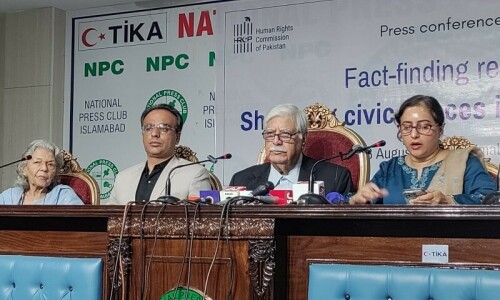
My sentiments stand endorsed by a recent HRCP fact-finding report on Balochistan’s crisis of trust. In the light of its findings, 13 key recommendations have been made to the state “to address the human rights, governance and political challenges currently facing Balochistan”.
While all the recommendations are important, the following need urgent attention. One, “demilitarise the province and create conditions conducive to meaningful dialogue with all genuine political stakeholders to rebuild public trust…”. Reconciliation was a key point of the counterterrorism National Action Plan, originally launched in 2015 and reinforced in 2021.
While relentless kinetic measures may be taken against proscribed militant organisations like the BLA, including the Majeed Brigade, and BRA and BLF, the government must undertake constructive engagement with the BYC that represents the angry Baloch youth. They should not be deprived of their political, social, economic and legal rights.
Two, “immediately cease the practice of enforced disappearances”. The issue of the missing persons must be resolved in the light of recommendations made by the IHC-designated commission headed by Akhtar Mengal. A constitutional and legal framework under ATA 1997 is a viable way to heal this festering wound in the province’s body politic.
Three, “ensure transparency, fairness and accountability in all electoral processes”. Only a legitimate and truly representative government can earn the trust of the public and deal effectively with militancy.
Four, end “reliance on paramilitary forces for civilian law enforcement”. Highly professional, accountable and rights-compliant policing is critical to gaining public trust. Above all, give respect to the Baloch: they may break but will not bend.
The writer is former inspector general of Balochistan Police.
Published in Dawn, August 15th, 2025