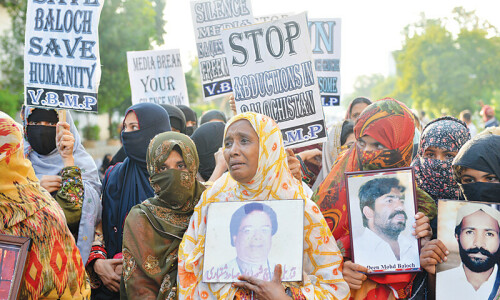
AGP to present mechanism for production of detained persons before top judicial body
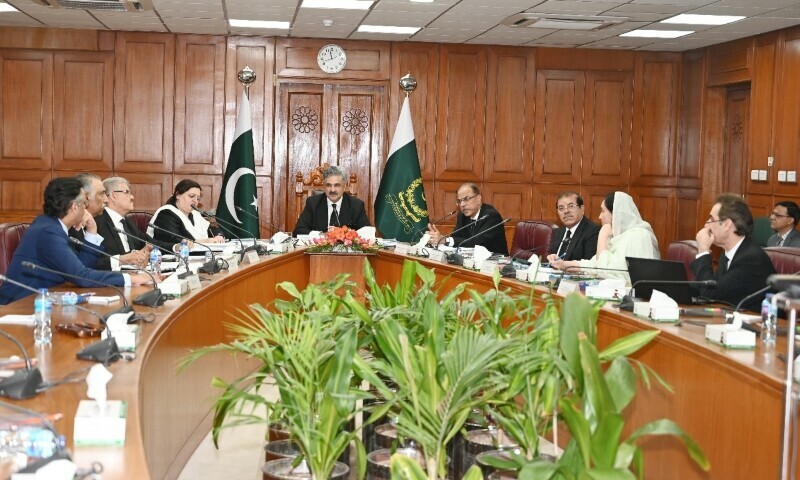

Attorney General for Pakistan (AGP) Mansoor Awan on Monday assured the National Judicial Policy Making Committee (NJPMC) that a mechanism for producing detained people in cases of enforced disappearances would be presented before the body in its next meeting.
The NJPMC, which was set up under an ordinance in 2002, makes recommendations for bringing about an improvement in the capacity and performance of the administration of justice, setting performance standards for judicial officers and persons associated with performance of judicial and quasi-judicial functions, improvement in the terms and conditions of service of judicial officers, court staff and to ensure skilled and efficient judiciary. Last month, the NJPMC constituted a “dedicated committee” to devise an institutional response to the emotive and chronic issue of enforced disappearances in the country.
A press release issued today from the Supreme Court said the committee’s 54th meeting was held under the chairmanship of Chief Justice of Pakistan (CJP) Yahya Afridi and attended by the high court chief justices, as well as AGP Awan.
In its institutional response to cases of enforced disappearances, the committee “unanimously reiterated the need for a comprehensive mechanism for ensuring [the] production of any detained person before the magistrate within 24 hours”.
The press release added that AGP Awan “ensured that such a mechanism would be developed and placed before the committee in its next meeting”.
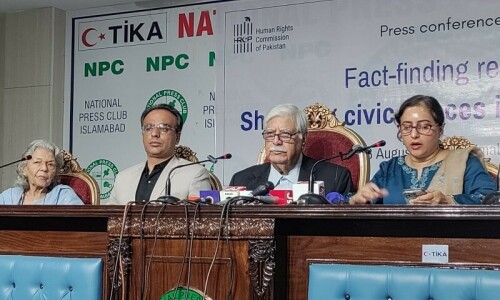
Earlier this month, the Human Rights Commission of Pakistan (HRCP) revealed that enforced disappearances and other issues were fuelling public alienation and political instability in Balochistan following a fact-finding mission to the province.
According to the report, titled Balochistan’s Crisis of Trust, the HRCP undertook the mission from July 9-12 to respond to the “escalating concerns over the deteriorating state of fundamental rights and civic freedoms in the province”. The mission aimed to examine the state of fundamental freedoms in the province and the broader impact of conflict and militarisation on civilian life, the report said in its terms of reference.
In the first half of 2025, a total of 125 missing persons cases were submitted to the Commission of Inquiry on Enforced Disappearances. The total number of cases received up till June 2025 was 10,592, while 1,914 cases of them were disposed of and 6,786 were traced, the commission said.
In December 2024, the Constitutional Bench of the Supreme Court emphasised that only parliament holds the authority to address and resolve the longstanding, yet unlawful, practice of enforced disappearances — a persistent issue that has plagued the nation for decades.
Protecting judiciary and case disposal timelines
On the issue of safeguarding judicial independence, the press release noted that the NJPMC appreciated the high courts for making standard operating procedures (SOPs), emphasising the “inclusion of stage-wise timelines from complaint filing to final action”.
“It was decided that all such instances of extraneous influence shall be reported within 24 hours and action thereon shall be finalised within 14 days,” the press release added.
The NJPMC said that the SOPs should provide for immediate redressal measures to safeguard the dignity of the complainant judge. It also called for a reporting mechanism to the CJP for information and intervention, where necessary.
“The high courts shall notify the SOPs and share the same with the Law and Justice Commission of Pakistan,” the press release said.
The committee also approved the following uniform timelines for the disposal of different categories of cases:
- Declaratory suit (land disputes): 24 months
- Declaratory suit (inheritance disputes): 12 months
- Injunction suit (land disputes): six months
- Recovery suit (public revenue/money matters): 12 months
- Specific performance (contract enforcement): 18 months
- Rent cases: six months
- Family suit (dissolution/dower/maintenance/guardianship): six months
- Succession cases (uncontested): two months
- Execution petitions/family court decree: six months
- Execution petitions/banking court decree: 12 months
- Execution petitions/civil court decree: 12 months
- Execution petitions/rent matters: three months
- Criminal trial (juvenile offenders-JJSA, 2018): six months
- Criminal trial (punishment up to seven years): 12 months
- Criminal trial (punishment above seven years): 18 months
- Criminal trial (murder): 24 months
- Labour cases: six months
“These timelines would be considered as one of the key performance indicators in judges performance evaluation,” the press release said.