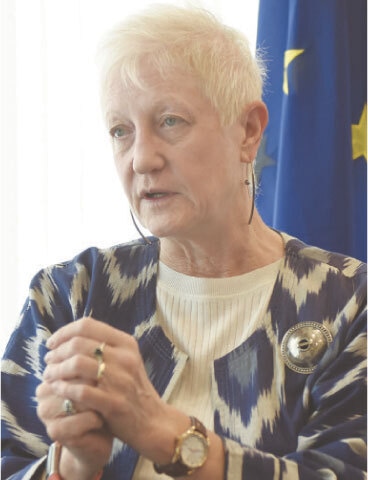
ISLAMABAD: Noting a deteriorating human rights climate, outgoing European Union Ambassador Riina Kionka has called on Pakistan to show ‘credible’ and ‘visible progress’ on human rights and labour reforms ahead of a crucial trade assessment in November, signalling that the EU’s next trade preference scheme will demand stronger compliance.
Speaking to Dawn days before leaving Islamabad, Kionka said the upcoming GSP+ monitoring mission, which had been delayed from June because of the Iran-Israel conflict, will scrutinise Pakistan’s record on 27 international conventions tied to the trade scheme, which grants duty-free access to most Pakistani exports.
“Pakistan needs to show more visible progress especially ahead of the upcoming GSP Plus monitoring mission in November,” she said.
“Governance is looking pretty good, (progress on) environment also positive. But labour rights need more work, and human rights remain the most challenging area.”
EU envoy says crucial trade assessment due in November
On human rights, she was blunt: “If you talk to many human rights defenders, civil society activists —and even just live here, like I have for three years — you often see … a clear degradation. Our monitors read the newspapers. They have networks, they know what’s going on. So, they’re in a position to judge whether things are moving in the right direction or not.”
European lawmakers and civil society, she added, are increasingly vocal about conditioning trade support on rights performance: “Why should we continue to offer this level of support if there’s no reciprocal progress on the values side?”
Despite what she described as “quiet diplomacy” between EU and Pakistan on sensitive issues like human rights, Kionka has sometimes been vocal on these issues.
“If we can’t support them (human rights activists) effectively because they’re being silenced or intimidated, then we lose a key channel of communication, a way to engage in dialogue and debate,” she said while explaining the reason for taking strong positions adding “civil society is essential to the EU’s human rights policy. It’s how we project values. It’s how we engage.”
The GSP+ programme is a lifeline for Pakistan’s export sector, with the scheme delivering 83pc growth in exports to EU since its inception. But Kionka stressed that the arrangement is “a two-sided equation — one side is trade, which has been very successful. The other is sustainable development and we need to see credible progress on both fronts.”
The EU measures progress towards sustainability through active implementation of the 27 conventions Pakistan has pledged to uphold, covering human rights, labour rights, governance and environmental standards, the diplomat noted.
She welcomed the Senate’s recent vote to reduce the number of crimes punishable by death, calling it “encouraging”, but urged further movement on freedom of religion and belief, freedom of expression, and the right to assembly.
The EU is finalising a new GSP+ regulation for 2024–2034 that will require all current beneficiaries to reapply before the next cycle begins by 2027. The revised framework, Kionka said, will introduce “a more efficient way of addressing ongoing concerns”.
The proposed regulation will give Brussels more flexibility to withdraw benefits in cases of serious, systematic violations including climate and environmental breaches.
“Once the new regulation comes into force, Pakistan will have to reapply and submit an action plan — a roadmap explaining how it intends to meet the required milestones,” she said. “It doesn’t roll over automatically.”
The proposed regulation will also have an expanded list of conventions to include children’s rights, disability rights, and stricter labour inspection regimes. The widened scope and expedited withdrawal mechanism could, meanwhile, make it more challenging for countries with weak compliance to stay in the scheme.
As she departs after three years, a tenure that started after the 2022 floods for which the EU mobilised nearly €1 billion in aid and ends with yet another episode of devastating floods, the envoy pointed to structural weaknesses in the trade relationship.
“About 75pc of Pakistan’s exports to the EU are textiles. There are many other industries that could also benefit from GSP+,” she said, urging diversification and value addition.
She also emphasised the need for political stability and plurality “to get things done and maintain long-term partnerships”, and highlighted the EU-Pakistan Business Network — a platform for European investors — as an unfinished project she hopes her successor will formally launch.
Published in Dawn, August 26th, 2025