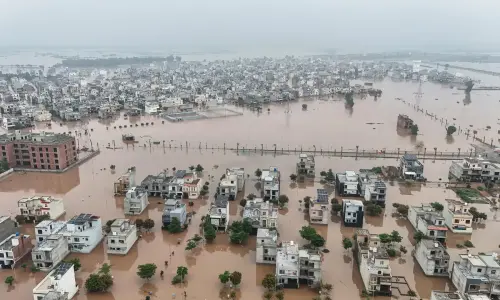
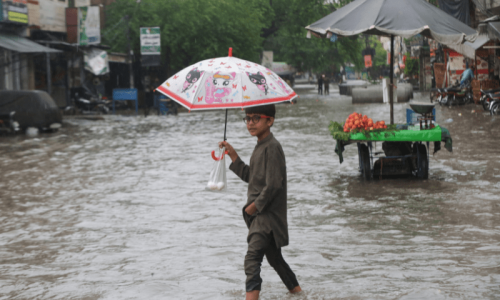
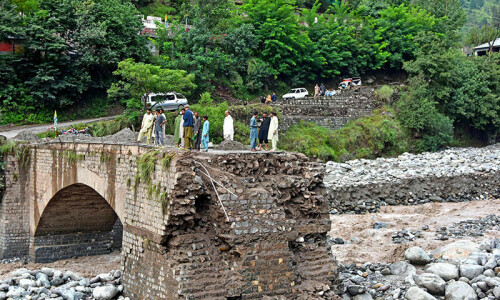
ISLAMABAD: The United Nations Office for the Coordination of Humanitarian Affairs has said that 3,233 acres of agricultural land were damaged during the ongoing floods in Khyber Pakhtunkhwa.
The ‘Rapid Needs Assessment’ report prepared by UN-OCHA says Buner recorded the largest losses of agricultural land with 1,157 acres affected, followed by Swat with 853 acres, Shangla with 559 acres, and Swabi with 330 acres.
Over 80 per cent of people reported crop losses which were significant in Battagram and Mansehra, while Lower Dir and Torghar reported smaller but notable losses, further threatening food security and livelihoods, the UN-OCHA report says.
People lost about 6,206 livestock across the affected areas of 10 districts. Buner reported the highest losses with 4,818 animals, followed by Swat with 618, Shangla with 295, Battagram with 219, and Swabi with 105. Smaller but significant losses were recorded in Bajaur, Mansehra, Torghar, and Upper Dir, while Lower Dir reported minimal impact.
Report says over 80pc of people reported crop losses; 6,206 livestock lost
The loss of livestock further weakened the livelihoods of rural households already facing crop damage and displacement.
Across most flood-affected areas, market access has remained relatively stable. Overall, 77 per cent of markets were reported as accessible, with full access in districts such as Bajaur, Battagram, Lower Dir, Tor Ghar, and Upper Dir.
Swat and Mansehra also reported high levels of access, showing that even in areas severely hit by floods, physical access to markets was somehow maintained. However, Buner had the lowest access at only 35 per cent, leaving people there with limited options for essential supplies.
Despite this physical access, food and non-food availability in markets remains a challenge across many districts.
The regular supply of essential commodities was disrupted in 55 per cent of the affected areas, with Swabi, Shangla, and Swat facing the most significant interruptions.
This means that while people in several districts can reach markets, goods they need are often either unavailable or supplied inconsistently, affecting food security and basic household needs.
Despite considerable efforts by the KP government and humanitarian actors, the assessment data reveals that many affected people continue to face critical gaps in assistance across multiple sectors.
Food assistance reached the largest proportion of affected households at 42 per cent overall, with significant support reported in Buner, Swabi, and Shangla districts.
However, in Battagram, Lower Dir, Torghar, and Upper Dir districts, people reported no or very limited food assistance. Similarly, health services were the second-most supported sector, reaching 39 pc of the affected population.
Major health interventions were reported in Buner (82pc), Swabi (50pc), and Shangla (22pc), but Torghar and Upper Dir districts reported no health assistance at all. In terms of shelter support, only 20 per cent of households reported receiving assistance.
Districts like Swabi (50pc) and Buner (31pc) reported the highest coverage, whereas most other districts reported minimal or no assistance despite extensive housing damages. Nutrition support was reported by just 15pc of people, largely concentrated in Buner (48pc), with almost no coverage in other districts, leaving children and pregnant women at risk.
The education sector was the least supported, with only 2pc coverage, despite widespread damage to school infrastructure in districts like Buner, Swat, and Shangla, potentially impacting thousands of children.
Overall, the data highlights that while food and health received the most attention, shelter, nutrition, and education remain critically underserved, requiring targeted and sustained interventions to bridge the assistance gaps across all affected districts.
Published in Dawn, September 4th, 2025