Urban storm-water management


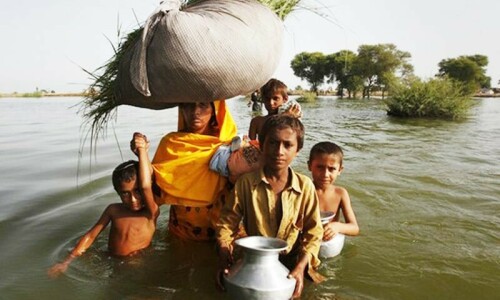
PAKISTAN has been ravaged by riverine and pluvial floods this monsoon season too.
The United Nations Office for the Coordination of Humanitarian Affairs reports that during the current monsoon season, 785 lives have been lost; the number is increasing with each passing day. July 2025 saw 82 per cent more rain than July 2024, reports the Pakistan Meteorological Department. In Punjab alone, two million people have felt the season’s impact; and visuals from KP and Sindh are grim to say the least.
Sadly, it will only get worse as the Intergovernmental Panel on Climate Change projects 26pc faster warming rates till 2050. This means more frequent heatwaves, erratic weather, glacial lake outburst floods and riverine and pluvial floods.
Pakistan’s challenges are multifold; they include an aging infrastructure, fragmented institutions working in silos, and under-resourced local governments, to name a few. Most urban areas have non-existent storm-water management, often piggybacking on decaying sewerage systems, and leading to compounded fiascos. For the urban poor living in informal settlements on city margins, the situation is even more dire — when downtowns catch a cold, slums catch fever. Every year, the monsoon triggers disasters that result in life-threatening conditions for the less-privileged urbanites in particular.
As a developing country with limited resources, Pakistan must make smart choices to address the aforementioned ills while improving public service delivery too. Instead of reinventing the wheel, we can learn from global best practices, leading to customised solutions for our local challenges. Globally, there are two approaches when it comes to dealing with storm-water: get rid of it as soon as possible or treat it as an asset instead of viewing it as a threat. The latter approach is reckoned as more progressive, and cities adopting it are referred to as ‘sponge cities’. A sponge city essentially acts like a sponge: it absorbs water and can release it whenever needed. This property can resolve a problem faced by our cities: deluges and droughts throughout the year.
Sponge cities are based on blue-green infrastructure (BGI), comprising a specially designed network of water bodies and green spaces such as urban parks, wetlands, bioswales and water plazas.
The BGI model presents Pakistani urban centres with an opportunity to enhance livability.
BGI, unlike single-purpose grey infrastructure (storm-water drains), is multifunctional and provides ecosystem services through urban nature. This climate infrastructure is not buried underground and provides flood mitigation, storm-water management, urban heat island impact reduction, recreational opportunities as well as enhanced biodiversity.
We present Copenhagen’s example and how the city’s climate adaptation model can help Pakistani cities be climate-proofed for the future. Copenhagen has made great strides towards climate resilience using BGI over the last decade or so. The city was jolted by a cloudburst event in 2011, sending shockwaves and losing more than $1 billion in damages. Consequently, the city came up with its pioneer Cloudburst Management Plan, 2012.
The plan serves as a blueprint for the city’s climate adaptation and envisages urban nature as its fundamental pivot. The plan provides a robust system consisting of BGI to manage storm-water on the ground in addition to four underground tunnels. The city found out that its limited sewer capacity led to combined sewer outflows during intense downpours.
The Cloudburst Plan responded to this challenge through a unique idea. Relying on hydraulic modelling, experts divided the city into seven catchment areas based on where it would rain and where the city would want its rainwater to go. The surface system comprises more than 350 projects spread over seven catchments. Further, each catchment area is divided into cloudburst branches comprising various BGI projects in different neighbourhoods. These projects are meant to stop storm-water from entering the sewers as the city expects 30pc more than usual rain in the future.
A Copenhagen climate neighbourhood (building block of the system) comprises streets, courtyards and parks acting as BGI. With a focus on the water in the neighbourhood, these urban spaces are all connected and have a dual function. The system ensures that rain falling in the neighbourhood can flow through the BGI projects. The water, which cannot infiltrate, has an outlet to the next system. Therefore, the idea is not just to drain water quickly, but to slow it down, store it and use it, turning excess water into an urban asset. These functions to retain, detain and convey storm-water are performed by various cloudburst typologies. For example, parks and plazas are designed to retain storm-water from surrounding rooftops. Green roads delay storm-water conveyance and cloudburst boulevards ensure its speedy transportation.
Instead of relying solely on conventional drainage systems, the plan reimagines Copenhagen’s streets, parks and public spaces as dynamic tools for managing storm-water, reducing flood risks, and enhancing urban livability. These BGI projects in Copenhagen are expected to be completed over 30 years, aligning with the city’s broader urban development agenda.
The model presents Pakistani urban centres with an opportunity to enhance urban livability while managing storm-water and urban flooding effectively. It would create synergies amongst government agencies, break management silos as well as provide a systemic approach for cost-effective and integrated sustainable development. Every city with a peculiar water cycle, topography and public participation must chalk out its own unique plan to climate-proof itself through a multifunctional climate infrastructure. This is a crucial moment for Pakistan to propose pragmatic climate-adaptation projects for climate justice funding worldwide. The time to act was yesterday; let’s at least start today. n
Ramiz Shafqat is a civil servant and a Fulbright Scholar in Environmental Policy & Sustainable Development.
shafr651@newschool.edu
X: @Rana_Ramiz
Muhammad Hassan Dajana is a climate entrepreneur and Fulbright Scholar in Climate Adaptation.
muhammadhassandajana@gmail.com
X: @HassanDajana
Published in Dawn, September 8th, 2025