Aurangzeb terms Rs1.2tr circular debt deal ‘largest financing’ in Pakistan’s history


Finance Minister Muhammad Aurangzeb has hailed the Rs1.2 trillion bank loan secured to settle Pakistan’s circular debt as the “largest financing and largest restructuring transaction” in the country’s history.
On Wednesday, the government signed loan facilities worth approximately Rs1.225tr with 18 banks to settle the outstanding dues of Independent Power Producers (IPPs) parked in circular debt. These dues will be serviced through a Rs3.23 per unit surcharge on consumers for a period of six years.
The signing ceremony was held at the PM Office, witnessed virtually by the prime minister from New York. No official announcement was made, although ministers confirmed the signing of the agreement. Under the agreement, the government will have 30 days to request disbursements from banks for prompt utilisation to avoid penalties.
Today, the ceremony was aired on television, with both the premier and the finance minister addressing the gathering.
In his remarks, Aurangzeb said that facility “resolves the structural issues of the power sector”.
“Ultimately, it’s all for the benefit of Pakistan and the benefit of the consumers,” he said, branding it a “win-win situation”.
Lauding the efforts of the authorities involved in arranging the loan facility, the finance minister remarked, “This is a very important step in reducing the energy equation.”
Echoing the minister’s thoughts, PM Shehbaz termed the facility a “huge success”, remarking that “circular debt was eating up all our resources”.
The premier noted that negotiating with IPPs was a “big challenge”, but the team “lived up to their responsibility at the right time.”
He also thanked Army Chief Field Marshal Syed Asim Munir for his “behind-the-scenes support”. Outlining future steps, PM Shehbaz said that the power sector’s next targets included privatisation of power distribution companies and dealing with line losses.
“These are big challenges that we have to take on with faith,” he added.
Speaking at the ceremony, Power Minister Awais Leghari called the move a “bold step”, pointing out that “circular debt has burdened the energy sector for a long time”.
“The circular debt financing scheme is another landmark initiative to restore the health of our power sector,” Leghari added.
‘A major breakthrough’
Separately, in a press release issued by the Ministry of Finance on Thursday, Aurangzeb called the agreement a step towards “restoring fiscal discipline, investor confidence, and energy sector sustainability”.
The success of the agreement “sets a precedent for addressing Pakistan’s structural challenges with innovation, unity and resolve,” the press release quoted him as saying.
The finance minister, in the statement, maintained that “release of Rs660 billion in sovereign guarantees through this arrangement will channel much-needed liquidity into priority sectors such as agriculture, small and medium enterprises, housing, education, and healthcare”.
In its statement, the ministry hailed the “historic joint effort”, calling it a “major breakthrough in addressing one of the most chronic challenges of Pakistan’s energy sector”.
Under the facility, the servicing of the Rs1.225tr debt would be serviced through a Debt Service Surcharge (DSS) at the rate of Rs3.23 per unit. Of this, Rs659bn would be used for loans payable by Power Holding Ltd (PHL) — a shell subsidiary of the Power Division.
The remaining funds — 556bn — would be used to pay dues to IPPs, petroleum sector entities, and make subsidy adjustments, including through book adjustments and cash settlements.
The Ministry of Finance facilitated the loan agreements with 18 banks, including Habib Bank, Meezan Bank, National Bank of Pakistan, Allied Bank Ltd, United Bank Ltd, Faysal Bank Ltd, Bank Al Habib Ltd, MCB Bank Ltd, Bank Alfalah, Dubai Islamic Bank, Bank of Punjab, BankIslami Pakistan, Askari Bank Ltd, Habib Metropolitan Bank, Al Baraka Bank Ltd, Bank of Khyber, MCB Islamic Bank and Soneri Bank.
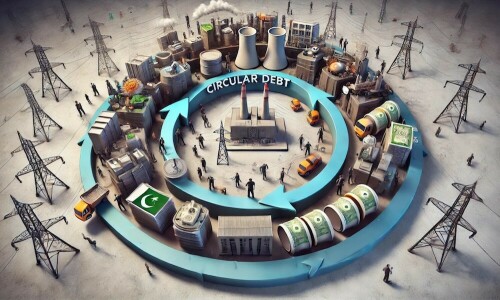
Amid little reform and a stock of over Rs4.6tr circular debt, Pakistan’s energy sector continues to weigh heavily on its economy across all sectors, owing to weak collections, theft, poor infrastructure, governance problems, and market inefficiencies.
According to the Washington-based Institute of International Finance (IIF), “there is about 4pc of GDP worth of debt stemming from the energy sector. The repercussion of this debt reverberates throughout the economy, not only impacting the fiscal but also growth, inflation, the external balance, and the financial sector.”
It said circular debt and energy subsidies added significant pressure to public finances, contributing to persistent fiscal imbalances and forcing the government to allocate resources away from other investments, social programmes, and infrastructure projects, and crowding out the private sector.