• Retired Justice Chandrachud’s remarks appear at odds with 2019 Indian Supreme Court judgement on Ayodhya title dispute
• Former judge also defends survey of Gyanvapi Mosque, claims Hindus worshipped there for centuries; also backs court’s stance on held Jammu & Kashmir
NEW DELHI: Contrary to the Ayodhya judgement of the Supreme Court in 2019, former Chief Justice of India (CJI) D.Y. Chandrachud has spawned a fresh controversy by claiming that “the very erection of Babri Masjid (in the 16th century) was a fundamental act of desecration”.
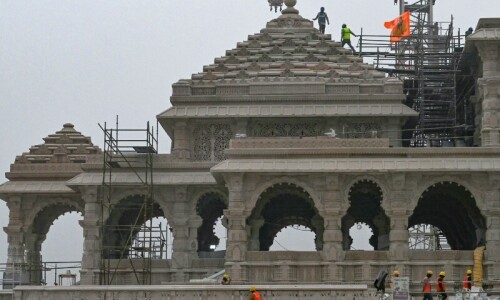
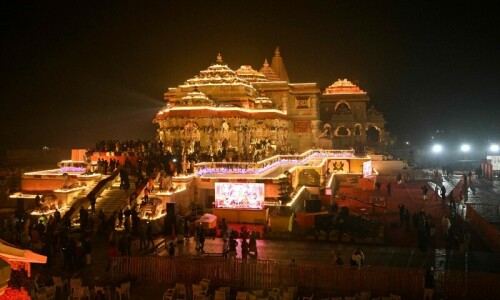
Retired Justice Chandrachud was a member of the five-judge bench led by the then CJI Ranjan Gogoi which, in November 2019, had given the green signal to build the Ram temple at the disputed site in Ayodhya.
At the time, the court permitted construction of the Ram Temple on the disputed site, but stressed that the Archaeological Survey of India (ASI) findings could not prove the Babri Masjid was built after demolishing a pre-existing structure.
“Title to the land must be decided on settled legal principles and applying evidentiary standards which govern a civil trial,” the bench held.
However, in an interview with journalist Sreenivasan Jain for Newslaundry on Wednesday, Mr Chandrachud pointed to archaeological evidence but acknowledged its legal limitations.
“There was adequate evidence from the archaeological excavation. Now, (what’s) the evidentiary value of an archaeological excavation is a separate issue altogether,” he said. “All that I want to say really is this, there is evidence in the form of an archaeological report.”
The former CJI’s controversial response was to a question asked by Jain, noting the inner courtyard dispute arose partly from Hindus “committing illegal acts like desecration and creating disturbance”.
He argued that Muslims, who did not challenge the outer courtyard, saw their lack of resistance turned against them in the judgement. “The fact that you didn’t put up a fight, while the Hindus did, actually weighs against the Muslims,” Jain said, calling it a critical reading of the judgement.
Mr Chandrachud responded, saying: “When you said that it was the Hindus who were desecrating the inner courtyard, what about the fundamental act of desecration — the very erection of the Mosque. You forget all that happened? We forget what happened in history?”
The former CJI referred to ASI’s conclusion that a Hindu-origin structure from the 12th century existed beneath the mosque. Calling it evidence of “what happened in history,” he accused commentators of taking a “selective view of history” and ignoring inconvenient facts.
“How can you (then) shut your eyes? So, what is really being done by many of these commentators, that you referred to, is that you have a selective view of history, ignore evidence of what happened beyond a certain period in history…” he said.
But when asked if such history could justify the mosque’s demolition in 1992, Mr Chandrachud rejected the idea.
“Not at all. Supreme Court judgement applies conventional yardsticks of determining the adverse possession and it is on the basis of evidence and conventional yardsticks that we have applied and come to the conclusion,” he said.
“The criticism that the judgement is based on faith and not on evidence is a criticism, I dare say, of those who have not read the judgement.”
Contrary to what Mr Chandrachud had told Newslaundry, The supreme court, in its ruling, was categorical that ASI’s report could not alone establish title.
The judgement noted a “gap of several centuries” between the structure dated to the 12th century and the 16th-century mosque, with “no evidence… in relation to the course of human history between the twelfth and sixteenth centuries” or “whether the pre-existing structure was demolished for the construction of the mosque”.
Mr Chandrachud also addressed another contentious case — the Gyanvapi Mosque dispute. Explaining why the Supreme Court permitted a survey there despite the Places of Worship Act, he said the site’s religious character was not settled.
“Hindus had worshipped in the mosque’s cellar undoubtedly through the ages,” he said, calling the claim “undisputed,” even though Muslims have consistently challenged it.
On Jammu and Kashmir, Mr Chandrachud defended upholding the government’s reorganisation of the held state, stressing that “security considerations” meant authorities must “take a call on what’s in the interest of the nation”.
Asked about post-retirement roles, he said he does not believe in strict limits on judges taking government posts. “I do not subscribe to doctrinaire ideas about what retired judges should or should not do. To each their own.”
Published in Dawn, September 26th, 2025