Yaqoob Atif’s musical legacy lives on through his song ‘Pani Da Bulbula’ [Water Bubble]. With its upbeat melody and reflection on the fleeting nature of existence, the song became a cultural sensation throughout the country.
Released in 1979, a year that saw both the judicial execution of former prime minister Zulfikar Ali Bhutto and scientist Abdus Salam’s Nobel Prize victory, Pani Da Bulbula resonated with a nation experiencing social and political transformation.
Yet, Atif’s fame was short-lived. Despite his contribution, he spent his final years in poverty, paralysed and forgotten by the industry he helped shape.
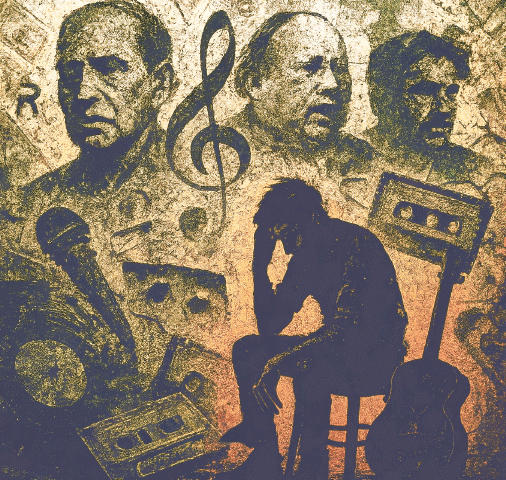
Yaqoob Atif’s own tragic trajectory is a larger reflection of Pakistan’s musical landscape, an industry that is filled with stories of artists whose talents were celebrated briefly, but whose legacies faded into oblivion due to systemic exploitation and a lack of financial support.
Despite Pakistani music being celebrated globally, Pakistan’s music icons often fade into obscurity as victims of systemic exploitation that denies them fair recognition and financial security.Can this broken system be reformed?
Mehdi Hassan stands out as another example of an icon who emerged as Pakistan’s “King of Ghazals” and received numerous accolades, such as the Nishan-i-Imtiaz and Pride of Performance. However, his legendary status was accompanied by severe financial hardships in the later years of his life.
The struggle for royalties
One of the ways musicians monetise their work is through residual payments, but the system of royalties in Pakistan has always been a grey area, with no clear framework.
Under the current system, many artists are creating music without a sustainable income that could offer a stable career in the industry. But the issue of residual payments is easily overshadowed by the fact that the performing arts such as music, even in the year 2025, are still not a recognised profession in Pakistan.
State-run broadcasters such as Pakistan Television (PTV) and Radio Pakistan were the dominant outlets for music distribution since Pakistan came into being, but they often paid only a one-time fee for songs, and sidelined the concept of royalties from the beginning. Consequently, full-time professional artists who depend on royalties for income continue to remain deprived of long-term financial stability.
When approached, veteran musician and lead guitarist of the Mekaal Hasan Band, Mekaal Hasan said he strongly believes that the problem is bigger than Pakistan lacking a residual payment system in the music industry. According to him, “Pakistan still doesn’t have a music industry. Period.”
He says that profit-driven private entities have exploited the opportunity to shift their priorities from creating quality cultural hits to creating marketable hits that sell, even if the quality suffers and the artist ends up being exploited without fair compensation.
Pakistan’s first ‘music policy’
Pakistan introduced a draft of its first music policy in August 2023 and, at the time, it was regarded as a historic step in the right direction, as the policy aimed to promote the country’s musical heritage and safeguard intellectual property rights through legal frameworks.
That same year, Pakistan mourned the loss of musician Asad Abbas, who was battling kidney failure for several years, during which his family and friends had reached out to the government, and later the public at large, to ask for financial assistance for undergoing dialysis three to four times a week.
The recipient of many awards, including the Tamgha-i-Imtiaz, Asad Abbas, during one of his final interviews, had urged the state to help him with his medical expenses. Sadly, his struggle lays bare the gap between accolades and the basic safety net Pakistani artists continue to lack.
Hasan believes that a policy without an industry is not a viable accomplishment for musicians. “Performing arts need to be recognised as a profession first and foremost in order for artists to reap any benefits from state support.”
The role of unions
Another factor contributing to the instability of a career in musical arts in Pakistan is the absence of formal unions. While international entertainment industries rely on unions to ensure fair pay and compensation through residuals, Pakistani artists are left to navigate an unregulated industry with very little security.
The Actors’ Collective of Pakistan (ACP) remains the only registered performing artists’ union in the country, but its scope is limited to actors. Thus, musicians, songwriters and folk artists find themselves left behind without representation in an unstable territory.
The benefit of unionised structures goes beyond advocating for fair contracts or ensuring residual payments. With that scaffolding in place, creatives can focus on their career, making art without the constant dread of being short-changed. Given how vital unions are for the growth and stability of the industry, if Pakistan wants to establish a respectable industry on a national scale, unions are not optional but mandatory.
The path forward
Mekaal Hasan says that real support from the government has to begin at the roots. Art disciplines should be taught from a younger age and dedicated programmes, with well-equipped music rooms and workshops, should be established to support aspiring performers from their first chord to a viable career.
He also points to a fault-line in the industry: the mainstream is overwhelmingly Punjab-centric. “Local music from the regions of Sindh and KP, for example, vanish outside their provinces,” he says. “A music economy that sidelines half the country’s languages cannot hope to stay vibrant for long.”
Countless Pakistani musicians have suffered the same fate as that of Yaqoob Atif and Asad Abbas. Globally celebrated artists such as Ustad Nusrat Fateh Ali Khan faced challenges in preserving their intellectual property, leaving much of their work exploited.
“You should not have to be as gifted as Mehdi Hassan to make a case for basic rights like healthcare,” Hasan adds. A functioning industry, real unions, residual systems and provincial stages can still be put in place. None of these demand radical reconstruction — only the will to honour the musical icons who have contributed significantly to the cultural landscape of Pakistan.
“Artists such as Ustad Nusrat Fateh Ali Khan and Mehdi Hassan were once-in-a-lifetime legends,” Hasan says, “and if the situation doesn’t change, then we might never have another once-in-a-lifetime legend ever again.”
The writer is an academic. She can be reached at mishazafarr@gmail.com
Published in Dawn, September 28th, 2025