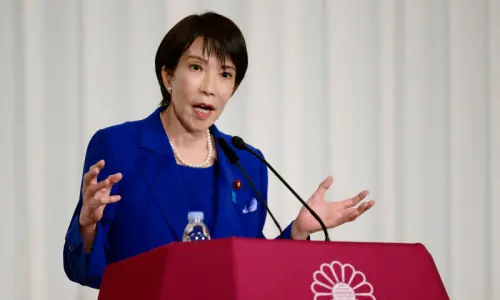
THE election of Sanae Takaichi, Japan’s former economic security minister, as LDP leader on Saturday, positioning her as Japan’s first likely female prime minister, is all about survival and strategy, where her hardline stance and the future of the Japan-China relationship serves as a crucial geopolitical stress test for the country.
The driving force behind this is Takaichi’s uncompromising identity and her long-standing ideological allegiance. The 64-year-old is an unusual politician: she is not from a prominent political family; she chose the state-run Kobe University over top private schools like Waseda and Keio to save money for her younger brother’s education.
A former heavy metal band drummer and motorcycle enthusiast, Takaichi interned with US Democrat Congresswoman Patricia Schroeder before entering politics. Dubbed the “Female Abe,” her political viability came from aligning with former Japanese prime minister Shinzo Abe, becoming his most direct political heir and adopting his economic blueprint through “Sanaenomics”, which commits to massive fiscal expansion and, crucially, the formal revision of Article 9 of the nation’s pacifist Constitution.
However, the true paradox of her potential premiership is that the ideological purity that rallied the conservative LDP base now threatens her ability to govern. She faces continuous infighting from within her own party’s moderate wing and LDP’s coalition partner Komeito, compounded by the necessity of building bridges with centrist opposition parties alienated by her nationalist stance. Her mandate for bold action is thus tenuous, constrained by the necessity of domestic compromise.
As Komeito leader Tetsuo Saito said after Saturday’s election: “To be frank, I was surprised. If we proceed with talks regarding a coalition government, I definitely want to hear what kind of thinking the new president has. Based on that, we will advance discussions on whether we can align our policies and principles.”
Takaichi visited ‘notorious’ Yasukuni shrine, which glorifies Japan’s wartime militarism by honouring war criminals
Securing the party leadership is merely the first step; a host of profound political and economic problems await Takaichi. Since the LDP has lost majority control in parliament, Takaichi’s selection as prime minister is no longer guaranteed, despite her party’s nomination. While a divided opposition makes her selection possible, experts note that it is “no longer a sure thing, as it was in years past”.
The LDP’s losing legislative dominance forces Takaichi into a difficult era of compromise and coalition-building to enlarge the governing coalition — including the possibility of inviting another opposition party to the LDP-Komeito coalition to regain a parliamentary majority.
Beyond the political quagmire comes the real work of governing one of the world’s largest economies.

The new prime minister inherits a slate of thorny domestic issues. Most pressing is inflation, but this is overshadowed by Japan’s severe demographic crisis, characterised by a rapidly aging population, falling birth rate, shrinking workforce, and growing costs of elder care and welfare.
This kind of domestic compromise might be required on the global stage, too, given Takaichi’s historical revisionism and staunchly conservative views when it comes to Japan’s Asian neighbours. She has repeatedly claimed that Japan’s invasion of China and other Asian countries, during World War II, were in “self-defence”, a view that goes against international consensus.
Her rhetoric is also backed by action: she has visited the notorious Yasukuni Shrine, which glorifies Japan’s wartime militarism by honoring war criminals, including 14 convicted Class-A criminals, almost every year in the past 12 years, publicly vowing to continue the practice regardless of her political office.
The shrine is regarded as a symbol of Japan’s past atrocities and militarism worldwide with its Yushukan, a war museum inside the shrine, espousing Japan’s right-wing narrative, portraying Japan as a victim of the conflict and contending that the country was forced into war because of a Western economic blockade.
No matter how she tries to justify it, Takaichi’s continuation of such visits as prime minister presents a nightmare scenario for regional relations, guaranteed to cause serious diplomatic tensions. This is particularly perilous now: Japan is currently enjoying a warm period in relations with the Republic of Korea, and ties with China have seen small signs of stability as both countries brace for the impact of global trade shifts.
These critical relationships would be immediately jeopardised if a future prime minister, say Takaichi, emphasises these conservative views on historical issues. Even more damaging are remarks tying her to security posture, including suggesting a “quasi-security alliance” with the Taiwan island — a red line of Beijing. This direct security provocation will, no doubt, shatter the current calm in East Asia. Takaichi’s victory may be a survival strategy for the LDP, but the question now is whether she is also willing to simultaneously sacrifice East Asia’s hard-won stability on the altar of Japan’s right-wing ideology.—China Daily/ANN
Published in Dawn, October 6th, 2025