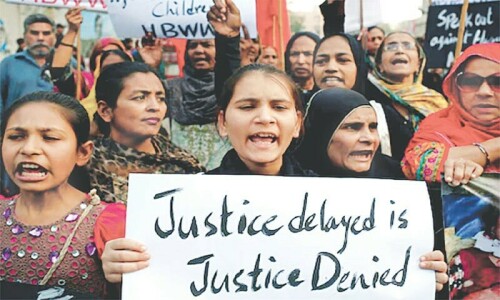
Conviction rate in gender-based violence cases stands at just 1.2pc, Karachi moot told

KARACHI: A dialogue on the provincial action plan on prevention and response to gender-based violence (GBV) held here on Thursday saw many members of the civil society discuss how to pave the way for justice in such cases.
The event was organised by the Sindh Women Lawyers Alliance (SWLA) in collaboration with the Human Rights Commission of Pakistan (HRCP).
Starting the discussion, advocate Shazia Nizamani said that in order to effectively combat gender-based violence in Sindh, institutional actions must focus on strengthening systems, enforcing laws and fostering coordination across government, judicial, law enforcement and civil society sectors.
“But, only 1.2 per cent of GBV cases result in convictions due to weak prosecution and judicial delays. There is also no centralised GBV database, hindering data analysis. Besides, due to resource constraints, shelters and crisis centres, GBV courts, police protection cells and the likes are underfunded,” she added.
Experts, activists call for proper coordination among all relevant institutions
“The police and judiciary often lack training, leading to mishandling of cases. There is also a patriarchal mindset in the judiciary, the legal community and law enforcement authorities,” she observed.
It was explained that the objective of having a provincial action plan was to have system reforms and social change to achieve a 50 per cent reduction in GBV incidents by 2030, increase conviction rates to minimum 20 per cent by 2030 through GBV survivor and survivor-centric scientific investigation and reduce judicial delays.
The advocate also recommended the establishment of district-level emergency response centres to provide immediate medical, legal and psychological support to GBV survivors; increasing women representation in the police, judiciary, ombudsperson office and as medico-legal officers, besides having professionally trained psychologists in hospitals, police stations, women protection cells and shelter homes.
She also suggested the implementation of anti-rape special courts, crisis centres and victim & witness protection programmes.
Rape and abuse cases must be investigated with full responsibility, sensitivity and a survivor-centric approach, ensuring justice and dignity.
Moreover, there should be capacity building of police. They should have specialised training of gender-responsive handling of GBV cases in accordance with international and national legal standards.
More recommendations included online FIR registration, human rights and women rights education as part of the curriculum along with sexual education.
The former chairperson of the Sindh Commission on the Status of Women, Nuzhat Shirin, said that since there is no budget for special courts, the regular courts should be made more effective.
Rights activist and GBV expert Khalida Mallah said that there was a need to reach out to donors to see how the initiatives suggested by Advocate Nizamani could be funded.
Community engagement expert Dr Kausar S. Khan brought up the concept of patriarchal bargaining.
“It gives ownership for GBV advocacy in communities. Communities should be provided awareness because victims trust their communities,” she pointed out.
Chandan Malhi of the National Commission for Human Rights (NCHR) said that departments and civil society organisations that are there to spread awareness should at least know the laws. “There are many helplines but no one nowadays speaks or gives advice on the basis of existing laws,” he said.
Minority rights activist Seema Maheshwari said that there is a need to train data collectors. “There needs to be one mode of data collection. But out here the data taker confuses everyone by putting in wrong information in the categories provided because he or she simply doesn’t understand what to put where,” she said.
Human rights activist Anita Pinjani said that there was a need to interview both the educated class and rural people in order to understand their mindsets and how they see women. “It will give you a clue as to why laws passed to aid women are not implemented,” she said.
Transgender rights activist Masooma Umar Rasool said that when people are afraid to fight for their rights in case of gender-based violence, then transgender people are in an even worse situation. “The police, too, lack sensitivity to deal with transgender victims,” she said.
“The transgender law is based on protection for the community but we are not getting any protection,” she added.
Huzaifa Gill said that due to feeling unsafe, many transgender persons do not come out to reveal their identity. “Inclusion in society means providing an environment where one feels safe not to pretend to be someone else,” he said.
Published in Dawn, October 17th, 2025