‘Pakistan got just $600m aid after 2022 floods’

• Ahsan says govt to self-fund recovery, rejected ‘external crutches’ after fresh deluge
• Preliminary damage of this year’s floods put at $2.9bn across sectors
• 1,039 dead, 1,067 injured; surveys to conclude in two weeks
ISLAMABAD: Pakistan suffered more than $30 billion in damages and losses in the 2022 floods but received only $600 million in foreign assistance, Planning Minister Ahsan Iqbal said on Friday.
Apart from that, all international commitments were loans, most of them repurposed from previous facilities, he said while releasing preliminary estimates for flood-related damages at Rs822bn (about $2.9bn).
“This is an irony,” he said, adding that the global community had pledged a $100bn climate-finance fund but “did not provide even $1bn”.
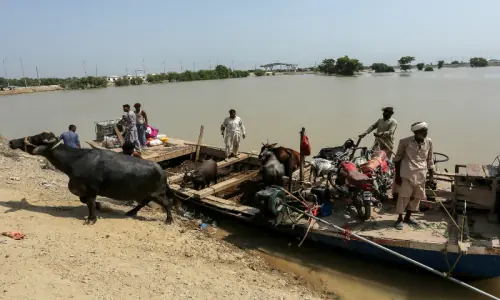
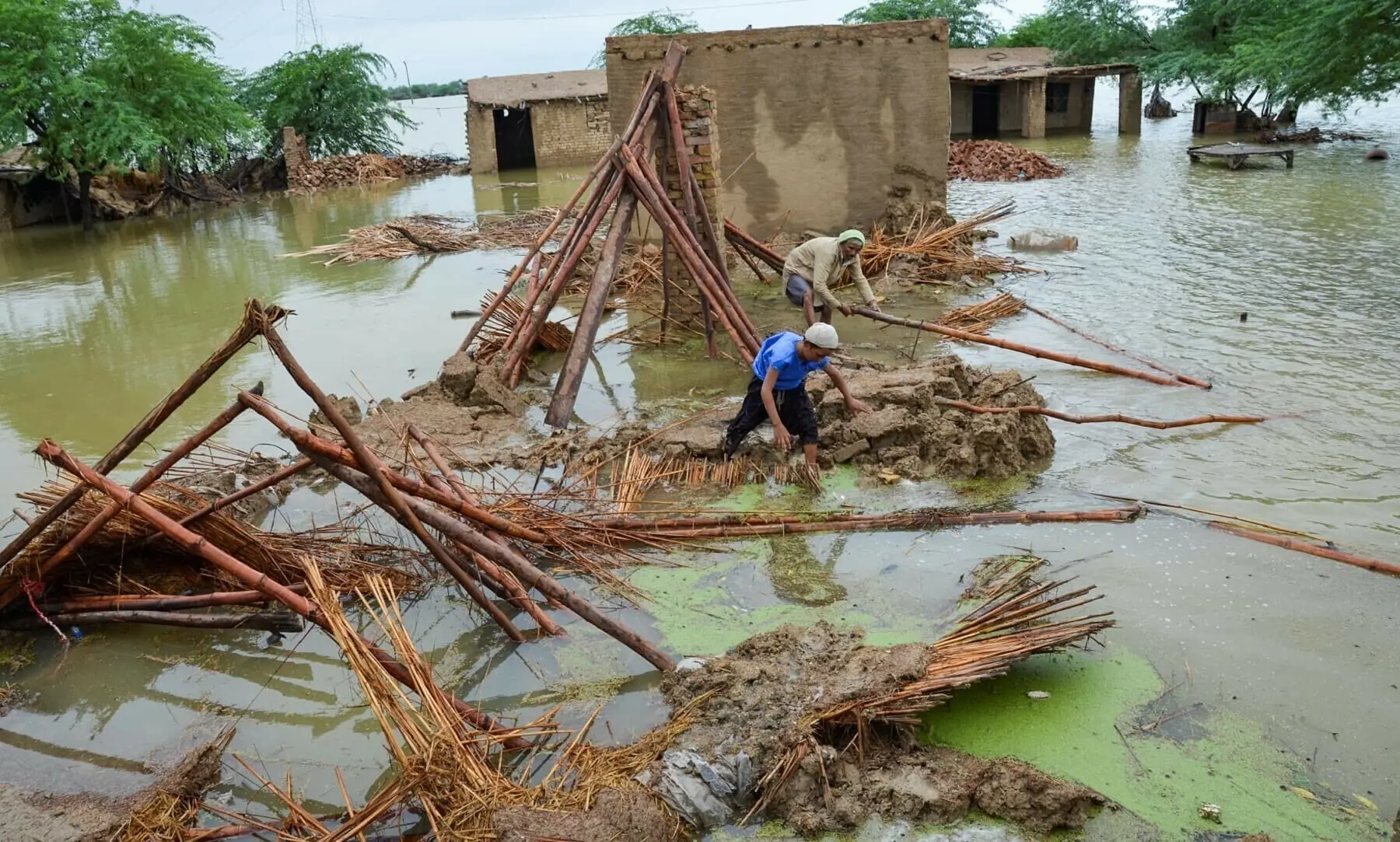
Therefore, after consultations, the government decided to meet the latest losses through domestic resources rather than “external crutches” despite the around $3bn damages to agriculture and infrastructure on top of human lives following the recent “apocalyptic floods”.
The minister said the surveys for flood losses, including those in the economic field, were currently in progress and would be finalised in about two weeks. He said the preliminary report entailed human losses of more than 1,039 lives and 1067 injuries, besides about Rs822bn damage to infrastructure and agriculture.
This included Rs430bn damages in the agriculture sector, Rs307bn in infrastructure, besides damage to more than 229,763 houses, including 213,000 in Punjab alone.
Besides, 6,370 houses were damaged or destroyed in Balochistan, 3,677 in Azad Kashmir and Gilgit-Baltistan, 3,332 in Sindh and 3,222 in Khyber Pakhtunkhwa.
“At least 6.5m people across 70 districts have felt the brunt, including around 4m temporarily displaced as waters receded and families assessed the wreckage”, he said.
More than 2,811 kilometres of roads were damaged, over 2,200 head of livestock lost, around 2,200 educational institutions affected, more than 250 health facilities impacted and roughly 866 water-infrastructure assets hit, he added.
Crop losses included up to 3.4m bales of cotton, more than 1m tonnes of rice and an estimated 1.3m to 3.3m tonnes of sugarcane, subject to ground verification.
Punjab suffered the most, with Rs632bn of the nationwide Rs822bn tally, the minister said, adding that the provincial chief minister had briefed a meeting chaired by the prime minister on a support package for farmers and families.
On development expenditure, Mr Iqbal said that about Rs40bn had been disbursed under the Public Sector Development Programme in the first quarter, almost 16 per cent higher than last year’s Rs34.8bn.
Addressing progress under the China-Pakistan Economic Corridor, he said minutes of the recent Joint Cooperation Committee would be finalised by the end of the month and dispelled the impression that tangible progress on the second phase of bilateral economic cooperation was missing in the JCC.
At Pakistan’s request, China had agreed to finance 85 per cent of the Karakoram Highway works linked to the Diamer-Bhasha Dam, with bidding expected to start in about two months, he said.
The government has designated 2026 as the “year of reform” to modernise the economy, society and politics, the minister announced, aiming to convert recent diplomatic and macroeconomic gains into faster growth through “bold and quick” structural changes.
A three-year reform window would prioritise social, economic and political measures to encourage wealth creation and investment, remove “anti-business bias” and cut red tape and bureaucratic inertia. The prime minister has constituted a high-level forum to present an action plan this year for implementation in 2026.
The minister said that while the National Institute of Public Administration was being converted into a university to train bureaucracy in line with global standards for economic development and business promotion, many of the social sector reforms were not possible without the full involvement of provinces.
Published in Dawn, October 18th, 2025