Agreement eludes neighbours despite three days of talks
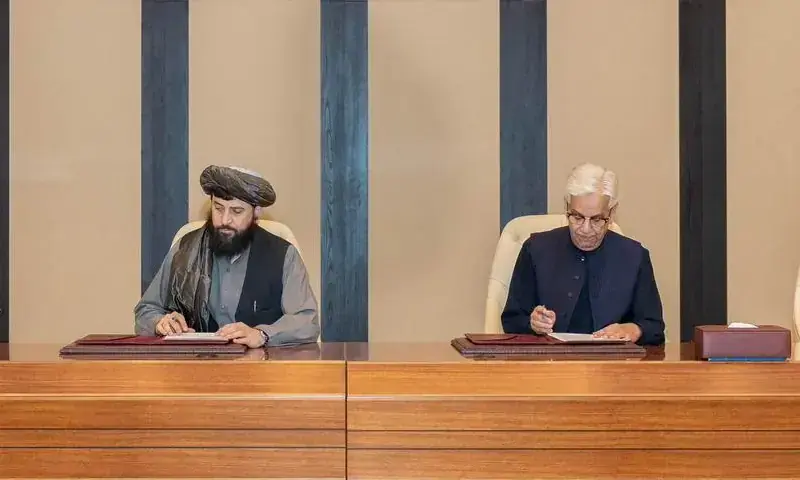

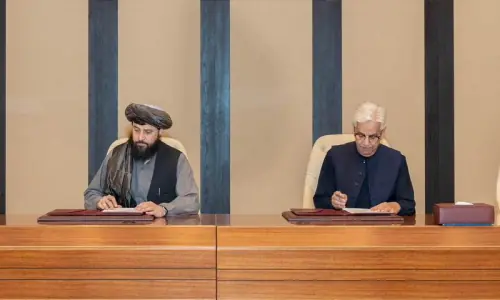
ISLAMABAD: The third day of talks between Pakistan and Afghanistan in the Turkish capital kept oscillating between hope and despair on Monday, as both sides struggled to bridge their differences over a mechanism to curb cross-border terrorism.
By late evening, officials said a final agreement still remained elusive.
Sources familiar with the closed-door discussions said that while “most of the points had been mutually agreed between the two sides”, the mechanism for verifiable action against terrorist groups operating from Afghan territory continued to be the main sticking point.
“We kept hoping that we would be able to sign a mutual document with Afghanistan soon, followed by a joint statement, but it still remains out of our reach,” one source said, sounding dejected, yet unwilling to abandon hope.
Mechanism for verifiable action against terrorists operating from Afghan soil remains main issue between Islamabad and Kabul
The atmosphere early in the day had been markedly positive. Participants described “encouraging progress” and “serious engagement” from both delegations.
As the day wore on and talks stretched into the evening, optimism began to fade. “It is a difficult phase,” a source admitted, reflecting the growing sense of frustration within the room.
By nightfall, it appeared that the process had once again hit a roadblock. According to the participants, the Afghan Taliban delegation continued to resist putting anything in writing, particularly on the issue of providing verifiable guarantees to end support for the outlawed Tehreek-i-Taliban Pakistan (TTP).
“The hosts understand Pakistan’s concerns,” one Pakistani official said, “but people in Kabul and Kandahar are not willing to commit.”
This hesitation has left the Pakistani side increasingly frustrated. “Pakistan’s principled stance has been clear from the outset,” a security source said. “The Taliban must end their patronage of the TTP and prevent Afghan territory from being used for terrorism against Pakistan.”
The source added that despite “some negative and external influences” — a reference to India, Pakistan and the mediating countries remained “sincere and serious” in their efforts to move the dialogue toward a positive outcome.
The tone at the start of Monday’s proceedings contrasted sharply with the pessimism that followed Sunday’s session, when Pakistani officials told reporters that Islamabad had presented its final position to the Taliban delegation — a statement widely interpreted in local media as signalling the possible collapse of the talks.
In contrast to those reports, members of the Afghan negotiating team had on Sunday night and Monday morning continued to express optimism.
They maintained that the dialogue in Istanbul could still yield results, describing the remaining disagreements as “few” and “resolvable”.
“The Afghan side has made it clear that tensions benefit no one,” one member of the delegation said. “We are hopeful that these talks will produce a positive outcome.”
Mediators from Turkiye and Qatar were said to share this sentiment, stressing the importance of maintaining engagement and preventing the process from unraveling.
Despite the lingering stalemate, diplomatic sources described Monday’s session as “not without significance”.
“Even if the talks didn’t produce a breakthrough, the fact that both sides stayed engaged for three straight days is important,” one mediator said. “It shows that neither wants the process to collapse.”
By late evening, negotiators in Istanbul were weighing whether to extend discussions into a fourth day.
Published in Dawn, October 28th, 2025