Experts for recalibrating CPEC initiative

ISLAMABAD: Experts have called for recalibrating the China-Pakistan Economic Corridor (CPEC) initiative to better address underlying causes for conflict and underdevelopment in the country and foster sustainable peace and development. They said that challenges related to transparency, governance, and security continued to hinder the effective execution of CPEC.
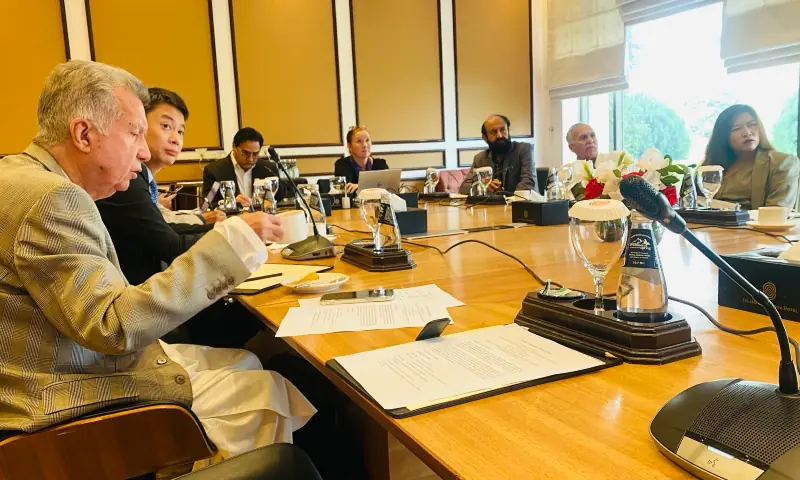
These views were expressed at an international roundtable conference: “Strategic Corridors: CPEC and the Quest for Peace and Stability in Pakistan and the Region”, held at a local hotel.
The Islamabad-based Pak Institute for Peace Studies (PIPS) in collaboration with Peace Research Institute Oslo (PRIO) organised the moot.
The event brought together academics, diplomats, lawmakers, journalists, and peace and development experts from China, Norway and Pakistan. Dr Arne Strand of the Chr. Michelsen Institute (CMI), Norway, opened the discussion by explaining a link between peace and development.
He called for taking the people-centric projects forward under CPEC. “Is there a need for adjustments to CPEC to better address underlying causes for conflict and underdevelopment (in Pakistan),” he posed a question to the participants.
Dr Zhang Jiegen, associate professor at the Center for South Asian Studies in Fudan University, China, emphasised the need for exploring the potential of CPEC to bring peace, stability and development not only in Pakistan but also for the entire region.
“Negativities circulating about CPEC are not a reality,” he said, adding that the programme is linked to geo-economics.
Dr Ma Zheng, special associate research fellow at the School of International Relations in Sun Yat-sen University, China, said for Pakistan, CPEC meant modernisation of agriculture, industrialisation, infrastructure enhancement and social and economic development and stability.
“CPEC has given a sense that Pakistan’s peripheries, especially Balochistan, are being integrated into regional development,” she said. Political analyst and human rights activist ex-senator Afrasiab Khattak said that CPEC was very popular in Khyber Pakhtunkhwa, and no segment of the society was opposing this programme.
“There is a need to resolve conflict in the region to move the project forward,” he said, adding that terrorism was a major hurdle in its implementation. National Party Senator Jan Mohammad Buledi said economic development was not possible without open political discourse, and all issues about CPEC, especially in Balochistan, should be resolved with political consensus.
Dr Wang Xu, executive deputy director of the Centre for South Asian Studies in Peking University said China served as the economic facilitator for Pakistan both at the federal and regional level. “We want poverty alleviation and social development in our neighbouring country,” he said, putting emphasis on more interactions with Pakistani students, politicians and officials to give them better understanding about the Chinese development model.
Former president of the Pakistan Federal Union of Journalists (PFUJ) and Quetta-based journalist Shahzada Zulfiqar said the official narrative on the CPEC was very weak as compared to that of locals and dissident groups in Balochistan.
Imtiaz Gul, executive director at the Center for Research and Security Studies (CRSS), underlined that Pakistan should bring drastic changes in its governance model to fully implement CPEC. “There is a disconnect between the Chinese expectations and the country’s capacity,” he noted.
Tahir Khan, a senior journalist and expert on Afghan affairs, said there were little prospects of the extension of CPEC to Afghanistan because it had some outstanding issues with Pakistan.
Former foreign secretary Inamul Haque stated that Pakistan and China had enjoyed a strategic partnership for many decades and would continue to do so. “Both should sit together to address all of each other’s concerns,” he added.
Dr. Kaja Borchgrevink, senior researcher at the PRIO, said issues on security and governance were coming in the way of cooperation for the execution of CPEC. She thanked the participants for the heated discussion.
PIPS President Mohammad Amir Rana, while moderating the session, highlighted that centre-periphery tensions and governance challenges were a hindrance in the way of effective implementation of CPEC.
Published in Dawn, November 6th, 2025