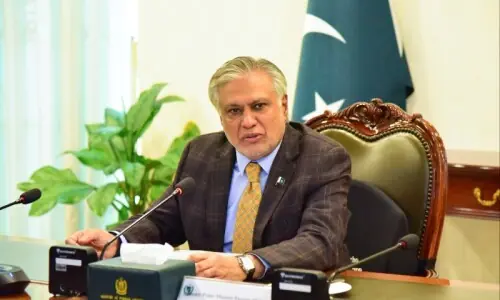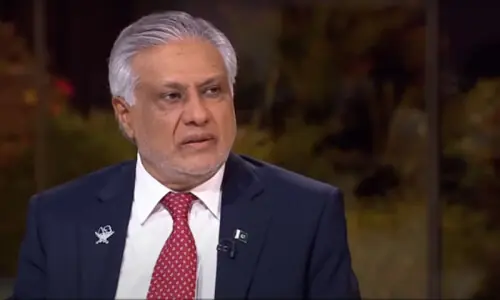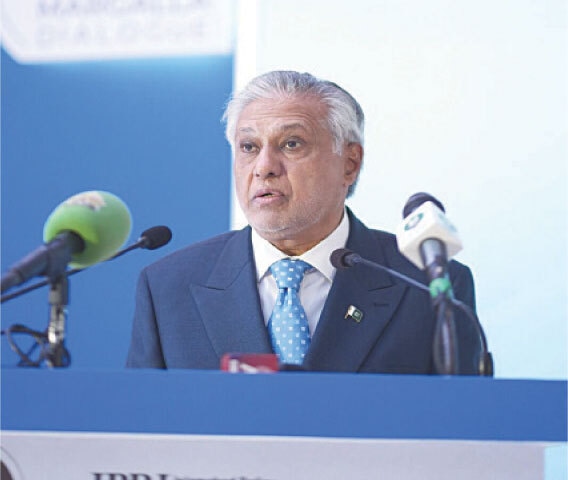
ISLAMABAD: Deputy Prime Minister and Foreign Minister Ishaq Dar has underscored the need for furthering multilateralism, promoting geo-economics in the regional context and strengthening the role of United Nations for coping with the challenges of a world faced with erosion of values and increase in unilateral bloc politics.
“Failing to maintain international peace and security is the biggest challenge, and cannot be abandoned half-way,” declared Mr Dar while speaking at the inaugural session of the two-day Margalla Dialogue on Tuesday.
The theme of the Margalla Dialogue is ‘The future of global order: cooperation or confrontation’. The event organised by Islamabad Policy Research Institute (IPRI) has brought scholars, diplomats, policymakers and academicians from around the world.
Mr Dar said Pakistan stood for engagement with all in the region, so that the bounties of trade, connectivity and development could bolster. He said Pakistan also remained determined to capitalise on inherited advantages for the prosperity and betterment for people and the region by prioritising geo-economics, which was one of the cardinal pillars of engagement with the international partners.
Says Pakistan stands for engagement with all in region
Mr Dar said the Organisation of Islamic Conference (OIC) was the second biggest multilateral forum, and must come up with a role in this age of revulsion.
The deputy PM also mentioned Chinese President Xi Jinping’s Global Development Initiative, and praised it for ushering across the world a phase of trade and development. He said global financial institutions must further equitable development and reform for the collective good of all member states, so that sustainable development was attained. He, however, said the policies of financial institutions should not be discriminatory.
Mr Dar also highlighted the existential threat of climate change, stating it cannot be delayed any further. He hoped that the upcoming COP-30 Summit in Brazil would go a long way in addressing climate challenges, and usher in a new hope for nature-impacted states.
“To break the vicious cycle of poverty and rising global inequality, we must confront the imbalances in international economic relations,” he added.
Speaking on the occasion, former senator Mushahid Hussain Syed said India’s efforts to impose a new-normal of terror had failed, and the four-day war was a case in point. He alleged that India harboured expansionist designs against nine states in the region, including Tibet.
He mentioned China as a rising power, and praised it for blanketing a trade canvas with more than 130 countries of the world.
Dr Victor Gao, Chair Professor at Soochow University and Vice-President of the Centre for China and Globalisation, said Pakistan had been the winner in the war with India.
“In fact, it was a victory of peace over war”, he said.
Dr Gao termed the bilateral relationship as China-Pakistan-Plus, and said Islamabad should continue to play a positive role with the US.
“If you want to impose nuclear war on China, China will wipe you out with nuclear retaliation,” he warned.
Associate Prof at St Petersburg University Dr Anastasia emphasised on the development and sustainability of the Eurasian security and connectivity architecture.
IPRI President retired Lt-Gen Majid Ehsan said the sixth edition of Margalla Dialogue was an opportunity to look threadbare into issues and problems confronted with a world sliding towards multipolarity and devise measures for cooperation and engagement.
He referred to the age of social media where genuine and true information itself has become a dilemma, and moreover, the trends of populism are posing new challenges to the established order.
He talked of three Ds — de-dollarisation, democratisation and demilitarisation, stating that the world is confronted with new-age mysteries such as climate change and development at par.
Published in Dawn, November 12th, 2025