ISLAMABAD: As countries discuss climate finance and goals at COP30 in Belem, Brazil, Dawn is speaking to experts to answer questions on people’s minds about climate change negotiations.
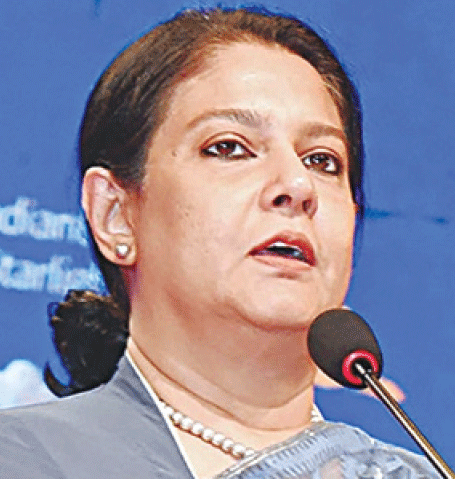
In this conversation, Bangladesh’s Climate Minister Rizwana Hasan explains the hurdles in climate talks, the insufficient climate finance for Global South countries, and regional approaches to finding homegrown solutions.
Speaking on the sidelines of the SDPI’s 28th Sustainable Development Conference in Islamabad, Ms Hasan stressed the need to revive Saarc, scale up climate finance and speed up efforts to reduce climate emissions.
Q. Do you think regional forums like Saarc can play a role in tackling climate change?
Dawn speaks to Rizwana Hasan, who calls for transparency in climate finance and an end to debt-based funding
I think Saarc has great potential. Both in terms of pushing the development agendas of different countries in the region and pooling common resources and also in tackling climate change. There are many resources that we share — for example, water. So if, in the face of climate change, Saarc countries could come up and take a common regional river management or shared water management policy that is climate-sensitive, that would be a major step towards climate adaptation.
There are some countries in Saarc that do not take the same degree of interest in the forum’s proceedings. So, while some countries may take their time to actively engage in Saarc, other countries that are ready to cooperate should come forward.
Q. Is Bangladesh working with regional countries to address climate change?
On climate change, Bangladesh is actually working with Nepal and Bhutan because the three Saarc countries will become middle-income countries at around the same time. The challenges we will face in accessing the climate fund will therefore be the same.
That’s why we have already started contacting and working with these two countries so that we can take a common position in climate negotiation forums for accessing the climate fund, as well as other concessional grants and technological assistance.
Q. The Global North is asking for compliance with emission reduction targets, while the Global South nations are asking for finance in order to meet their climate goals. Is there a middle ground?
Emissions reduction is our choice. It was not mandatory for us under the UNFCCC and Kyoto Protocol. Under the Paris Agreement, it is also not mandatory. It creates a high ethical ground for countries, but the amount of emissions we generate is negligible in the global context.
But for the sake of our own people, we need to reduce emissions. We need to keep our air pure, and there are so many options to switch to safer alternatives that there is no reason why we should continue in the old grey way of industrialisation and energy production. There are cost-effective ways, there are safer ways. We should simply switch to them because they prove to be not expensive in the long run. You may need an initial investment, but over time, it is very cost-effective.
I think Western countries should not be tagging compliance with adaptation support because that was not the intention of the UNFCCC. For most Saarc countries, our NDC commitments are partly unconditional and partly conditional. The unconditional ones are progressing well, but for the conditional ones, it is rather us who are putting the condition that “if you give us money, we will be able to mitigate better”.
Q. What counts as climate finance, given that some development money has also been tagged as climate funding?
What we want is a clear definition of climate finance so that regular development assistance cannot be tagged as climate finance. The promise under the UNFCCC was new and additional funds, so it has to be new and additional. We are also requiring that it should not come to us as debt because that is creating double jeopardy for us. On the other hand, you are climate vulnerable; on the other hand, you are paying interest while being impacted by climate change. It is not our fault that we face these climate threats. It is because of the fault of those who are imposing this debt on us. So transparency in the climate finance is absolutely a must.
Q. Is Bangladesh going to access the loss and damage fund?
Bangladesh will surely come up with proposals. But $250m is what Bangladesh needs per year for adaptation based on UN calculations. So $250m as a total pot, to be shared with others, is not something that will meet Bangladesh’s needs and it also does not fulfil the promises made by the developed countries when this fund was announced. It is grossly inadequate.
Published in Dawn, November 12th, 2025