Partition of Gaza a looming risk as Trump’s plan falters

MANAMA: A de facto partition of Gaza between an area controlled by Israel and another ruled by Hamas is increasingly likely, multiple sources said, with efforts to advance US President Donald Trump’s plan to end the war beyond a ceasefire faltering.
Six European officials with direct knowledge of the efforts to implement the next phase of the plan told Reuters it was effectively stalled and that reconstruction now appeared likely to be limited to the Israel-controlled area. That could lead to years of separation, they warned.
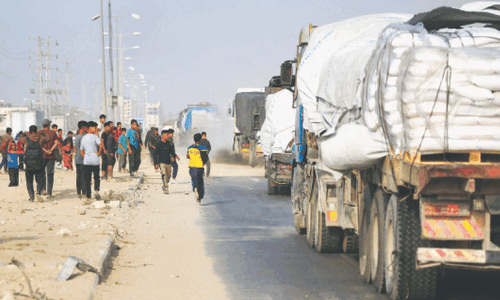
Under the first stage of the plan, which took effect on Oct 10, the Israeli military currently occupies 53 per cent of the Mediterranean territory, including much of its farmland, along with Rafah in the south, parts of Gaza City and other urban areas. Nearly all of Gaza’s 2 million people are crammed into tent camps and the rubble of shattered cities across the rest of Gaza, which is under Hamas control.
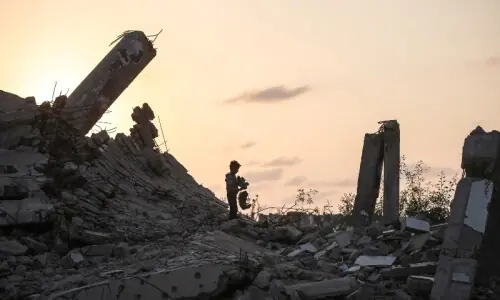
Reuters drone footage shot in November shows cataclysmic destruction in the northeast of Gaza City after Israel’s final assault before the ceasefire, following months of prior bombardments. The area is now split between Israeli and Hamas control.
The next stage of the plan foresees Israel withdrawing further from the so-called yellow line agreed under Trump’s plan, alongside the establishment of a transitional authority to govern Gaza, the deployment of a multinational security force meant to take over from the Israeli military, the disarmament of Hamas and the start of reconstruction. But the plan provides no timelines or mechanisms for implementation.
Meanwhile, Hamas refuses to disarm, Israel rejects any involvement by the Western-backed Palestinian Authority, and uncertainty persists over the multinational force.
European officials say reconstruction appeared likely to be limited to Israel-controlled area, can lead to years of separation
“We’re still working out ideas,” Jordanian foreign minister Ayman Safadi said at a Manama security conference this month. “Everybody wants this conflict over, all of us want the same endgame here. Question is, how do we make it work?”
Without a major push by the United States to break the impasse, the yellow line looks set to become the de facto border indefinitely dividing Gaza, according to 18 sources, among them the six European officials and a former US official familiar with the talks.
The United States has drafted a UN Security Council resolution that would grant the multinational force and a transitional governing body a two-year mandate. But ten diplomats said governments remain hesitant to commit troops. European and Arab nations, in particular, were unlikely to participate if responsibilities extended beyond peacekeeping, and meant direct confrontation with Hamas or other Palestinian groups, they said.
A State Department spokesperson said that while “tremendous progress” had been made in advancing Trump’s plan, there was more work to do, without responding to questions about whether reconstruction would be limited to the Israeli-controlled area.
Hazem Qassem, a Hamas spokesperson in Gaza City, said that the group was ready to hand over power to a Palestinian technocrat entity so that reconstruction could begin. “All the regions of Gaza deserve reconstruction equally,” he said.
Gaza City resident Salah Abu Amr, 62, said that if no progress was made on disarming Hamas and redevelopment began across the yellow line, people might think of moving there. But the realities of a divided Gaza were hard to contemplate, he said. “Are we all going to be able to move into that area? Or Israel will have a veto over the entry of some of us,” he said. “Are they also going to divide the families between good people, bad people?”
It remains unclear who would finance rebuilding parts of Gaza under Israeli occupation, with Gulf nations loath to step in without involvement of the Palestinian Authority and a path to statehood, resisted by Israel. Reconstruction costs are estimated at $70 billion. Palestinian Foreign Minister Varsen Aghabekian Shahin also rejected territorial division of Gaza, and said the Palestinian Authority was ready to assume “full national responsibility.” “There can be no genuine reconstruction or lasting stability without full Palestinian sovereignty over the territory,” she said in a statement in response to questions.
Published in Dawn, November 12th, 2025