Public goodwill towards China increased since 2015: report
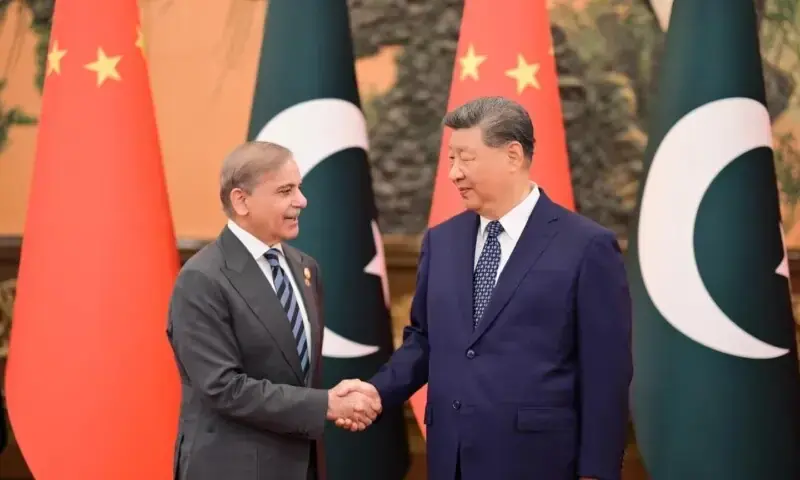

ISLAMABAD: A new study has found Pakistani public goodwill toward China strengthened markedly between 2015 and 2025 with respondents crediting CPEC-linked development, improved security and increased social interaction for the shift.
The study also notes that the May 2025 Pakistan-India war further boosted China’s standing among participants.
Authored by Dr Hassan Siddique, communications specialist at the World Bank’s Punjab Green Development Programme, and Yasir Habib Khan, President Institute of International Relations and Media Research, the study examined how public perceptions evolved before and after CPEC’s implementation.
It investigated two core questions: how Pakistanis viewed China prior to 2015 and how those views changed after a decade of corridor projects.
Using a quantitative approach, the researchers surveyed respondents from government, the establishment, business, academia, media, cultural circles, think-tanks, religious groups, civil society and the general public.
Survey respondents credit CPEC-linked development, improved security and increased social interaction for shift
Closed-ended items measured attitudes across economic, social, and strategic dimensions, while statistical comparisons and visualisations tracked shifts in sentiment.
The research findings show that Pakistanis entered the CPEC era with already favourable views, shaped by longstanding diplomatic cooperation and defence ties.
Before 2015, China was largely seen as a steadfast political and strategic ally, though with limited presence in day-to-day economic life. Expectations at the time centred on China eventually assuming a more active developmental role.
The study reports that perceptions improved further after visible CPEC outcomes, particularly in infrastructure, transport links and connectivity. Respondents highlighted ease of doing business, enhanced security and increased social interaction between Chinese and Pakistani workers as key contributors.
Cultural exchange and routine workplace cooperation were cited as elements that elevated trust and made the corridor a people-centred undertaking.
According to the authors, performance and delivery were the most decisive opinion drivers, while media exposure and people-to-people contact served as secondary reinforcements.
The report concludes that Pakistani goodwill toward China is closely tied to tangible outcomes, transparency and clear communication of shared goals.
The authors note that CPEC’s ongoing expansion and its social spillovers are likely to continue shaping public attitudes, with future perception trends depending on project continuity and economic impact.
Beyond geopolitics, enhanced exchange of religious groups, think-tanks, bureaucracy (civil, military and judicial) besides cultural and educational exchanges have also played a critical role in shaping these perceptions.
The trend of learning Chinese language has evolved from a cultural curiosity into a strategic economic and educational necessity within the context of CPEC.
The findings show that Pakistani students and professionals increasingly view Chinese language proficiency as a tool for career advancement, academic mobility and cross-border collaboration.
CPEC has been the subject of extensive research and public discourse since its formal launch in 2015, emerging as one of the most ambitious undertakings within China’s Belt and Road Initiative (BRI).
Designed to link China’s western region of Xinjiang with Pakistan’s Gwadar Port, CPEC represents both a strategic and economic partnership that seeks to transform Pakistan’s infrastructure, energy and trade landscape.
It was also highlighted that the English-language media in Pakistan has adopted a pro-CPEC stance, reinforcing government narratives while minimising critical perspectives, while social media has amplified both enthusiasm and scepticism.
Published in Dawn, November 18th, 2025