South Africa accepts huge rate of violence against women is national disaster

South Africa said on Friday the rate of violence against women in the country was a national disaster, as thousands protested to highlight the problem ahead of this weekend’s G20 summit of world leaders.
The country has one of the world’s highest rates of gender-based violence and femicide (GBVF), leading to deaths five times higher than the global average, according to the United Nations’s gender equality organisation UN Women.
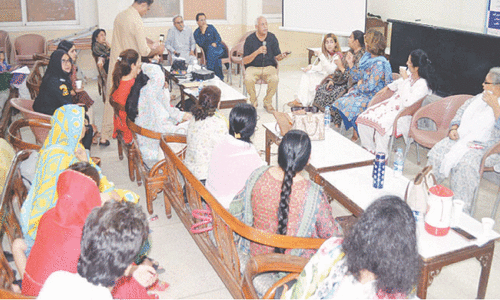
In one of dozens of “lie-in” protests countrywide, thousands of people dressed in black lay on the ground for 15 minutes at an event in Johannesburg’s city centre, just a few kilometres (miles) from the venue where G20 leaders will meet on Saturday and Sunday.
Organisers said the action was to honour the 15 women murdered every day in South Africa.
A 2022 government survey found that one in three South African women had experienced physical violence, and almost 10 per cent had faced sexual violence.
More than 10,700 cases of rape were reported to police in the first three months of 2025, but the real numbers are expected to be much higher.
“I’m here standing for not only myself but my younger sisters, my siblings and every woman in South Africa,” said one of the protesters, 23-year-old Lefika Jonathan.
The government’s disaster management said that after evaluating the “persistent and immediate life-safety risks posed by ongoing acts of violence”, it had concluded that GBVF met the “threshold of a potential disaster”.
This made the issue a priority for the executive branch of government and “all organs of state”, it said.
“All we want is justice,” said another protester, 19-year-old student Nomhle Porogo.
She hoped the timing of the protest meant “those in higher positions can hear our cries”. But she was unimpressed by the decision to wait until South Africa was in the international spotlight to classify the problem a disaster – a longstanding demand from women’s rights groups.
“For them to declare it a national disaster when it suits them and in front of our visitors because they want to make our house look clean for visitors…is an injustice,” she told AFP.