
As we explore the fascinating world of technology, where unlimited information is just a touch away, we should also remember its dangers and consequences on our society and on us as the youth.
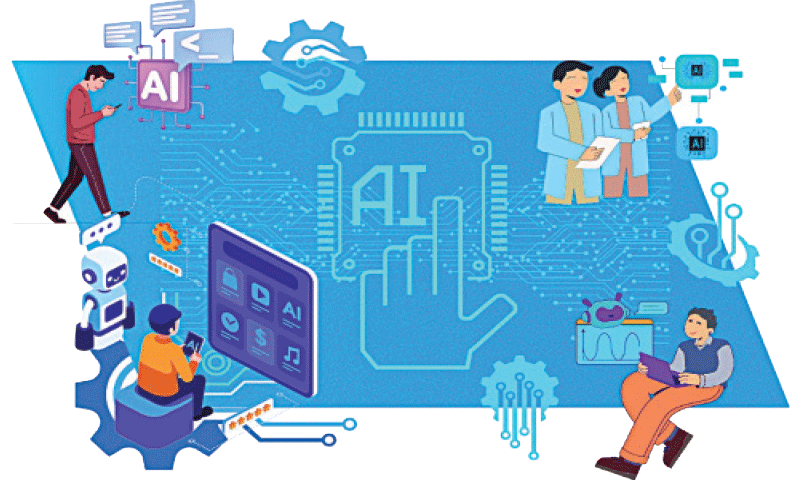
Artificial intelligence, or AI, is progressing day by day and has become an integral part of our lives over the past few years. Whether it’s a school assignment, a speech or any other task we need to complete, we just open our tab or smartphone, use ChatGPT or any other AI tool, and there we go — the answer to all our worries and problems appears within moments. From writing a speech to learning how to make new friends at school, all we need to do is give a command and the results show up instantly.
Often, while using it, we forget its dangers and begin to overuse it in our daily lives. According to research, 70–80 percent of people use some form of AI without even realising it. Many of us have started relying on it so much that we feel we can’t carry out our daily tasks without it.
Just think of a day without AI, we would have to do all our homework, especially maths problems, by ourselves. Even imagining it feels terrible. That’s because we have turned it into a need, even though it began as a want. Before AI, people managed everything just fine, and so can we. But after its invention and introduction to the public, we now treat it as a need when it is actually a want.
The difference between a need and a want is very small. Without something we need, we cannot survive, but without a want, we can. AI makes our lives easier, so we assume it is needed. However, it is something we want, and we can live without it. Understanding this difference is important because if we continue treating it as a need, we will never see the line between taking help and completely relying on it. The sooner we understand this, the better, because AI also has some serious negative impacts.
One major impact is seen in children who complete their homework and assignments by simply copying and pasting AI-generated material. It has been observed that many children who use AI to copy assignments, do not even try to
understand what they are submitting. If they are asked to explain their assignment, they are left completely confused.
This is one of the harmful effects of AI on our youth, as it weakens our ability to focus, understand, answer appropriately, comprehend ideas and think critically about a topic.
Although AI seems perfect, it is still created by humans, who themselves are not perfect. Because of this, AI tools sometimes fail to filter inappropriate content, and this negatively affects children exposed to harmful material. AI tools in social media and gaming can also impact mental health by creating unrealistic expectations and comparisons, putting children under pressure to meet certain standards.
As a result, more and more of us are glued to screens, and our social interactions decrease. Our social quotient (SQ), which deals with interacting with others, and our emotional quotient (EQ), which helps us understand others’ emotions and use our own effectively, both get affected.
With less face-to-face interaction, our SQ declines and we begin to feel isolated. Our EQ also lowers, as isolation and constant use of AI, which has no feelings or emotions, make it difficult for us to understand the emotions of people around us, leading to a weakened personality.
However, like everything else, AI also has a positive side. It can be used to positively change our environment and help us grow into well-learned individuals. It can support us in overcoming obstacles that keep us from being social and allow us to connect with the world in a better way. It can also be used to improve healthcare and education systems.
All we need to remember is that the line between a need and a want is very thin — and crossing it depends on our self-control.
Published in Dawn, Young World, November 29th, 2025