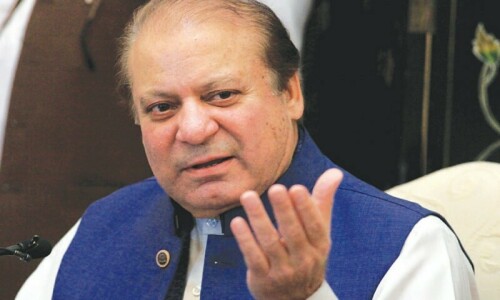
ALTHOUGH former prime minister Nawaz Sharif has largely kept a low profile after returning to Pakistan in 2023, the PML-N leader broke his silence on Wednesday on sensitive political matters, while speaking to newly elected lawmakers. Mr Sharif was of the view that the “bigger criminals” that had brought the now incarcerated PTI leader Imran Khan to power must also face justice.
Though the elder Sharif refrained from naming names, in 2023 he had accused former army chief Gen Qamar Bajwa, ex-ISI head Gen Faiz Hameed, and former Supreme Court chief justice Saqib Nisar, as well as other senior judges, of playing a key role in his ouster from Prime Minister House in 2017. While there can be little argument that accountability, particularly of those who have interfered in the democratic process, is necessary, such an exercise should not be a selective one.
Mr Sharif had in the past taken a stand for civilian supremacy — and paid for it by losing his job. But his case alone does not provide a holistic view. For decades — well before Mr Khan’s arrival on the political scene — various state institutions played a role in making and breaking governments. And in the case of individuals, ironically, many of the same elements Mr Sharif had blamed for his ouster were seen to be involved in the fall of Mr Khan’s government, and in helping the PML-N return to power.
For example, Gen Bajwa was army chief both when Mr Sharif was sent packing and when Mr Khan’s government was removed. So all such episodes should be examined in detail, and not just viewed through a selective lens. It is a bitter truth that the politicians, including those belonging to Mr Sharif’s party, as well as state institutions, including the judiciary, have often played ball with unelected forces to oust rivals through palace intrigues. Their role needs further scrutiny.
Meanwhile, it is notable that while Mr Sharif bemoans the meddling of such forces, his own party men, including ministers, sing paeans to the hybrid system. Introspection is needed and the political class must reflect on how they themselves create situations that allow non-political forces to seize the levers of power.
Nawaz Sharif and Benazir Bhutto signed the Charter of Democracy in 2006 to strengthen civilian supremacy. That document states that “no party shall solicit the support of the military to come into power or to dislodge a democratic government”. Both the PPP and PML-N, as well as the PTI, have ignored this aim of the CoD, and resultantly, have been victims as well as beneficiaries of the hybrid system.
Perhaps a new charter is needed. For this, all political forces will need to set aside their differences and come together to agree on and work towards a truly democratic, constitutional order.
Published in Dawn, November 28th, 2025