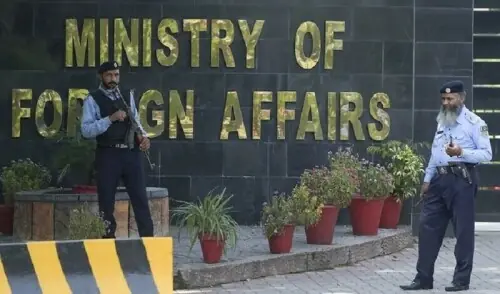
The Foreign Office (FO) said on Friday that the current ceasefire with Afghanistan was not a “traditional” one but contingent on whether any terrorist activity took place against Pakistan from the neighbouring country’s soil.
Relations between Pakistan and the Afghan Taliban are at their lowest point in the four years since the group came to power. Border crossings between the two countries have remained closed since October 11 and trade has been at a standstill following ground fighting and Pakistani airstrikes across their 2,600-kilometre frontier that killed dozens on both sides in the worst fighting since the Taliban’s 2021 takeover of Kabul.
Following those clashes, Turkiye and Qatar stepped in to mediate. The first round in Doha produced a fragile ceasefire, while the second, also in Doha, ended with only a general agreement to develop a mechanism for verifying compliance and a decision to continue talks. The third round concluded without any concrete agreement.
The situation deteriorated again following Afghan accusations of Pakistani airstrikes earlier this week, which the military and government ministers denied. The Afghan side also threatened retaliation.
Questioned about the threat and the shaky ceasefire during his weekly press briefing, FO Spokesperson Tahir Andrabi said: “The ceasefire between Pakistan and Afghanistan does not imply a traditional ceasefire implemented after two belligerent states in a war or a conflict situation. Pakistan-Afghanistan ceasefire implied that there would be no terrorist attack by Afghan-sponsored terrorist proxies into Pakistan. There have been major terrorist attacks after this ceasefire.”
“So, interpreting in that sense, the ceasefire is not holding because the ceasefire was about ceasing terrorist attacks inside Pakistan by TTP, FAK, and Afghan nationals using Afghan soil.”
He continued that “if Afghan nationals are attacking, as they did so in Islamabad and elsewhere, so we cannot be very optimistic about the ceasefire, which, in any case, I mentioned, is not the traditional ceasefire between the two states, but to be understood in the context of terrorist attacks from Afghanistan.”
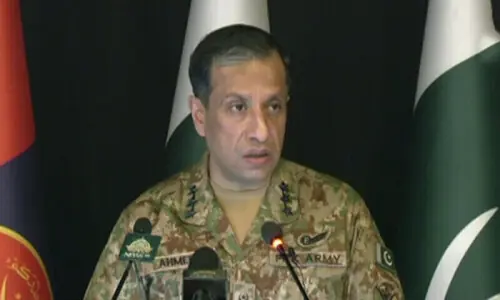
The spokesperson said that security forces remained fully alert and the military’s preparedness was robust in response to any alleged threat from Afghanistan.
“The security challenges we face would be addressed with the seriousness that they merit.”
The spokesperson was also questioned about allegations from the Afghan Taliban about Pakistan harbouring the banned militant Islamic State of Iraq and Syria (ISIS) group to which he responded that it was an “outrageous” claim.
“It is a figment of the imagination of the Afghan Taliban regime. Afghan side wants to externalise this menace of terrorism, which inherently is on their own soil and of their own making. They want to externalise it to Pakistan, naming various organisations. Any extremist terrorist element in Pakistan is treated, is dealt, as per our laws. This statement, of presence of any ISIS in Pakistan is totally baseless.”
Even before this week’s current flare-up in tensions, the information ministry earlier this month said that all terrorists involved in an attack on Cadet College Wana in South Waziristan were Afghan citizens.
The attackers had targeted the main gate of the college and gained entry to the educational institution, but a timely response from security forces averted a major tragedy. Government ministers had linked the attack to Afghanistan and said it was orchestrated from there.
Minister of State for Interior Talal Chaudhry had also said that a suicide bomber who carried out an attack outside the Islamabad district and sessions court building was “not a Pakistani national”.
Twelve people were killed and 36 were injured in the suicide blast outside the district and sessions court building in Islamabad’s G-11 area.
Prime Minister Shehbaz Sharif accused Afghanistan and India of involvement in terrorism, vowing a “befitting response” to the nation’s enemies following the two incidents.
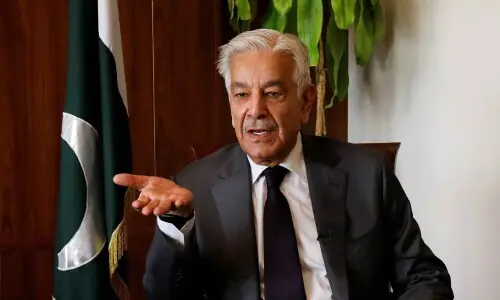
Defence Minister Khawaja Asif had also subsequently said that attacks on terrorist sanctuaries in Afghanistan could not be ruled out after the incidents in Islamabad and Khyber Pakhtunkhwa.