Exporters insist Pak-Afghan border closure costing them $4 million daily


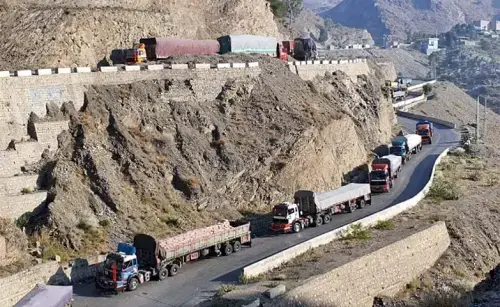
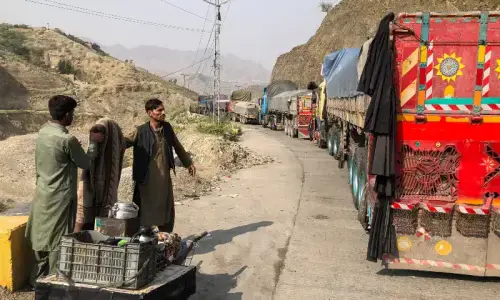
KHYBER: With all border crossings with Afghanistan closed for almost two months, value-added industrial products, raw material and miscellaneous goods worth billions of rupees are stranded along border points, with local exporters claiming over $4 million losses on a daily basis.
Exporters, industrialists and traders at the Sarhad Chamber of Commerce and Industries (SCCI) told Dawn that Pakistan had been fast losing both Afghan and Central Asian markets due to the security-induced border closure since October 12.
They said they’re left with no option but to mourn the “demise of bilateral trade”.
The exporters said that they had not only failed to honour their contractual commitments with Afghan and Central Asian counterparts for timely delivery of multiple goods but they had also to bear additional cost of $150-200 demurrage and detention charges of stranded vehicles.
Warn country rapidly losing both Afghan, Central Asian markets
Senior vice president of the Pak-Afghan Joint Chamber of Commerce and Industry Ziaul Haq Sarhadi said that the country’s trade with Afghanistan had the potential to reach $5 billion a year but unfortunately, the trade quantum had nosedived to a just $700-800 million annually due to the current volatile situation.
He said that the persistent drop in bilateral trade had confronted the national economy and revenue generation with a precarious situation which would be hard to recover in years to come.
“With exports to Afghanistan suspended for nearly two months and the supply chain completely broken, the misery of transporters, clearing agents and daily wagers has entered a critical stage with most of them facing bankruptcy-like situations,” he said.
Mr Sarhadi demanded of the federal government to devise a comprehensive “relief mechanism” for traders and transporters with a 100 per cent relief in detention and demurrage charges.
Former president of SCCCI Zahidullah Shinwari feared that it would be extremely difficult for Pakistan to recapture the Afghan and Central Asian markets as they were already flooded with Iranian and even Indian products.
He lamented that no prior information about border closure was shared with local entrepreneurs as most of them had their consignments loaded onto trucks for delivery in Afghanistan, Tajikistan and Uzbekistan.
“We have most of our merchandise either perished or expired due to the prolonged delay with no one at the federal and provincial level ready to compensate us for our losses,” he said.
Mr Shinwari said that while Sindh and Punjab industries were also badly hit by the current situation, Khyber Pakhtunkhwa could be the worst affected as they relied on cheap coal from Afghanistan.
He added that local products had a lucrative market in Afghanistan.
“Alongside huge financial losses, we also fear loss of jobs for thousands of our industrial labour that could pose a serious threat to the already uncertain security situation in Khyber Pakhtunkhwa,” he said.
Shahid Hussain, another enterprising businessman, said the export items stranded along border crossings included textile, pharmaceuticals, construction material, cement, rice, corn, agricultural machinery and tools, electric appliances, local auto parts, and raw material for chicken feed, rice and flour manufacturing units in different cities of Afghanistan.
He feared that medicines and raw material worth millions of dollars were at risk of expiry, while all perishable items had already returned to the local markets that were sold at throwaway prices by dealers.
Dawn failed to contact office-bearers of Khyber, Kurram and Waziristan chambers of commerce and industry who recently met former ambassador and special assistant on Afghanistan Sadiq Khan in Islamabad and highlighted their issues.
Sources told Dawn that Sadiq Khan told visitors that any decision regarding the reopening of border points was linked with a success in dialogue with Afghanistan on security issues.
They said the delegation also failed to convincingly plead their case with the former ambassador as they lacked legitimate authority and true representation from the local trading community.
Published in Dawn, December 5th, 2025