• Negotiations continue on ISF mandate as Pakistan warns against Israeli violations
• US media reports no one has come forward yet as Washington pushes states to step up
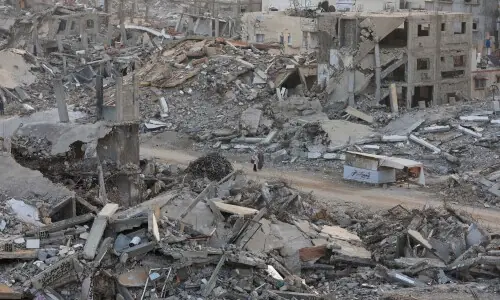
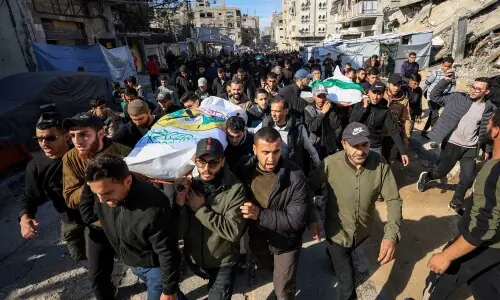
WASHINGTON: Pakistan and several other Muslim nations are seeking clarity on the mandate of the proposed International Stabilisation Force (ISF) for Gaza, even as the United States accelerates efforts to advance a strategy aimed at managing postwar security in the devastated territory.
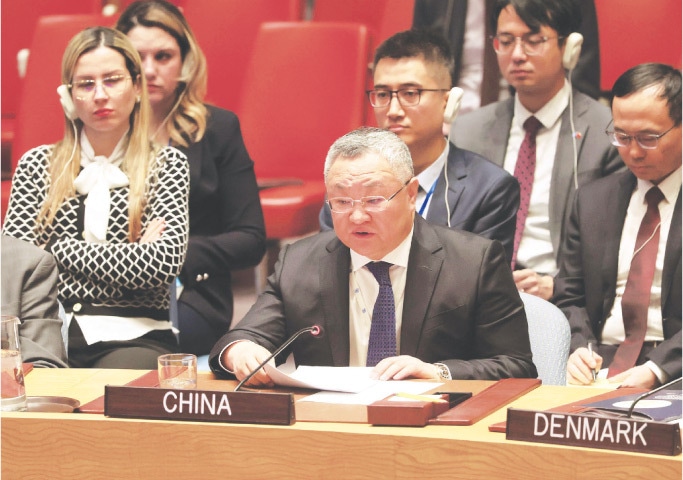
The issue came into sharper focus on Tuesday, when Pakistan urged the full implementation of relevant UN Security Council resolutions and warned that continued Israeli settlement expansion and military actions were rapidly eroding the viability of the two-state solution.
Addressing a Security Council briefing on the Middle East under Resolution 2334, Pakistan’s Permanent Representative to the United Nations, Ambassador Asim Iftikhar Ahmad, said the Palestinian people had endured “decades of illegal occupation marked by dispossession and denial of their inalienable rights,” with Gaza’s situation deteriorating to an “unprecedented scale” over the past two years.
His remarks followed reports earlier the same day that Israel had issued new demolition orders for the Nur Shams refugee camp in the northern occupied West Bank, effective this week — a development a senior official of the UN Relief and Works Agency (UNRWA) described as “more devastating news”.
The diplomatic push coincided with parallel discussions outside the UN. On Tuesday, US Central Command hosted a conference in Qatar bringing together dozens of partner nations to discuss plans for the ISF. US media reports earlier this week said the Trump administration was seeking to assemble a multinational force of around 10,000 troops, potentially under the command of a US general, which could take much of the next year.
The Wall Street Journal reported that while Washington was pressing other countries to contribute troops, “none have stepped forward yet”. “There is deep sensitivity about legitimacy,” a diplomat in Washington explained. “No country wants its troops to be seen as imposing security rather than supporting peace.”
Adding to the debate, the Washington-based Stimson Centre released a report on Tuesday cautioning the Trump administration that many countries were reluctant to provide troops for a Gaza security force, but that incorporating UN expertise and frameworks could help ease those fears. The idea of grounding any stabilisation force in a UN-mandated structure has also been advocated by Pakistan and several Arab and Muslim states during earlier UN deliberations.
Diplomats familiar with the talks say a central concern is avoiding a security vacuum following the ceasefire. Speed of deployment is therefore seen as critical. Officials say the ISF would need pre-positioned resources, streamlined command arrangements and political authorisation in advance to ensure it can move quickly once an agreement is reached.
Operational effectiveness is another key issue. Planners argue that the force would require robust logistical support, intelligence-sharing mechanisms and freedom of movement across Gaza. Force protection has also emerged as a major challenge. Gaza’s dense urban environment and the presence of armed factions pose significant risks to any international deployment. Officials stress that clear rules of engagement, adequate defensive capabilities and sustained political backing would be essential to safeguard personnel.
Negotiations are also continuing over the scope of the ISF’s mandate. While details remain unresolved, diplomats say it could include monitoring ceasefire compliance, supporting local security arrangements and facilitating humanitarian access. The extent to which the force would be authorised to use force remains highly sensitive, with some states advocating a robust mandate and others urging strict restraint.
Sustained political and financial backing from major powers is widely viewed as indispensable. Analysts note that past international missions have faltered when support from key capitals waned. “A stabilisation force cannot succeed if it becomes politically isolated or underfunded,” a former UN peacekeeping official said.
Humanitarian access is expected to be a core objective of such a deployment. Aid agencies have repeatedly warned that insecurity and restrictions have severely hampered relief operations in Gaza. Diplomats say a stabilisation force could help create conditions for large-scale humanitarian deliveries and early reconstruction, particularly in heavily damaged areas.
Published in Dawn, December 17th, 2025