UN General Assembly adopts Pakistan-backed resolution reaffirming right to self-determination
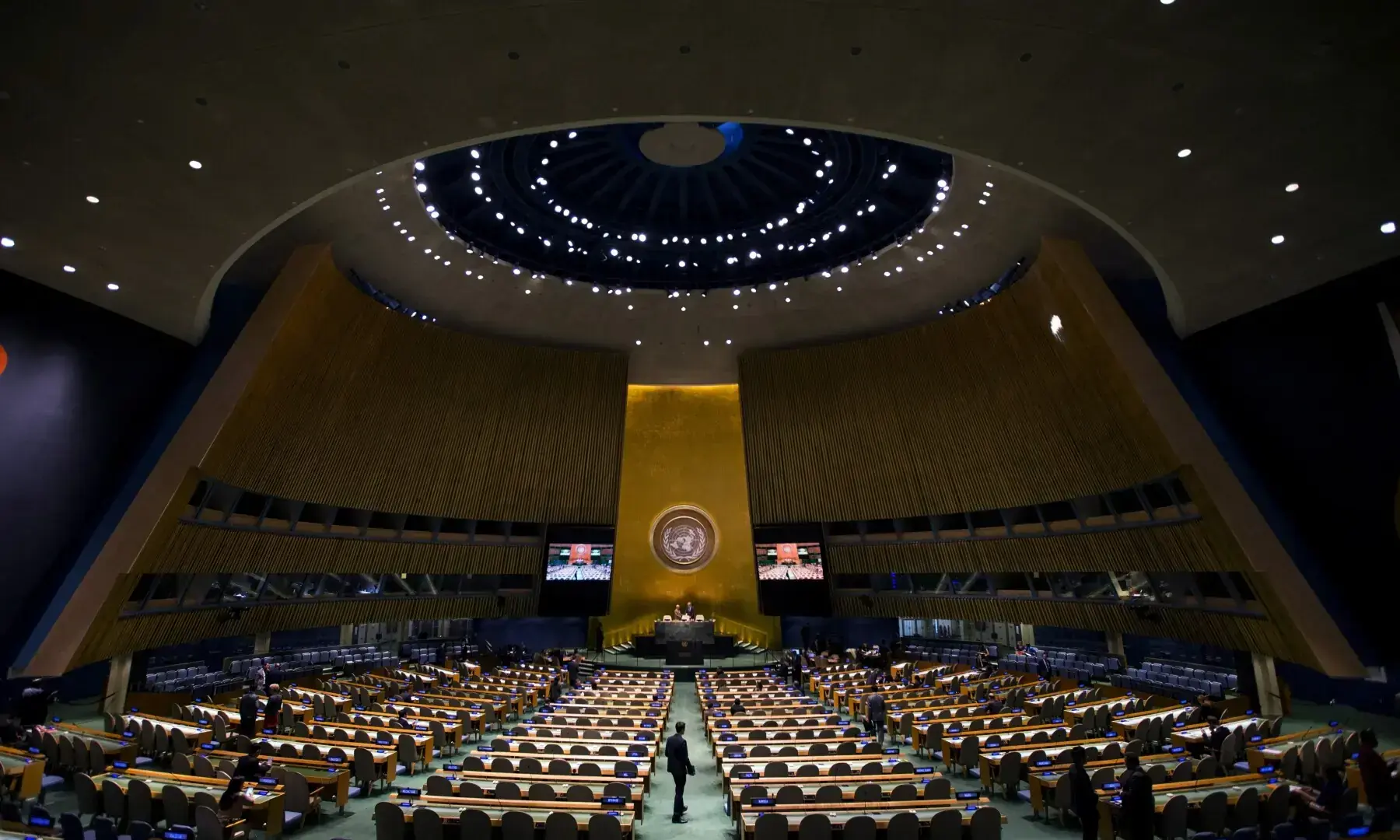

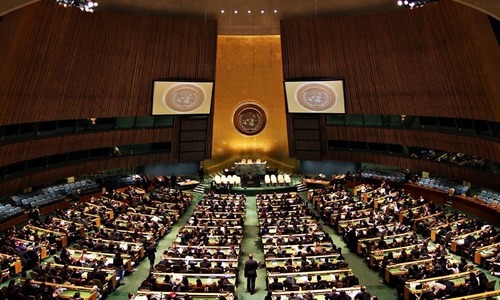
WASHINGTON: The United Nations General Assembly (UNGA) on Thursday adopted by consensus a Pakistan-sponsored resolution that reaffirmed the right to self-determination for peoples still subjected to colonial, foreign, and alien occupation.
According to Pakistan‘s Permanent Mission to the UN, the resolution — titled ‘Universal realisation of the right of the peoples to self-determination’ — was adopted during the UNGA’s 80th session.
“The consensual adoption of the resolution manifests broad international support for the inalienable right of the peoples facing colonialism, alien domination and foreign occupation,“ it said in a post on X.
“For the people of Indian Illegally Occupied Jammu and Kashmir (IIOJK) and Palestine, the resolution reinforces international attention to their just and legitimate cause and their aspirations for freedom and dignity in accordance with UN Security Council (UNSC) resolutions,” it added.
Diplomats said the adoption of the text by consensus — without a vote — underscored continued global recognition that the denial of self-determination remains a root cause of conflict in several regions, despite repeated UN commitments to bring colonialism to an end.
This year, the United States insisted on voting on almost every resolution presented in the UNGA, even on issues that had previously enjoyed consensus, both in committees and in the Assembly.
However, the Pakistan-sponsored resolution on self-determination was among the very few that the Americans did not insist on putting to a vote, allowing it to pass by consensus. Diplomats said this was likely due to Pakistan’s outreach. Otherwise, Washington had made it clear that it would not allow consensus on every issue, as it could create unnecessary pressure within the UN.
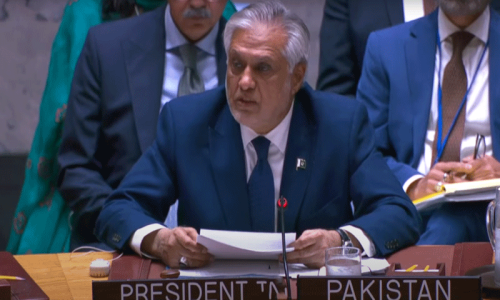
Earlier in the day, Pakistan told the UNGA that persistent failure to uphold the right to self-determination continued to undermine international peace efforts, particularly in the Middle East and South Asia.
Addressing the Assembly on the occasion of International Day against Colonialism in All Its Forms and Manifestations, Pakistan’s Deputy Permanent Representative to the UN Ambassador Usman Jadoon said self-determination was “not merely a historical aspiration, but an enduring obligation” of the international community.
“Recent developments in the Middle East demonstrate that lasting peace cannot be achieved through the continued denial and suppression of the legitimate right to self-determination of the Palestinian people,“ he said.
On occupied Kashmir, the Pakistani envoy reminded the UNGA that the issue was not a bilateral dispute but an internationally recognised one.
“The UNSC, through several resolutions, has recognised the legitimate right of self-determination of the people of Jammu and Kashmir,” he said.
“A just resolution of the Jammu and Kashmir dispute remains central to the establishment of durable peace in South Asia,” Ambassador Jadoon added, warning that continued inaction risked further instability in an already volatile region.
Marking the 65th anniversary of General Assembly resolution 1514 (XV) — Declaration on the Granting of Independence to Colonial Countries and Peoples — he said the implementation of the declaration and the decolonisation agenda was not confined to Non-Self-Governing Territories alone.
According to the UN, Non-Self-Governing Territories are defined as territories whose people have not yet attained a full measure of self-government.
“Rather, it also encompasses people living under alien occupation and foreign domination.
“The overarching objective, therefore, remains to ensure that all such peoples are enabled to exercise their inalienable right to self-determination,” he said.
He further said that the milestone also served as a reminder of unfinished work.
“While the decolonisation process stands among the UN’s notable achievements, this anniversary compels us to acknowledge that the promise of resolution 1514 (XV) remains unfulfilled,” he said, adding that this failure continued to pose “a serious challenge to the maintenance of international peace and security”.
Aligning Pakistan with a statement delivered by Uganda on behalf of the Non-Aligned Movement (NAM), he said the declaration made clear that colonial domination and exploitation were violations of fundamental human rights and were contrary to the principles and purposes of the UN Charter.
“The right to self-determination is an inalienable and universal right,” he reiterated, stressing that its application could neither be selective nor politically conditional.
Emphasising the UN’s role as a symbol of hope and justice for oppressed peoples, Ambassador Jadoon called for the consistent and non-selective implementation of UN resolutions and urged member states to uphold international law without exception.
Pakistan also called for renewed international resolve to fully and unconditionally eradicate colonialism in all its forms and manifestations.